“We had quality issues here. We had capacity issues here.”
GE Aerospace’s Lynn plant automation and the $100 million upgrade
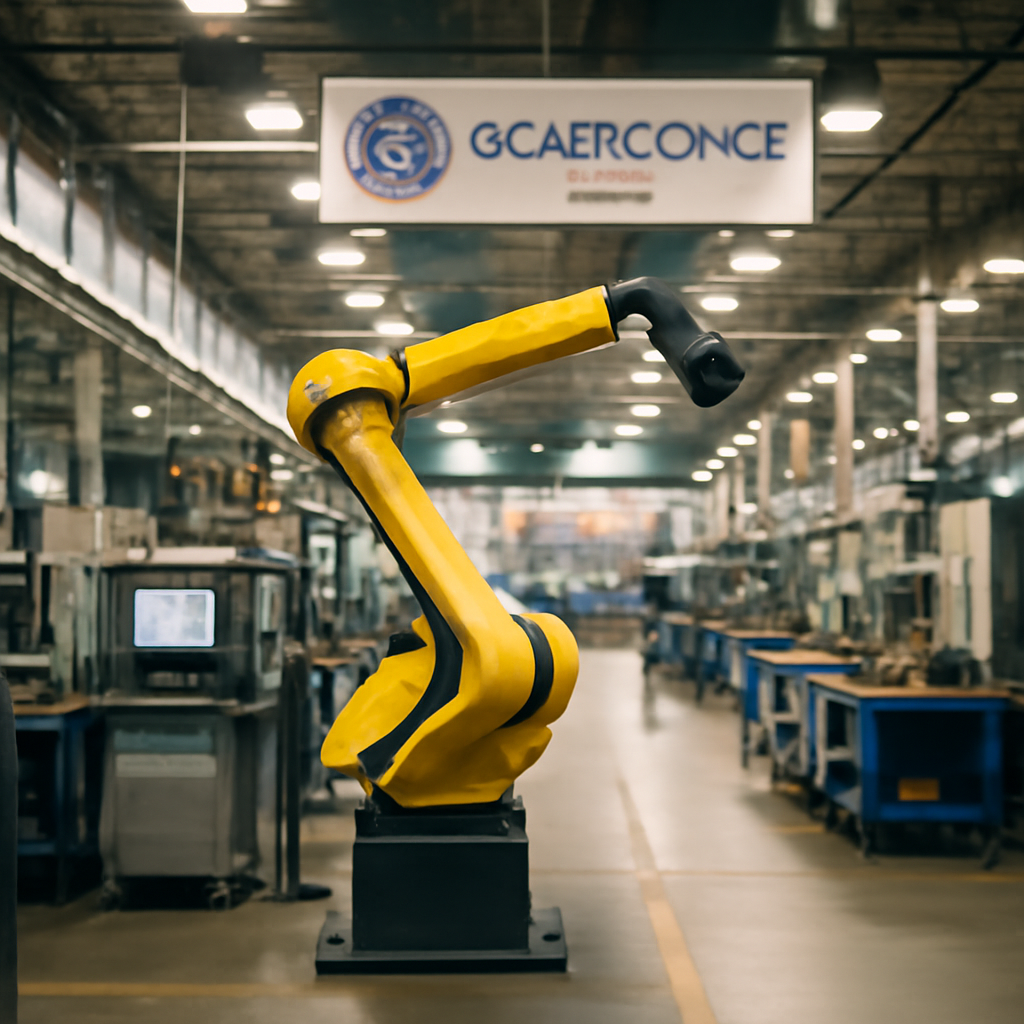
At GE Aerospace’s Lynn, Massachusetts factory, towering yellow robots nicknamed Rosie and Thomas now run a high‑cadence automated line that collects tools, machines parts and assembles rotating components such as cooling plates for the company’s T700 engines. The work is part of a multiyear, $100 million investment focused on machines and workflows intended to increase throughput and reduce prior bottlenecks. Dan Martin, who manages manufacturing engineering and leads the plant’s robotics and automation integration team, said the automation has removed constraints that once produced both quality and capacity problems.
Amy Gowder on supplier strategy and production cadence for F404/F414 and small engines
Amy Gowder, GE Aerospace’s president and CEO for its defense and systems division, framed the changes as explicitly aimed at meeting a faster production tempo required by next‑generation programs — including early planning for “collaborative combat aircraft” and smaller engines. Gowder described a shop‑floor mentality change: after a seven‑way exercise the team concluded they needed a “tack time of 100 seconds for each [screw], not an hour and a half” for 70 screws.
For the F404/F414 family (noted in the article as the engine found in the F/A‑18), Gowder said GE is shifting to a different supply base with “commercial off‑the‑shelf type standards” that are accustomed to higher volumes. She explained the expectation-setting in concrete terms: suppliers used to making one engine a month will be asked to scale to 20 engines a month within months, a pace that “doesn't phase them” if they have the right commercial volume experience; suppliers typically begin to seek new investments only when asked to reach roughly 100 engines a month. As part of that shift, GE is conducting “producibility reviews” with suppliers as they receive drawings and plan manufacturing approaches, standing by to suggest changes before final design lock‑in.

This site is the portfolio.
OSINTSights runs on Cloudflare Workers, D1, R2, and Vectorize, with an AI pipeline on Hetzner ARM. Nubivance designed, built, and operates it. We do the same for clients.
See what we buildHyCAT: GE as prime integrator for a hypersonic test bed
GE Aerospace was tapped by the Pentagon’s innovation arm to develop a hypersonic test bed under the Hypersonic and High‑Cadence Airborne Testing Capabilities (HyCAT) program, building on a prototype award in 2023. The firm aims for the first flight of the HyCAT test bed in 2028. Steve “Doogie” Russell, vice president and general manager of GE’s Edison Works, described GE as “the prime” on the effort while also saying the company will provide a dual‑mode ramjet for the vehicle — a propulsion feature Russell said can increase speed and range.
Russell emphasized GE’s posture: the company sees itself as a propulsion solution provider and integrator for a test capability rather than the developer of a weapons system, saying explicitly that “the company isn’t interested in developing a weapons system” for HyCAT. He also noted GE is working with a number of other platforms and partners on the all‑up test capability but declined to name those collaborators or discuss product ranges.
Dean Modroukas on testing approach: time in relevant flight conditions
Dean Modroukas, general manager of hypersonics at GE Aerospace, framed HyCAT’s purpose around the duration and relevance of flight testing. He argued the “best way to assess hypersonic systems is to make sure that you've got plenty of time in an operating mode that's relevant for things like thermal equilibrium, maneuverability.” Modroukas said HyCAT is a second step for developing a test bed and capability that allows engines to be brought into flight, and that the company seeks rapid learning through ground tests but ultimately wants testing “in a relevant environment” — in the air — to validate systems and payloads.
Modroukas also noted GE plans to use the HyCAT solution to test other payloads, including engine upgrades, reinforcing the program’s role as a platform for iterative propulsion and system development.
What this means for suppliers, the Marine Corps, and hypersonics test teams
- Suppliers: Companies that move into GE’s new supply base will be expected to scale from single‑digit monthly engine outputs to double‑digit monthly runs quickly; only at roughly 100 engines per month does the company expect suppliers to signal a need for capital investments. GE’s producibility reviews indicate the company will work with new suppliers during initial production planning to avoid late design changes.
- The Marine Corps and airframe programs: GE cited the T408 as a future engine for the Marine Corps’ CH‑53‑K King Stallion and referenced the T700 (used in Boeing’s Apache and Sikorsky’s Black Hawks) and F404/F414 (found in the F/A‑18) as contexts for where increased production cadence and new supply bases matter — signaling readiness preparations for platforms that may require quicker sustainment or upgrades.
- Hypersonics test teams: HyCAT is positioned as a flight‑centric test capability aimed at giving engines and payloads longer, relevant flight time to assess thermal and maneuvering behavior. GE intends to act as prime integrator while supplying propulsion (a dual‑mode ramjet), and yet it declined to position HyCAT as a weapons development program.
Navy certification of Rolls‑Royce mtu marine engines for autonomous vessels
Separately noted in the reporting, the Navy has certified Rolls‑Royce’s mtu series 4000 and 2000 marine engines to power autonomous surface vessels, expanding the range of propulsion choices for unmanned maritime platforms.
GE’s investments in automation, supplier shifts, and a hypersonic testing tempo now have a concrete timeline: higher engine cadences on the factory floor and a 2028 target for HyCAT’s first flight. The next milestones to watch are how quickly suppliers accept and execute the producibility reviews and whether the HyCAT prototype path stays on schedule toward its planned 2028 flight.