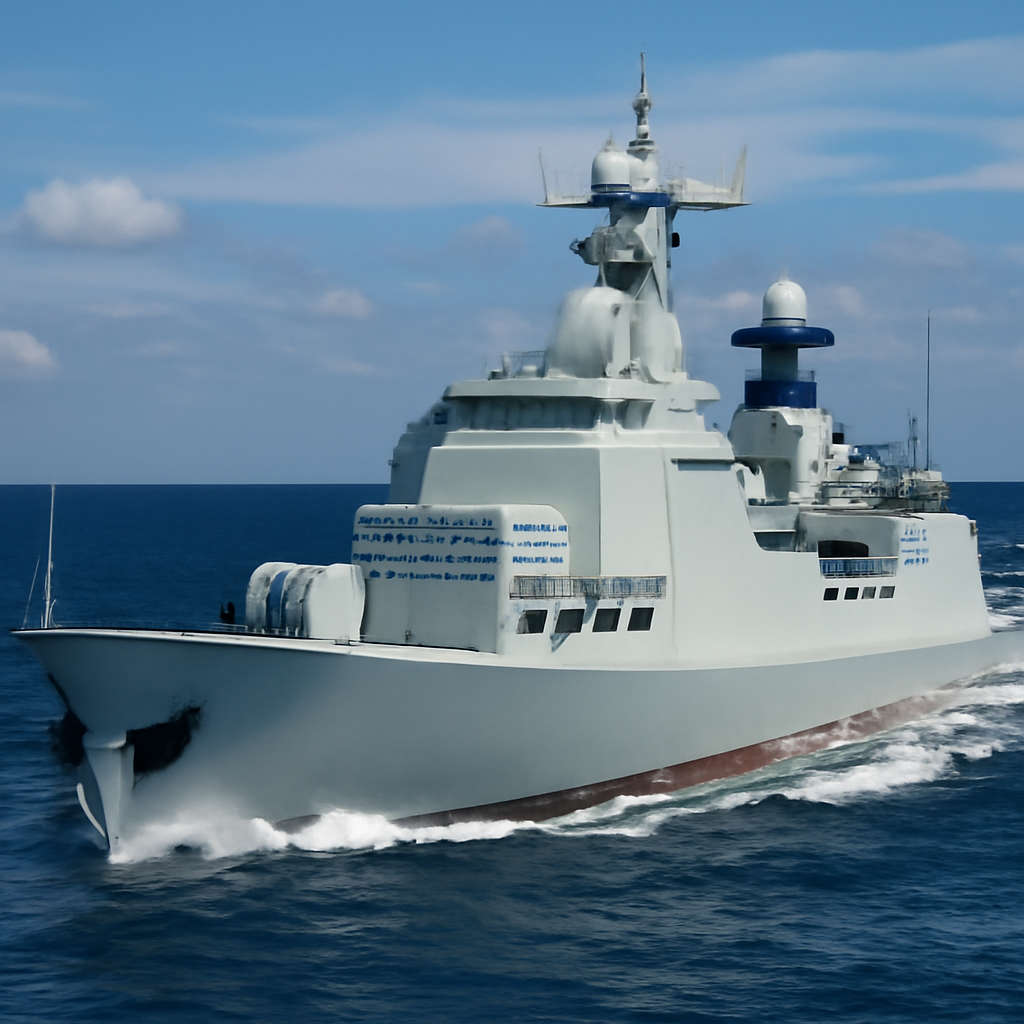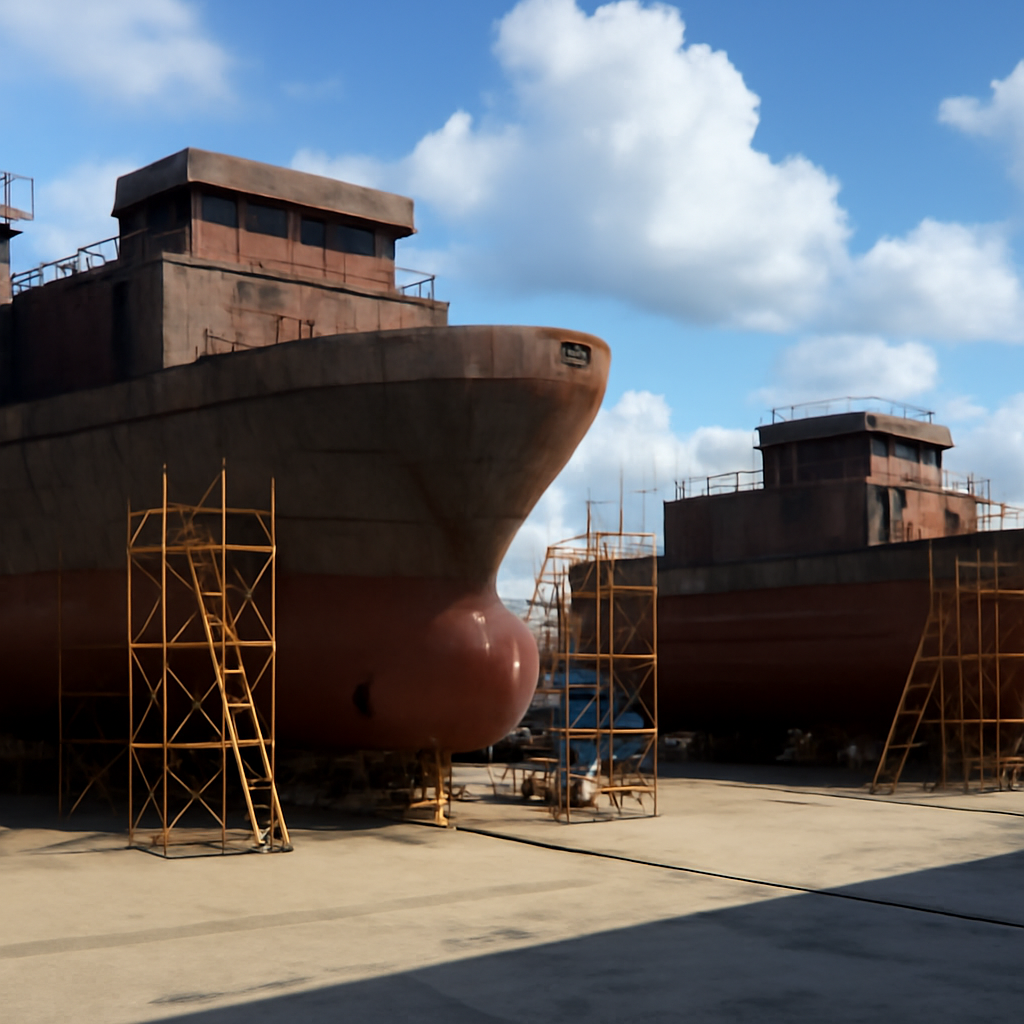
One vessel appears roughly one-third the size of its almost-identical counterpart — and both are configured as uncrewed underwater vehicle (UUV) motherships now nearing completion in two separate Chinese shipyards.
Two similarly configured UUV motherships emerge
Nearly a month after initial reporting on a distinctive UUV mothership under construction at Hudong‑Zhonghua Shipyard on Changxing Island in Shanghai, a second vessel with the same basic configuration has been photographed in Guangzhou. The Guangzhou vessel retains the major design elements seen in Shanghai but is proportionately smaller, “about a third smaller overall” according to the imagery-based assessment in the reporting.
Concrete design features and the differences between the two
Both hulls show a consistent set of design choices tied to a mothership role for large and small UUVs: a flight deck and hangar located behind a forward superstructure, a stern garage door and well deck for deploying and recovering craft, and large pylons intended to lift vehicles up and down out of the water and to multiple levels within the ship. The Guangzhou vessel preserves those features but exhibits a different pylons arrangement: six lift towers in total, in contrast to the Shanghai ship which has “six larger ones and six smaller ones.” The reporting also notes the relative locations of the smokestacks match between the two hulls.

The cyber insurance questionnaire just landed. Now what?
SOC 2, HIPAA, insurance renewals - someone has to own security strategy. Nubivance provides fractional CISO leadership without the full-time salary.
Get a security leadWhere they were built: Guangzhou Shipyard International and Hudong‑Zhonghua
Speculation about the Guangzhou-built hull’s origins pointed to Guangzhou Shipyard International (GSI) on Longxue Island, a subsidiary of China State Shipbuilding Corporation (CSSC). Archival satellite imagery reviewed for this report confirms GSI constructed the vessel: an image from October 2 shows the hull peeking out of a covered graving yard at the facility prior to launch. The earlier, larger hull was visible at Hudong‑Zhonghua in Shanghai.
Operational roles envisioned for large UUV tenders
The vessels’ layout — stern well deck, stern garage door, heavy lifts, hangar and flight deck — aligns with a ship intended to launch, recover, and tend multiple UUVs, including very large systems. The reporting highlights a spectrum of missions for long‑range UUVs that these motherships would support: mapping the seabed; anti‑submarine and anti‑ship hunting; mine countermeasures; launching cruise missiles and drones; and the possibility of UUVs being converted into weapons capable of bypassing traditional defenses. A fleet of dedicated tenders able to operate far from home ports and keep UUVs on station for extended periods would increase both the tactical reach and the strategic options linked to those systems.
How the People’s Liberation Army Navy, the U.S., and technologists will view this
- People’s Liberation Army Navy planners: The emergence of two similarly configured motherships — and the suggestion of more to come — signals a bet on expeditionary UUV operations. A dedicated fleet for launching, recovering, and tending large and numerous UUVs would demonstrate the priority placed on unmanned undersea capabilities.
- The U.S. Navy and planners: The reporting notes that the launch and recovery of large UUVs “remains a conceptual work in progress for the U.S.,” underscoring a capability gap in fielded U.S. inventory compared with these Chinese tenders as they enter service.
- Technologists and security teams: Those tracking undersea autonomy will watch the vessels’ ability to deploy both very large UUVs and swarms of smaller vehicles, because the spectrum of tasks described — from seabed mapping to weapons delivery — changes requirements for endurance, navigation, and command-and-control integration.
The appearance of two near‑complete hulls in quick succession — one in Shanghai and one at GSI on Longxue Island near Guangzhou — strengthens the case that the design is moving beyond a single experimental prototype. If additional hulls follow, the People’s Liberation Army Navy’s expeditionary UUV plans and their operational footprint will come into clearer focus. Satellite imagery, shipyard activity, and subsequent launches will be the immediate, concrete markers to watch as these motherships enter service.
https://www.twz.com/sea/second-chinese-submarine-drone-mothership-emerges