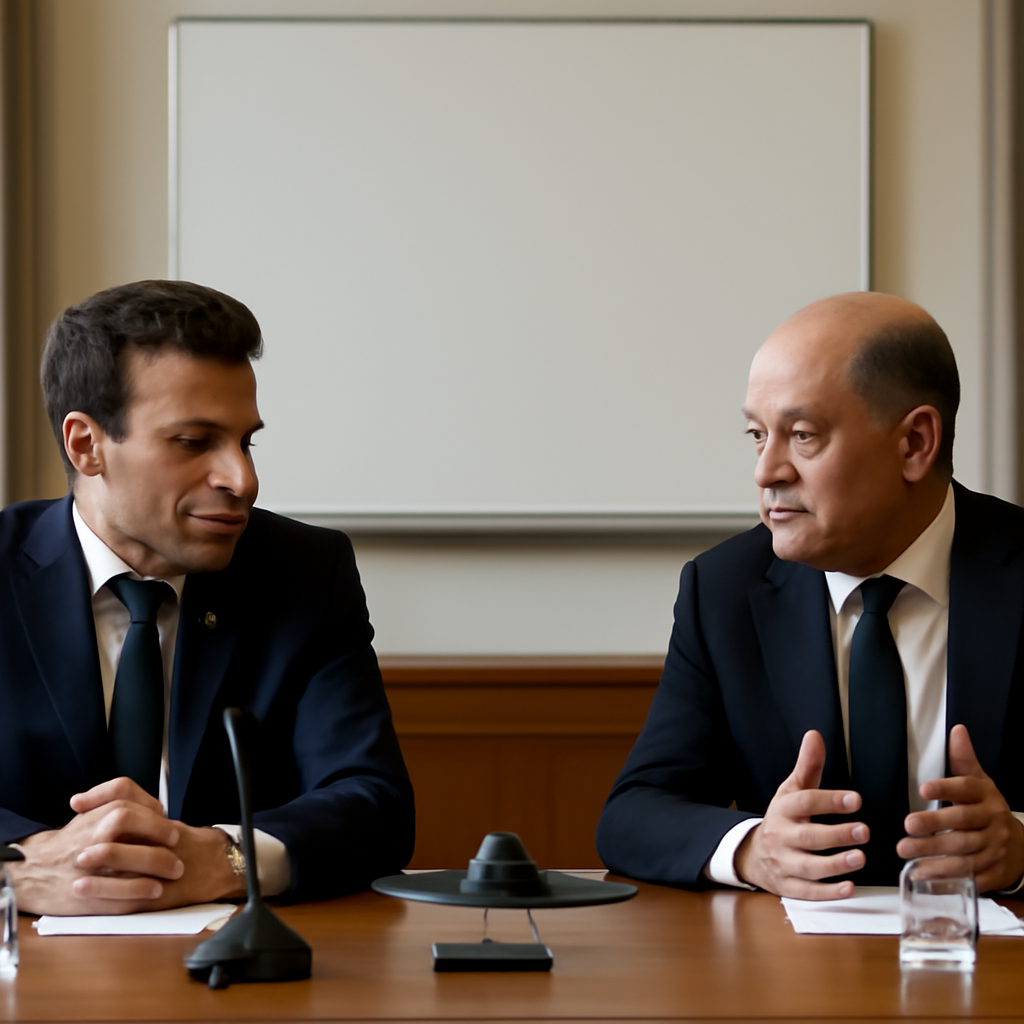
"The President of the Republic and the Federal Chancellor have held extensive and frequent discussions on ways to move forward with this important project for European defense," a French diplomat told TWZ — a remark delivered amid reports that France and Germany have effectively abandoned their joint effort to produce the New Generation Fighter (NGF).
Merz and Macron: leaders conclude NGF is no longer viable
Media reports, including the Frankfurter Allgemeine Zeitung and TWZ, say German Chancellor Friedrich Merz has urged French President Emmanuel Macron to end the NGF program. Unnamed German government sources told the Frankfurter Allgemeine Zeitung that Merz and Macron agreed the industrial partners could not reconcile their differences. The German leader had publicly raised doubts earlier this year, saying the partners had "fundamentally different operational requirements" — and that French needs for nuclear carriage and carrier operations do not align with Germany's. "This is not primarily a political disagreement," Merz said. "The real issue lies in the requirements profile. If we cannot reconcile those differences, the project cannot continue."
Dassault and Airbus at odds over industrial terms and workshare
At the heart of the collapse is industry conflict. Reports say Dassault Aviation and Airbus could not reach agreement on key aspects of the NGF, especially workshare and design priorities for the crewed fighter. Dassault CEO Éric Trappier reportedly declared the FCAS project dead if Airbus refuses to cooperate. French officials expressed frustration at what they saw as uncoordinated messaging from Berlin and a German preference for national solutions that risk sidelining French industrial input. A French diplomat told TWZ that France will continue to "encourage our industries and armed forces to explore avenues for ambitious European projects" consistent with national security interests, but it remains unclear whether the French government fully shares Berlin's assessment or is ready to accept the program's consequences.

Audit-ready is a season. It shouldn't be.
Evidence in spreadsheets, controls drifting between audits, frameworks multiplying on flat headcount. Nubivance runs continuous compliance on Rapid7 Cyber GRC - SOC 2, HIPAA, ISO 27001, PCI, CMMC.
End the scrambleFCAS architecture, history and schedule
FCAS was launched in 2017 with the aim of replacing France's Rafale fleet and Germany's Eurofighters, and envisaged a next-generation European combat air system entering service around 2040. The NGF — a crewed fighter — was the program's spearhead, and as of 2022 in‑flight demonstrations had been envisaged for 2028 or 2029. Beyond the NGF, FCAS intended to field families of drones, air-launched weapons and other aerial platforms tied together through a satellite‑linked "combat cloud." France has been developing complementary paths: Dassault is leading the industrial side of a new uncrewed combat air vehicle (UCAV) designed to complement a forthcoming Rafale F5 crewed fighter, drawing on the nEUROn demonstrator, and France plans the F5 standard to keep Rafale in frontline service until around 2060.
Alternatives: GCAP/Tempest, Saab, drones, and exported platforms
Europe was never monolithic on FCAS. A rival British-led program — now commonly called the Global Combat Air Program (GCAP) and centered on the Tempest crewed fighter — involves Italy and Japan. Sweden also runs its own next-generation combat-air program led by Saab, which is also referred to as FCAS. Reports say Airbus has raised the possibility of teaming with Saab on the manned tactical component, and that Airbus has been actively exploring post-FCAS alternatives. Airbus and Kratos have pitched the U.S.-made XQ-58A Valkyrie to Germany, and Airbus has worked on a stealthy "Wingman" CCA-like concept. The coverage also notes an expanding foothold for the U.S.-made F-35 in Europe and references a possible future sixth-generation F-47 being offered for export in a reduced form — all options that change the strategic calculus for partners.
What this means for France, Germany, and Spain
- France: Losing major partners for the NGF would be consequential. Paris reportedly remains committed to Franco‑German cooperation and will press industry and the armed forces to pursue ambitious projects, including the Rafale F5 and a Dassault‑led UCAV program building on nEUROn experience.
- Germany: Berlin appears ready to step back from exerting political pressure on companies and to explore national solutions and unmanned options; reporting notes Germany's acceptance of receiving F-35s and more Eurofighters as part of its near‑term force structure.
- Spain (and Belgium as junior partners): Spain's industrial support and financing are cited as part of the pan‑European program, but whether either country can sustain a viable fighter program if France and Germany split remains an open question in the reporting.
The program now sits at its largest inflection point to date. Reports portray FCAS as at a crossroads: the NGF in doubt, industrial partners divided, and multiple alternative threads — GCAP/Tempest, Saab's Swedish FCAS, drone concepts and existing export fighters — competing to fill the void. With the ILA Berlin airshow starting on Wednesday, the reporting suggests policymakers and industry may disclose Germany's next moves before the end of the week. Whether Paris will accept a formal end to the Franco‑German NGF, or can preserve elements of the broader FCAS architecture without the NGF, remains uncertain.