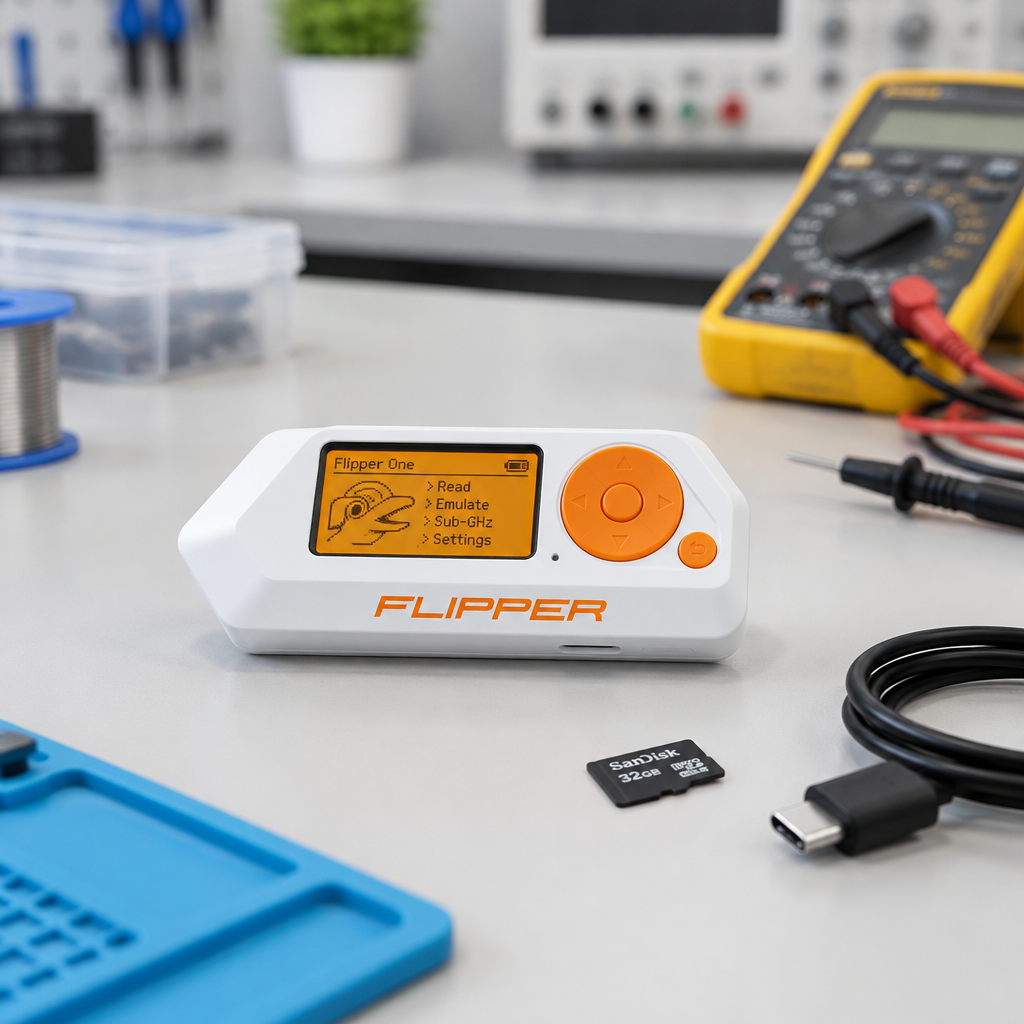
"Instead of waiting for perfect market conditions or raising the price, we’re moving forward with the Kickstarter campaign," reads the press release Flipper Devices shared with BleepingComputer.
Flipper Devices' pricing and production decision
Flipper Devices has set a launch price of $399 for the Flipper One, a figure the company says covers production costs and leaves no profit margin. The firm attributed roughly half of the device’s hardware cost to RAM and UFS storage, and said global RAM shortages and price volatility influenced its decision. Rather than delay or raise the price, the company told BleepingComputer it will proceed with a Kickstarter campaign to fund the first production run.
Flipper One hardware and Flipper OS
Flipper One is described as a portable Linux computer running a Debian-based Flipper OS. The company reports the device already runs on the mainline Linux kernel, while USB-C DisplayPort patches are under review for inclusion in mainline. Ongoing engineering work includes improving memory power efficiency and eliminating the remaining closed-source boot components.

This site is the portfolio.
OSINTSights runs on Cloudflare Workers, D1, R2, and Vectorize, with an AI pipeline on Hetzner ARM. Nubivance designed, built, and operates it. We do the same for clients.
See what we buildNetwork features: Wi‑Fi 6E, eSIM, and multi-uplink management
The device targets IP networking and on-device computing rather than replicating the radio-focused capabilities of the Flipper Zero. Built-in connectivity includes Wi‑Fi 6E, Gigabit Ethernet, and an eSIM. Flipper One can manage up to five network uplinks, act as a hotspot, run VPNs and firewalls, and connect to an external display over USB‑C. Those capabilities position the product as a portable networking multi-tool for tasks that require on-device routing, tunneling, or multi-homing.
Expansion modules and ecosystem ambitions
Flipper Devices plans optional expansion modules for the Kickstarter campaign: LoRa support (noting compatibility with MeshCore, Meshtastic, Reticulum, and a walkie-talkie mode), a 5G modem, and software-defined radio (SDR) expansion modules. The company said full specifications for those modules will be disclosed as development continues.
Kickstarter campaign, schedule, and lineage
The Kickstarter campaign runs from November 17 to December 17, with a funding goal to enable the first production run. Flipper Devices estimates shipment for first buyers in July 2027; the pledged package includes the device and a USB‑C cable. The company has used Kickstarter before: its Flipper Zero project in 2020 reached its funding goal within eight minutes and raised $4.8 million in 30 days, and Flipper Devices says it has sold over 1 million Flipper Zero devices since that launch.
How technologists, enterprise teams, and hobbyists are likely to respond
- Technologists and Linux maintainers will watch the mainline kernel status and the progress of USB‑C DisplayPort patches, as their inclusion affects downstream support and integration.
- Enterprise network and security teams will note the device’s ability to manage up to five uplinks, run VPNs and firewalls, and use eSIMs and Wi‑Fi 6E when assessing supply-chain, remote-access, and edge-networking implications.
- End users and hobbyists will focus on the product positioning and timing: a $399 entry price that the company says carries no profit margin, a Kickstarter window from November 17 to December 17, and an estimated first-buyer shipment in July 2027.
Flipper One presents a deliberate pivot from the company's earlier radio- and hardware-focused device to a Linux-based networking tool with modular extensibility. The next concrete milestones to track are the Kickstarter funding outcome, the disclosure of full module specifications, and upstream kernel acceptance of the remaining patches — developments that will determine both technical interoperability and how quickly early supporters receive production units.