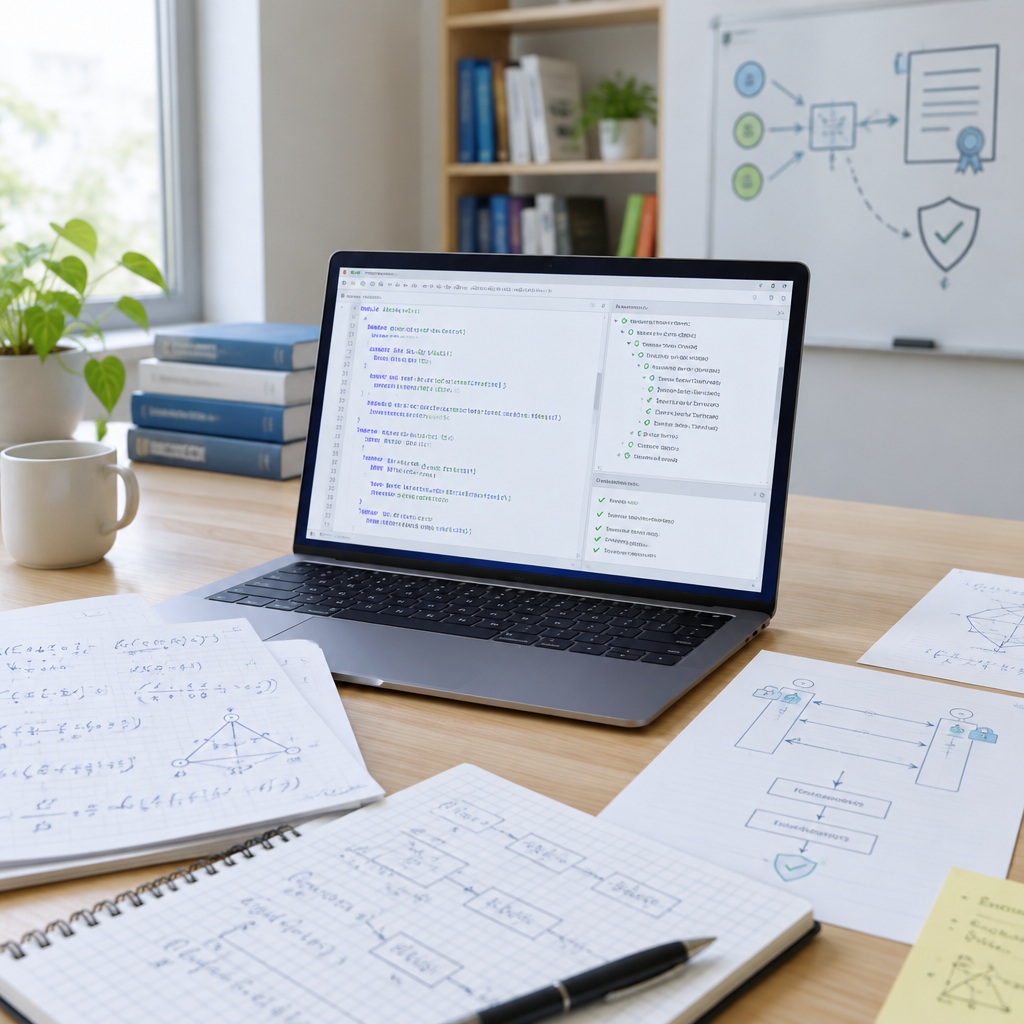
Over six million lines of Lean were generated by agents during a four‑week proof‑of‑concept effort to formally verify portions of the Signal protocol, Google DeepMind reported.
Google DeepMind's AlphaProof Code and Gemini Carbon
DeepMind described a new AI framework, AlphaProof Code, supported by a mix of models that included agents "powered by Gemini Carbon." According to the researchers, the agents carried out the bulk of the mathematical work: translating security goals into formal specifications, producing proofs and then auditing those proofs. Human experts reviewed every formal security goal and inspected the parts of the proof the agents flagged for further attention.
Formal verification results for the Signal protocol
The DeepMind analysis yielded two clear outcomes. First, on the portions of the current Signal protocol that the team examined, the work "did not find any new vulnerabilities." Second, when AlphaProof Code was applied to older versions of Signal that contain "known and long‑fixed vulnerabilities," the system correctly identified those flaws and demonstrated that those older versions could not be formally verified. DeepMind framed the work as both independent validation of widely used cryptography and a demonstration of its formal verification capabilities.

Audit-ready is a season. It shouldn't be.
Evidence in spreadsheets, controls drifting between audits, frameworks multiplying on flat headcount. Nubivance runs continuous compliance on Rapid7 Cyber GRC - SOC 2, HIPAA, ISO 27001, PCI, CMMC.
End the scrambleAI‑human workflow: Lean and the one‑percent focus
The researchers reported a hybrid workflow. Agents generated more than six million lines of Lean, the language that codifies mathematical proofs so they can be checked automatically. After generation, agents audited the proof and singled out a small subset—about one percent of the codebase—that needed human re‑examination. Because Lean performs automatic checking on the remainder, the team said experts "could focus their review where human judgment matters most," producing what DeepMind characterizes as a large time savings compared with fully manual verification.
What DeepMind released for further verification work
In support of broader formal verification efforts, DeepMind is releasing the specification and the proof developed for the Signal analysis. The researchers described the work as a proof‑of‑concept completed "in just four weeks" and pointed readers to a technical paper for greater detail. The release is intended to aid other teams seeking to apply formal methods to cryptographic protocols.
What this means for technologists, protocol maintainers, and end users
- Technologists and security teams: The reported workflow suggests a path to scale formal verification by applying agentic AI to generate machine‑checkable proofs and reduce the scope of human review to targeted areas. Teams will likely watch how much of the verification lifecycle can be reliably automated and how the one‑percent human focus functions in practice.
- Protocol maintainers and open‑source developers: DeepMind's public release of the specification and proof furnishes concrete artifacts that maintainers can inspect, reuse, or build on. The fact that the system flagged known, long‑fixed vulnerabilities in older Signal versions underscores that formal verification can distinguish between current and legacy weaknesses when given appropriate models and specifications.
- End users and the general public: The researchers framed the work as independent validation of cryptography that underpins widely used messaging applications. For users, the practical takeaway is that portions of the Signal protocol examined in this project were not shown to contain new flaws by this analysis; however, DeepMind’s account also makes clear that verification remains a process requiring both automated checks and human judgment.
DeepMind's experiment is both demonstrative and consequential: a concentrated, four‑week application of agentic AI produced machine‑checkable proofs at scale and reduced the human review surface to a sliver of the codebase. The team did not report new vulnerabilities in the examined portions of Signal, and it released the specification and proof to enable further independent work. The central question the release leaves in plain view is whether other teams will reproduce the approach—and whether the same mix of agentic generation plus targeted human review will scale reliably across other cryptographic protocols and larger verification targets.