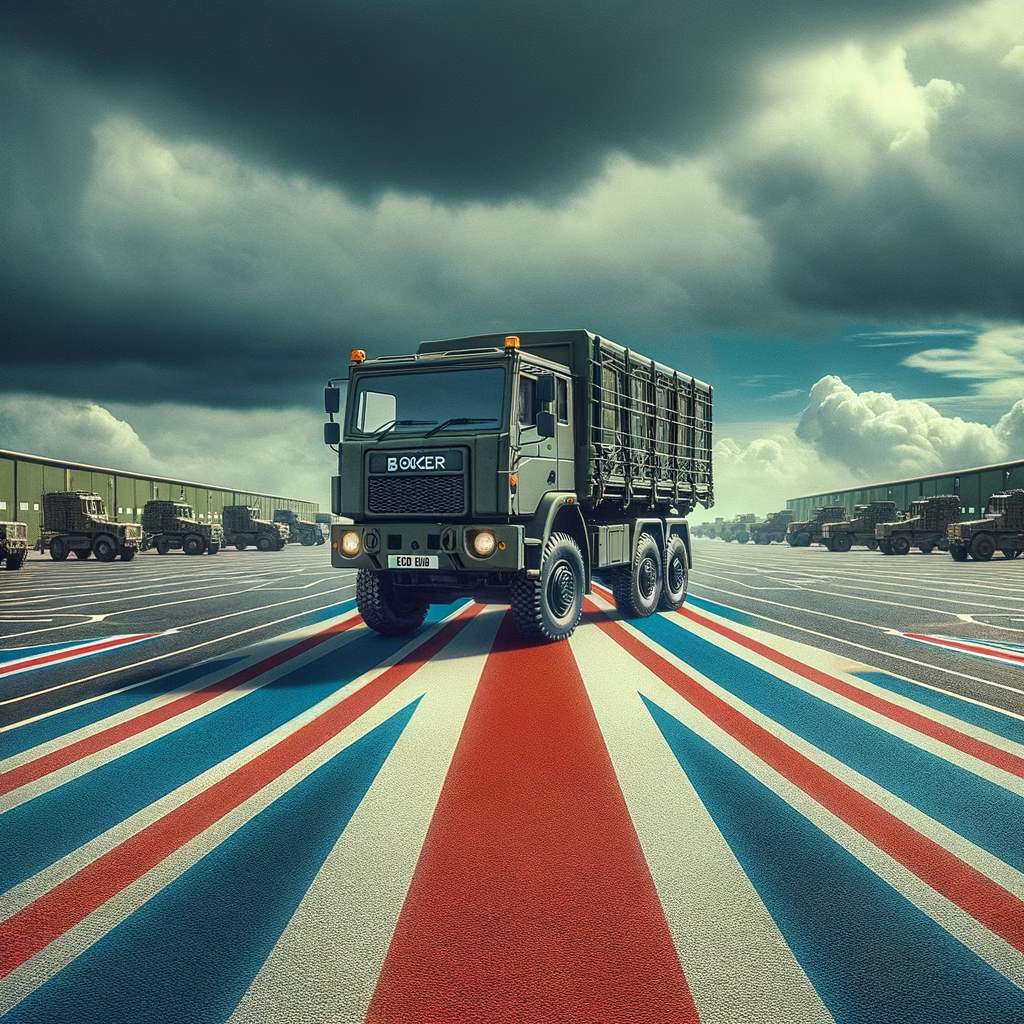
First UK-made milestone: the first Boxer produced arrives for service
Can a single vehicle capture both national resilience and the hard limits of state ambition? The British Army’s receipt of the first Boxer produced on UK soil answers that with a complicated yes. The milestone, part of a £5 billion, 623-vehicle programme, is a concrete symbol of a larger ambition: to reshape how Britain moves, protects and fights its infantry while rebuilding domestic defence manufacturing capacity.
Built by Rheinmetall BAE Systems Land (RBSL) at its Telford plant, the vehicle has been sent to Bovington for final induction and trials. The Boxer family — an 8×8 modular armoured vehicle already used by several NATO partners — arrives in multiple UK-tailored variants ranging from protected mobility and command-and-control to ambulance and specialist support. The programme is one of the most significant recent investments in Britain’s domestic armoured-vehicle industry and is being framed by officials as central to the Army’s mechanised capability.
Why the first Boxer produced matters
The Boxer design grew out of early-21st-century European cooperation and has attracted buyers through its balance of protection, mobility and a modular mission bay that allows rapid re-role. By committing to produce Boxers domestically, the UK sought to meet three aims: field a modern, survivable mechanised fleet; preserve and grow the domestic industrial base; and improve supply-chain resilience by bringing manufacturing under UK control.
For soldiers, the Boxer promises meaningful improvements in protection for dismounted infantry compared with many legacy wheeled and tracked platforms. Its modular construction lets units tailor vehicles quickly for troop carriage, command-and-control, casualty evacuation, and specialised engineering or signals tasks. That flexibility matters in modern conflict, where mission requirements can change faster than procurement cycles.

Audit-ready is a season. It shouldn't be.
Evidence in spreadsheets, controls drifting between audits, frameworks multiplying on flat headcount. Nubivance runs continuous compliance on Rapid7 Cyber GRC - SOC 2, HIPAA, ISO 27001, PCI, CMMC.
End the scrambleIndustrial, political and technical trade-offs of domestic production
Domestic production is about more than jobs and factories. The Telford line anchors skills, apprenticeships and intellectual property inside the UK, aligning with post-Brexit narratives of economic sovereignty and defence autonomy. Yet those benefits come with costs: homegrown build programmes are typically pricier and more complex than off-the-shelf foreign purchases, demanding rigorous procurement management and long-term funding certainty.
Technically, Boxer’s modular mission bay is a strength that enables upgrades and rapid reconfiguration. But integrating UK-specific systems — communications suites, remote weapon stations and classified electronics — adds programmatic complexity. Modern electronic architecture, software integration and battlefield networking are as crucial as armour thickness; the platform’s operational value will depend heavily on how well these components are harmonised and sustained over time.
What soldiers and commanders will judge
Operational users care about protection, mobility and reliability. Wheeled platforms like Boxer offer strategic and operational benefits: faster road movement and shorter deployment times compared with heavy tracked vehicles. They can transit quickly between objectives, reducing exposure during movement. However, heavier protected vehicles present trade-offs in air transportability and can stress bridges and roads in austere environments. The metric that will matter most to commanders is vehicle availability during sustained operations — advanced capability is irrelevant if vehicles spend more time in maintenance than on the road.
Strategic and coalition implications
Interoperability with allies is a clear advantage: fielding a platform already in service with partners streamlines shared logistics, training and battlefield data formats, smoothing coalition operations. Yet adversaries will adapt. Cheap, rapidly evolving threats — anti-armour guided missiles, loitering munitions, electronic warfare and drone swarms — are changing the balance and require continuous countermeasures, tactics development and investment across sensors, air defence and electronic warfare.
Cost, accountability and force design questions
The headline cost — £5 billion for 623 vehicles — masks a more nuanced financial picture that includes through-life support, upgrades and the costs of domestic integration. UK defence procurement has a mixed record on timelines and cost control, inviting political scrutiny. Optimists argue the Telford line is an investment in sovereign capability and jobs; sceptics ask whether the higher unit costs and schedule risks are justified.
Critics also warn that a stronger mechanised infantry need not come at the expense of balanced force design. Boxers enhance survivability, but they are one element of a larger ecosystem that must include artillery, air defence, logistics, electronic warfare and well-trained personnel. Without coordinated investment across these domains, the capability risks becoming an expensive silo rather than an integrated force multiplier.
Industrial ripple effects and risks
For RBSL and its supplier network — steel, electronics, composites and software firms — the programme will reveal the true economic effect of domestic production. For the Midlands, the Telford factory delivers jobs and apprenticeships; for the national economy, it is a long-term wager on sustaining specialised skills. Risks are real: a single production line concentrates vulnerability to strikes, supply-chain interruptions or quality-control issues. Geopolitical shocks or budget pressures could force schedule delays or fleet reductions. Rapid technological change also means vehicles must be modular enough to accept future protection and sensor upgrades without prohibitive cost.
Conclusion: the first Boxer produced in the UK is both symbolic and practical. It signals a determined effort to domesticise part of Britain’s defence industrial base and marks a concrete step toward equipping infantry with modern, protected mobility. But whether that symbolism translates into enduring operational advantage will be decided over years — by disciplined procurement, sustained funding, effective systems integration and the often-unseen work of maintenance crews and engineers who keep the fleet ready. The vehicle has been built; the harder test is whether building it domestically delivers a faster, more resilient infantry capability than the alternatives would have.