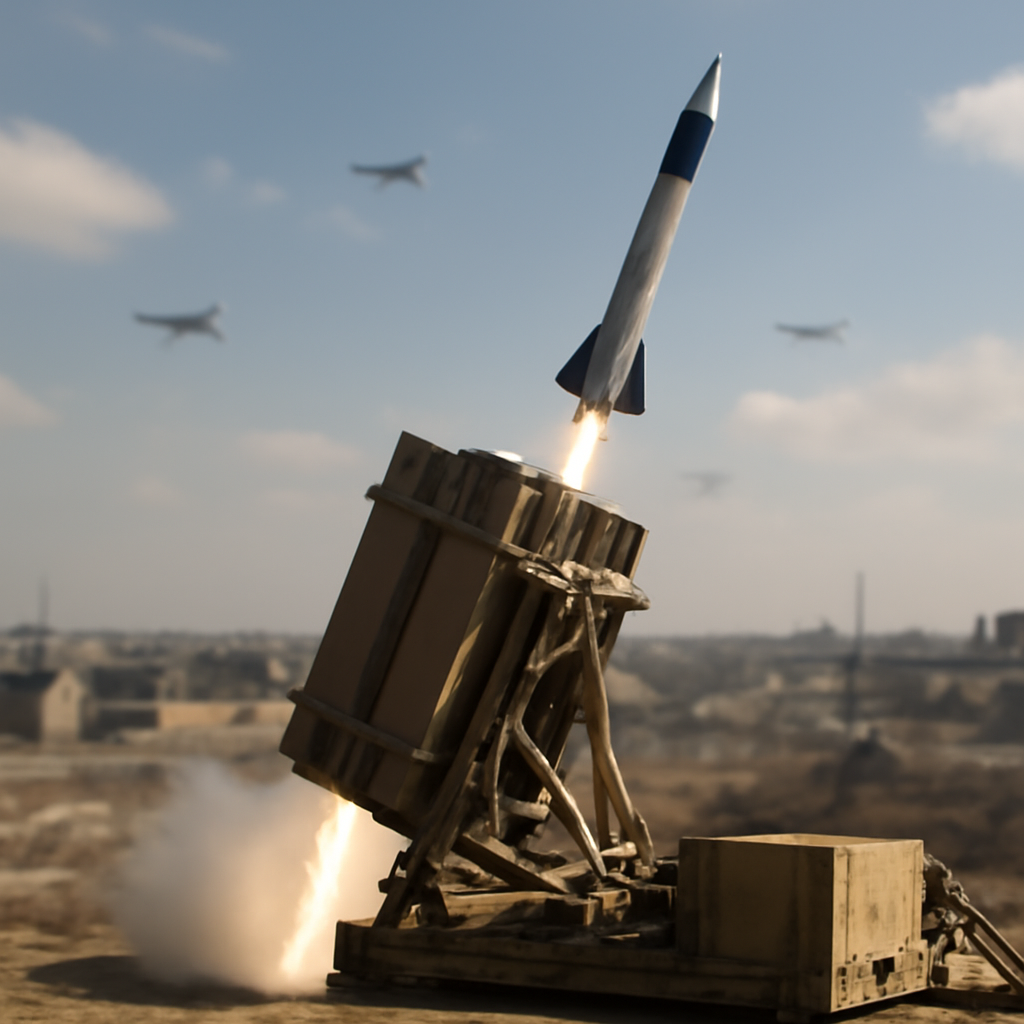
Fire Point estimates the cost per intercept for its Project Freya at under $1 million — a price point the company says would make ballistic-missile defence far more affordable for European users than current Western interceptors.
Fire Point published the Freya concept on May 14
Ukrainian defence company Fire Point publicly unveiled the full system concept for Project Freya on May 14, according to Militarnyi and Ukrainska Pravda. Co-founder and chief designer Denys Shtilerman presented Freya as a pan‑European air and missile defence architecture built around a new interceptor, the FP-7.x, and integrated with NATO‑standard European radar, command, and communications components.
FP-7.x interceptor: S-300 heritage, dimensions, and propulsion
Fire Point describes the FP-7.x as derived from the company’s FP-7 tactical ballistic missile and ultimately inheriting aerodynamic characteristics from the Soviet-era 48N6 anti-aircraft missile used in S-300 and S-400 systems, Defence Express reported. That heritage, the company says, is primarily external: Fire Point retained the 48N6’s external geometry and dimensional envelope — a design space well characterized by decades of flight data — while rebuilding most internal architecture.
According to Fire Point’s presentation, the FP-7.x measures 7.25 metres in length with a fuselage diameter of 0.53 metres. The company has moved away from the 48N6’s cold‑launch approach and adopted a hot‑launch system that ignites the motor at the moment of firing from a lightweight mobile launcher of the company’s design.

The cyber insurance questionnaire just landed. Now what?
SOC 2, HIPAA, insurance renewals - someone has to own security strategy. Nubivance provides fractional CISO leadership without the full-time salary.
Get a security leadGuidance and seeker suite: infrared plus Diehl’s semi‑active capability
The FP-7.x marks a clearer break from S‑300 lineage in its guidance architecture. Fire Point’s presentation describes an Image Infra‑Red (IIR) homing seeker as the primary guidance sensor, supplemented by semi‑active seeker technology supplied through a cooperation agreement with Germany’s Diehl Defence signed in April 2026, the reporting said.
Defence Express noted an ambiguity in the slides shown by Shtilerman: one slide referenced infrared homing while another referenced Diehl’s semi‑active homing, suggesting Fire Point may be proposing a two‑phase guidance model that blends IIR acquisition with semi‑active terminal illumination.
Performance claims and the cost argument
Defence Magazine recorded Fire Point’s claimed interceptor speed at 1,500 to 2,000 metres per second — lower than the Iskander‑M’s reported terminal speed of approximately 2,100 m/s but described as sufficient to reach the engagement envelope against tactical ballistic missiles in terminal descent. The FP-7 strike variant was successfully test‑fired in February 2026, and Fire Point plans the first ballistic missile interception by the end of 2027, the company told reporters.
Cost is central to the public pitch. Fire Point estimates the cost per intercept at under $1 million, contrasted in reporting with several millions of dollars per engagement for systems such as the Patriot PAC‑3. Shtilerman has framed Freya’s design philosophy as mirroring how Ukraine scaled attack‑drone production — stressing affordability and scalability over extreme technical complexity, Euromaidan Press reported.
Manufacturing plans and Danish regulatory steps
To support production, Fire Point plans to build a solid rocket fuel plant in Denmark. The Defense News reported that the Danish government approved the temporary suspension of over 20 laws and regulatory procedures to accelerate construction. Fire Point has also said it will reduce airframe mass and radar signature by rebuilding the missile airframe in carbon‑fibre composites rather than the original metallic structure, a change Defence Blog linked to lower manufacturing cost and reduced radar visibility.
What MBDA, Diehl Defence, and the Danish government will watch
- MBDA: Defence Blog reported MBDA is assisting with missile development. MBDA’s role will likely focus on technical integration and helping move Freya from concept toward an operational weapon, monitoring tests and system interoperability.
- Diehl Defence: The April 2026 cooperation agreement means Diehl’s semi‑active seeker technology is a named contributor to Freya’s guidance suite. Diehl will be watching seeker integration, licensing and export compliance tied to its technology.
- The Danish government: With temporary suspension of 20+ laws to speed a solid‑fuel plant, Danish regulators and lawmakers will track construction timelines, safety and environmental compliance as the plant is built to support Fire Point’s production goals.
Fire Point’s public filings paint Freya as an explicitly European, low‑cost approach to ballistic missile defence that leans on known aerodynamic envelopes, new materials, a mixed seeker architecture, and fast industrial scaling. The next concrete checkpoints are the company’s continued development work, integration with Diehl and other European firms, and the stated target of achieving a first interception before the end of 2027 — milestones that will determine whether Freya remains a provocative technical concept or becomes an operational element of European missile defence.
Source: Quwa — Ukraine’s Fire Point Reveals Architecture for Freya