"Extending the aircraft toward 'palletised, kinetic, and non-kinetic effects'." That was how Bosco da Costa Junior, president and chief executive of Embraer Defense & Security, framed a compact but consequential shift announced at the Farnborough International Airshow on 21 July.
Embraer and Anduril sign MoU at Farnborough
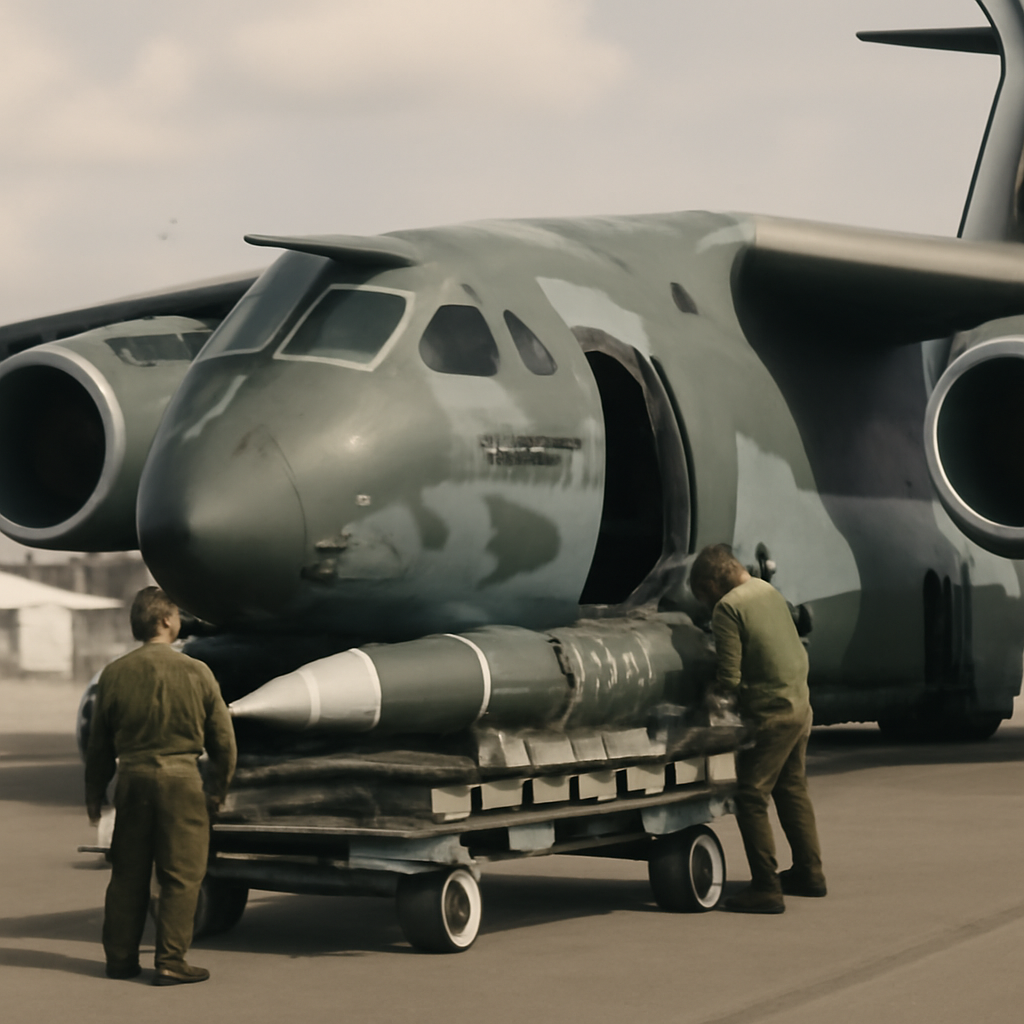
Embraer and the United States defence-technology firm Anduril Industries signed a memorandum of understanding (MoU) to integrate Anduril’s pallet-launched Barracuda-500M (B-500M) cruise missile onto the C-390 Millennium airlifter. Under the agreement, the two firms would load the B-500M aboard the C-390 on pallets and release the rounds from the aircraft’s rear ramp using roll-on/roll-off mission systems and conventional aerial-delivery procedures. A concept image shown during Embraer’s briefing depicted 25 missile rounds arranged on a single pallet, with one package loading while a second sat in the cargo hold.
Barracuda-500M design, lineage, and flight testing
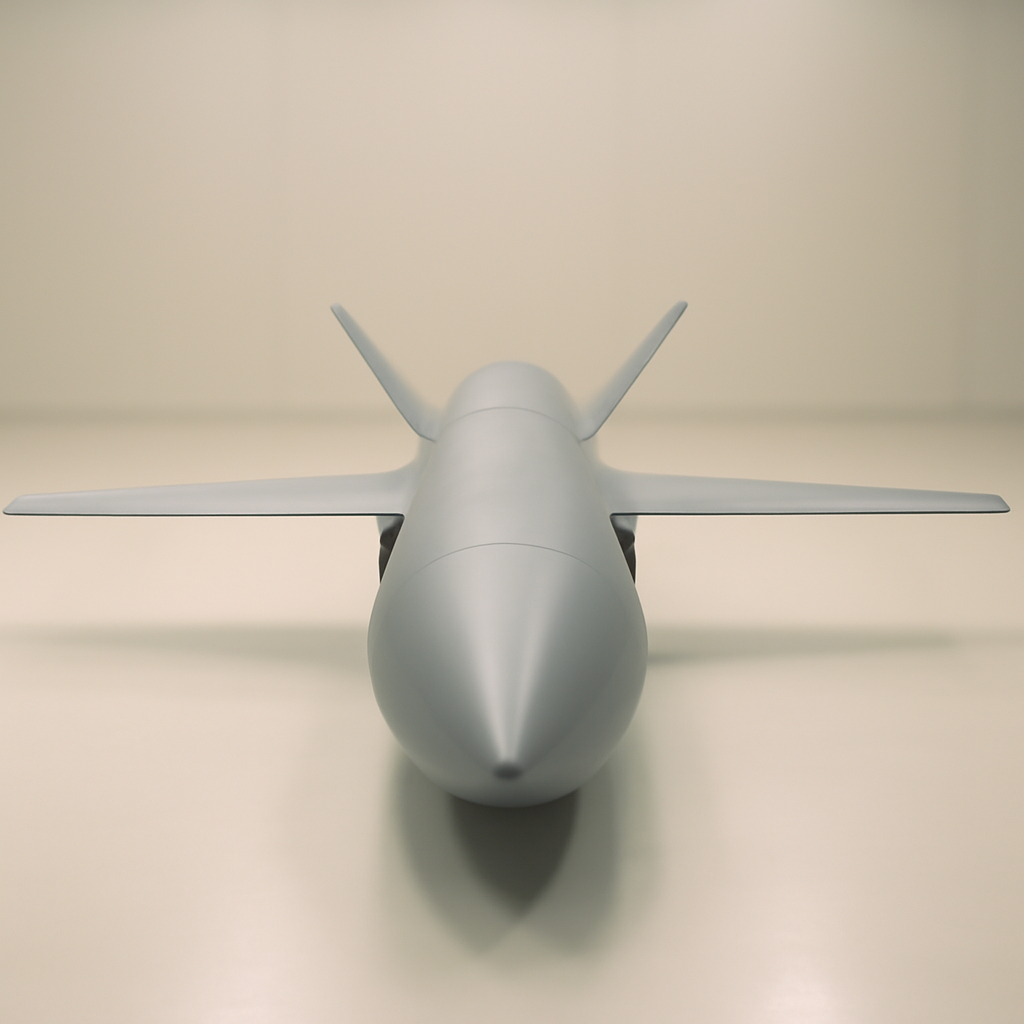
The B-500M is the largest cruise-missile member of Anduril’s Barracuda family, revealed in September 2024 in three size classes: the Barracuda-100, Barracuda-250 and Barracuda-500, the numeric suffix representing weight class in pounds. Anduril presents the B-500M with the United States military designation AGM-189 as a low-cost, mass-producible cruise missile carrying an explosive warhead and a single small turbojet, with a top speed near 930 km/h. The design traces to the United States Air Force Enterprise Test Vehicle (ETV) effort, run with the Defense Innovation Unit (DIU) and now transitioning into the Franklin Affordable Mass Missile (FAMM) line.
Anduril first flew the pallet-launched round from a vertical cell in September 2024 and has conducted dozens of tests since, validating networked autonomy and terminal guidance through its Lattice software. The company positions the pallet architecture as scalable for both kinetic and non-kinetic payloads as it completes further flight tests under United States supply contracts.

Audit-ready is a season. It shouldn't be.
Evidence in spreadsheets, controls drifting between audits, frameworks multiplying on flat headcount. Nubivance runs continuous compliance on Rapid7 Cyber GRC - SOC 2, HIPAA, ISO 27001, PCI, CMMC.
End the scrambleOperational concept: turning transports into stand-off launchers
The palletized configuration is central to the concept: rounds leave the aircraft on standard cargo pallets rather than dedicated pylons, letting existing transport types perform stand-off launches while keeping crews clear of defended airspace and removing any fighter-escort requirement. That approach enables a transport to employ dozens of munitions in a single pass, an economy-of-force concept described in the source as opening “large-scale strike concepts at reduced cost.”
The concept echoes the United States Air Force’s Rapid Dragon experiments, which drop palletized cruise missiles from cargo aircraft. Open-source analysis cited in the briefing notes that a single C-17 Globemaster III could carry 16 to 24 Barracuda-500 rounds per sortie—against the 20 AGM-86 air-launched cruise missiles a B-52H bomber carries—illustrating how palletized loads could change sortie-level firepower accounting.
Market reach, contracts, and related industrial moves
Embraer framed the MoU as oriented to the international market rather than the Brazilian Air Force. Bosco da Costa Junior said interest was coming from customers across Europe and Asia but declined to identify them and gave no date for a first test firing. The Embraer–Anduril pairing broadens the missile’s reach beyond recent United States Department of Defense supply contracts and a local-production arrangement with Poland’s Polska Grupa Zbrojeniowa (PGZ). Separately, the United States Army has moved to buy thousands of container-launched rounds. Other airframe manufacturers are exploring comparable ideas: Airbus is studying a palletized role for its A400M transport.
What this means for South Korea, the United States Army, and Embraer/Anduril
- South Korea: As a C-390 operator due to receive three of the type, South Korea stands out in the source as an early candidate for the strike role, a factor linked explicitly to the country’s exposure to North Korea’s conventional arsenal.
- The United States Army: With the Army already moving to buy thousands of container-launched rounds, the broader international adoption of palletized Barracuda-500Ms could reinforce demand for mass-producible rounds and encourage further standardization around palletized delivery concepts.
- Embraer and Anduril: Embraer is extending the C-390 from pure tactical airlift into long-range precision strike for export customers, while Anduril is taking its pallet architecture and Lattice-enabled autonomy into markets beyond current U.S. supply contracts and Poland’s local-production arrangement.
The pairing of a low-cost cruise missile with a pallet-based launcher is a concrete expression of the "affordable mass" approach described in the source—trading small numbers of high-cost weapons for many cheaper rounds fired in salvos. The announcement at Farnborough lays out a concept and market intent, but key milestones remain unspecified: Embraer declined to name customers, and the companies offered no date for a first C-390-launched test firing. Those facts make the next rounds of flight testing and formal customer decisions the clearest markers to watch.