"Many Air Forces are moving toward this idea of a layered defense," said Marc Ayala, Embraer's vice president for defense sales in North America.
Embraer A-29 Super Tucano as an airborne c-UAS layer
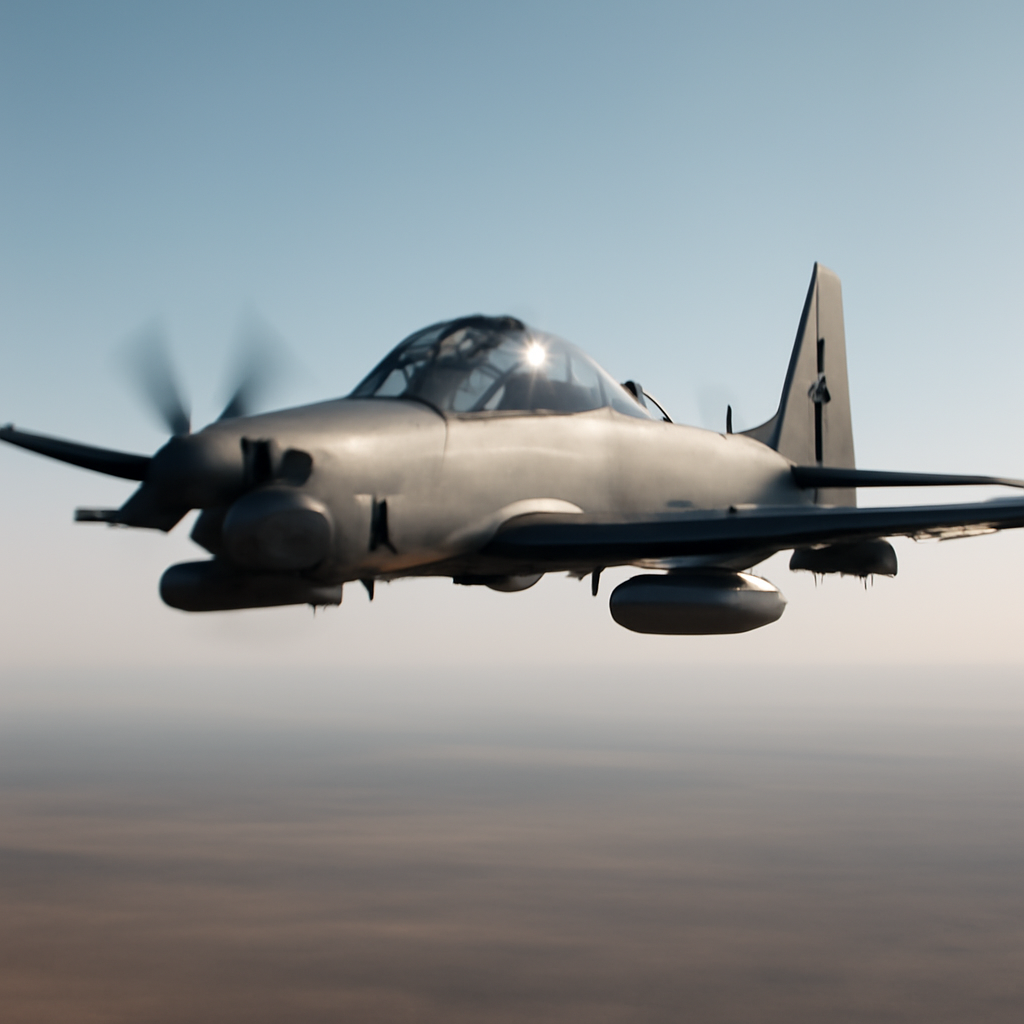
Embraer is adapting its A-29 Super Tucano light-attack aircraft to serve as a mid-range counter-unmanned aircraft system (c-UAS) interceptor, positioned between ground-based point defenses and high-end fighters. The company frames the A-29 as a way to thin incoming swarms farther from defended bases, infrastructure, and other high-value assets. Ayala used the defense of Guam as an example, saying the A-29 would cover a zone stretching from 50–200 miles out while fixed-point ground defenses would take over from 50 miles inward.
Find, fix, finish: datalinks and the WESCAM MX-15D
Embraer’s concept relies on external detection and secure information transfer: a ground-based air-defense radar or another external source detects an incoming swarm and passes the location to the A-29 over a datalink. Ayala emphasized the datalink as a critical element, saying the way information is received “is equally important, if not more important.”
Once vectored, the A-29 uses an L3Harris WESCAM MX-15D electro-optical/infrared sensor with embedded moving-target-indicator and an advanced video tracker to fix and track individual drones and generate firing solutions. For A-29s already equipped with the MX-15D, Embraer says no hardware change is required — only a software upgrade. Aircraft lacking an EO/IR sensor would need to be outfitted with one.

This site is the portfolio.
OSINTSights runs on Cloudflare Workers, D1, R2, and Vectorize, with an AI pipeline on Hetzner ARM. Nubivance designed, built, and operates it. We do the same for clients.
See what we buildWeapons fit: APKWS rockets, internal .50-caliber guns, and cost considerations
The A-29’s kill chain begins with Advanced Precision Kill Weapon System-equipped rockets (APKWS), backed up by internal wing-mounted .50-caliber machine guns. Ayala noted that the guns are integrated into the wings rather than carried in external pods, allowing the aircraft to keep hard points available for missile pods while retaining several hundred gun rounds depending on configuration. That combination increases the number of targets a single aircraft can engage if rockets miss or are expended.
Embraer frames the A-29 option in cost terms: using fighters such as F-15s, F-16s or F-35s and their air-to-air missiles against inexpensive one-way attack drones can be difficult to sustain. The company positions the A-29 as a lower-cost airborne layer that can reduce the strain on expensive interceptors and preserve front-line fighters’ airframe life for missions they were designed to perform.
Get there fast, attack slow: matching speed to the target
Speed and flight envelope drive part of the A-29’s argument. Ayala said the A-29’s high-powered turboprop engine is better suited to pacing and defeating slower-moving aerial threats than jet-powered fighters. The report contrasts a Shahed-style drone flying at about 115 miles per hour with fighters that transit intercepts at multiples of that speed, creating a speed differential that can leave only seconds to visually acquire, designate, fire and avoid collision.
In Ayala’s phrasing: “You have to get there fast and then attack slow.” The A-29 can close the gap in time, then slow, roll in behind a swarm and take out multiple targets on a single pass, offering several seconds of engagement time and a lower collision risk compared with high-speed fighters.
What this means for NATO allies, the U.S. Air Force Test Pilot School, and the U.S. industrial base
- NATO allies: Embraer reports increased interest from NATO members looking to increase defensive capabilities. For countries already flying the A-29 in roles such as light attack, close air support, reconnaissance, border security, and advanced training, the transition to a c-UAS mission is described as relatively straightforward for pilots.
- The U.S. Air Force Test Pilot School: The Air Force currently retains three A-29s in its inventory, flown by the Air Force Test Pilot School at Edwards Air Force Base, and Embraer says these could potentially be used to evaluate the airborne c-UAS concept.
- The U.S. industrial base: Embraer has an A-29 production line in Jacksonville, Florida, and the aircraft includes significant U.S. content with a large footprint of American suppliers. Ayala noted the Jacksonville production line “is not being fully utilized at its full capacity,” suggesting industrial capacity could be a factor in scaling the concept.
Embraer is already testing the idea in practice: the company is conducting a proof-of-concept demonstration with an undisclosed country using A-29s and actual drones as targets. The stated aims of that PoC are to refine the operational concept and optimize the human-machine interface of the integrated solution.
Embraer’s pitch for the A-29’s c-UAS role is straightforward and specific: pair an aircraft whose speed and endurance match slow, inexpensive attack drones with a datalink-enabled kill chain and weapons tailored to the threat. The PoC, the software-upgrade path for WESCAM-equipped aircraft, the internal gun integration and the underused U.S. production line are tangible pieces of that argument — and they point to concrete next steps that will determine whether the A-29 becomes a routine airborne layer in layered defenses or remains an experimental niche.