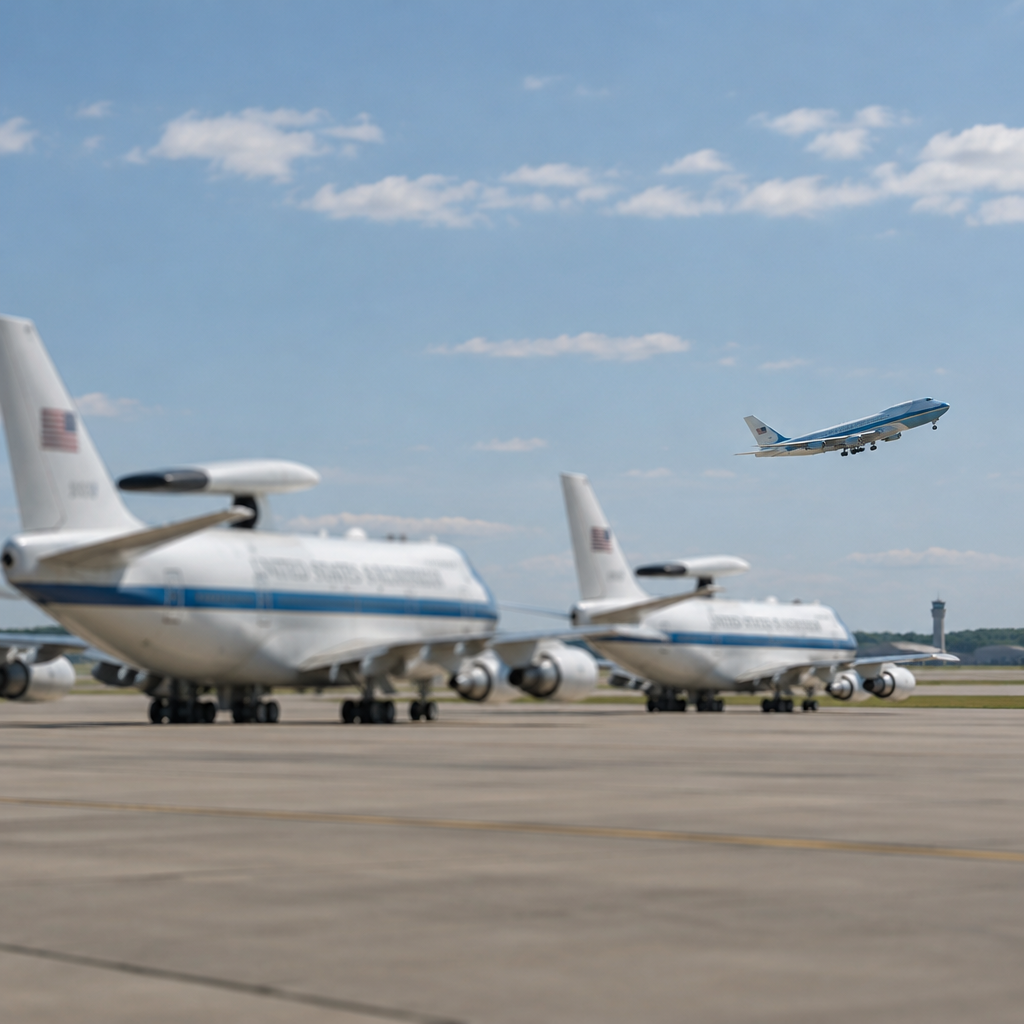
The Air Force currently operates four E-4B Nightwatch jets — National Airborne Operations Centers — all based at Offutt Air Force Base in Nebraska.
E-4B Nightwatch fleet at Offutt Air Force Base
TWZ reports that the Air Force’s E-4B fleet consists of four Boeing 747-200–based aircraft, all stationed at Offutt Air Force Base. Three entered service in the 1970s as E-4A Advanced Airborne Command Posts and were upgraded in the 1980s to the E-4B NAOC standard; a fourth entered service already configured as an E-4B. The jets have been continuously upgraded over the years and remain a unique, low‑visibility part of presidential travel logistics.
How an E-4B shadows Air Force One — recent movements to Kadena and Manila
During President Donald Trump’s November 2026 trip to the Philippines and China, flight trackers observed the E-4B operating separately from the VC-25s that carried the president. The VC-25s departed Andrews Air Force Base on November 16, and plane‑spotters captured all three VC-25s parked together at Ninoy Aquino International Airport in Manila. An E-4B left Offutt at about the same time, was tracked to Kadena Air Base on Okinawa, and then climbed to shadow the VC-25s as they flew over Japan on the return leg. TWZ notes this pattern — forward‑deploying an E-4B to a nearby friendly airfield and then keeping a deliberate distance from Air Force One — is standard operating procedure for overseas presidential travel.

This site is the portfolio.
OSINTSights runs on Cloudflare Workers, D1, R2, and Vectorize, with an AI pipeline on Hetzner ARM. Nubivance designed, built, and operates it. We do the same for clients.
See what we buildCapabilities: hardened communications, airborne endurance, and continuity of government
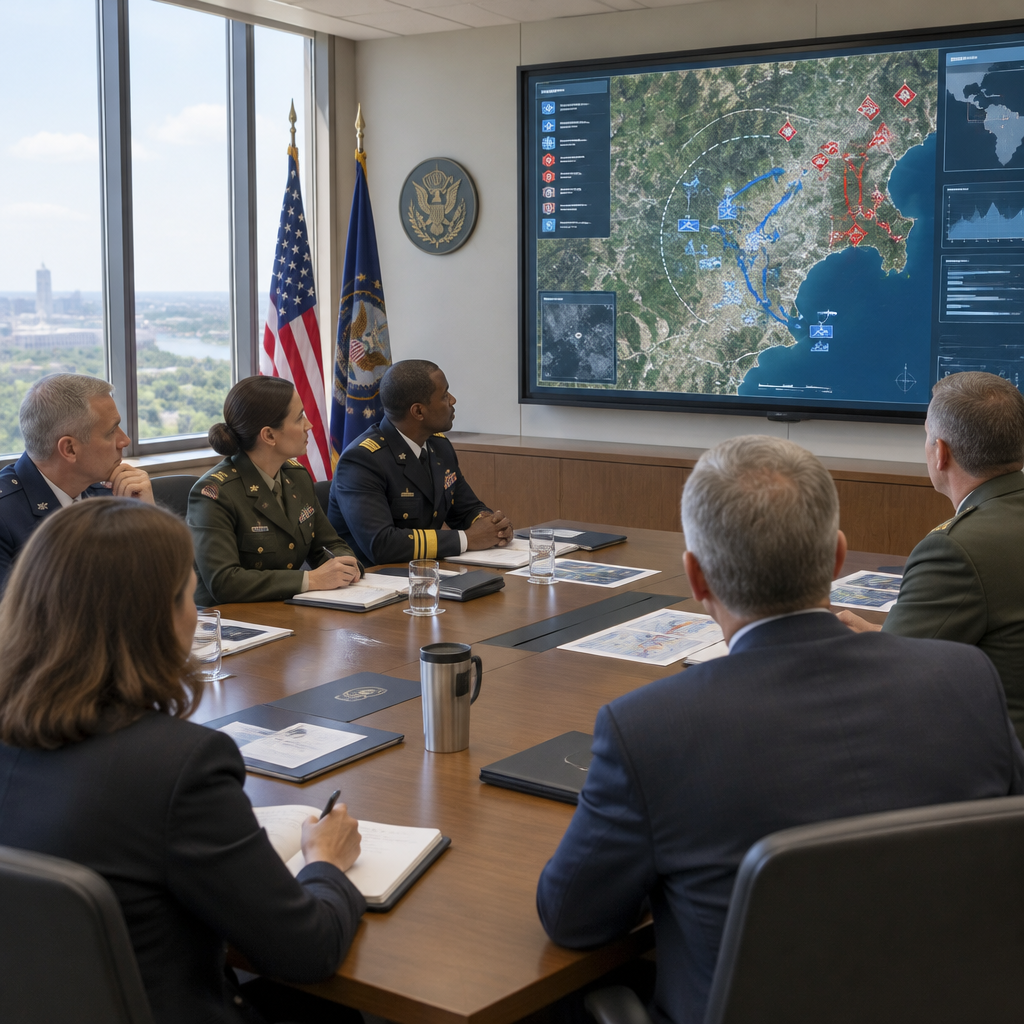
The E-4B is configured as an airborne command post: hardened against electromagnetic pulses from nuclear detonations, capable of remaining aloft for days, and equipped to provide the president and senior military leaders with a flying headquarters. TWZ describes the E-4B’s role as a critical component underpinning the National Command Authority and continuity of government plans; an E-4B is kept on alert to support those responsibilities. The platform has been used historically in high‑pressure moments — for example, TWZ recounts that on September 11, 2001 an E-4B (callsign ADDIS77) was scrambled from Andrews and orbited over Washington, D.C., ready to act as a secure, survivable node for command and succession if needed.
VC-25B Bridge versus VC-25A: refueling and operational trade-offs
TWZ highlights a concrete operational difference that surfaced during the November trip: the new VC-25B “Bridge” lacks aerial refueling capability, while the older VC-25As and the E-4Bs can be refueled in flight. Two fully outfitted VC-25Bs still being converted for the Air Force reportedly will also not be capable of in‑flight refueling. The stated rationale is that the VC-25Bs, based on 747‑8i airframes with more efficient engines, can fly longer unrefueled ranges. Nevertheless, TWZ points out that in‑flight refueling allows aircraft like the VC-25A and E-4B to remain aloft for days — a capability that can be decisive if secure airfields are unavailable during a prolonged crisis. The E-4B’s in‑flight refueling capability therefore remains a key operational advantage in continuity and survivability scenarios.
What this means for the Secretary of Defense, FEMA, and host bases like Kadena
- Secretary of Defense: TWZ notes that E-4Bs regularly transport the Secretary of Defense (referred to in the report as “the Secretary of War”) and staff during overseas trips, offering a hardened command node and an aviation option beyond the VC-25 fleet.
- FEMA and domestic emergency response: The E-4B’s capabilities can be made available to assist the Federal Emergency Management Agency during major natural disasters, serving as a command post and communications relay when ground infrastructure is impaired.
- Host bases (Kadena, Ninoy Aquino, Andrews): TWZ’s coverage underscores how host-nation and regional basing choices matter operationally — the E-4B will typically bed down at a different nearby airport (for example, Kadena during the November trip) and maintain separation by dozens of miles from Air Force One to balance access for Marine One with security and survivability requirements.
Taken together, these facts make plain why a low‑profile 747 like the E-4B routinely appears in the background whenever a president travels overseas: it is part of a layered, longstanding system that preserves command continuity, offers refuge and escape options, and supplements the Air Force One fleet where the Bridge’s configuration creates new operational trade‑offs. TWZ reports that the Bridge carried the president to China and that reporters onboard had their phones confiscated on the return flight; Fox News has reported the president was aiming to set a record for the longest continuous Air Force One flight. TWZ also notes it is unclear how the Bridge’s configuration has changed during recent months and that, at the time of writing, the E-4B was last tracked continuing to shadow behind Air Force One.
Original TWZ report: https://www.twz.com/news-features/why-the-e-4b-doomsday-plane-always-shadows-air-force-one-when-the-president-travels-abroad