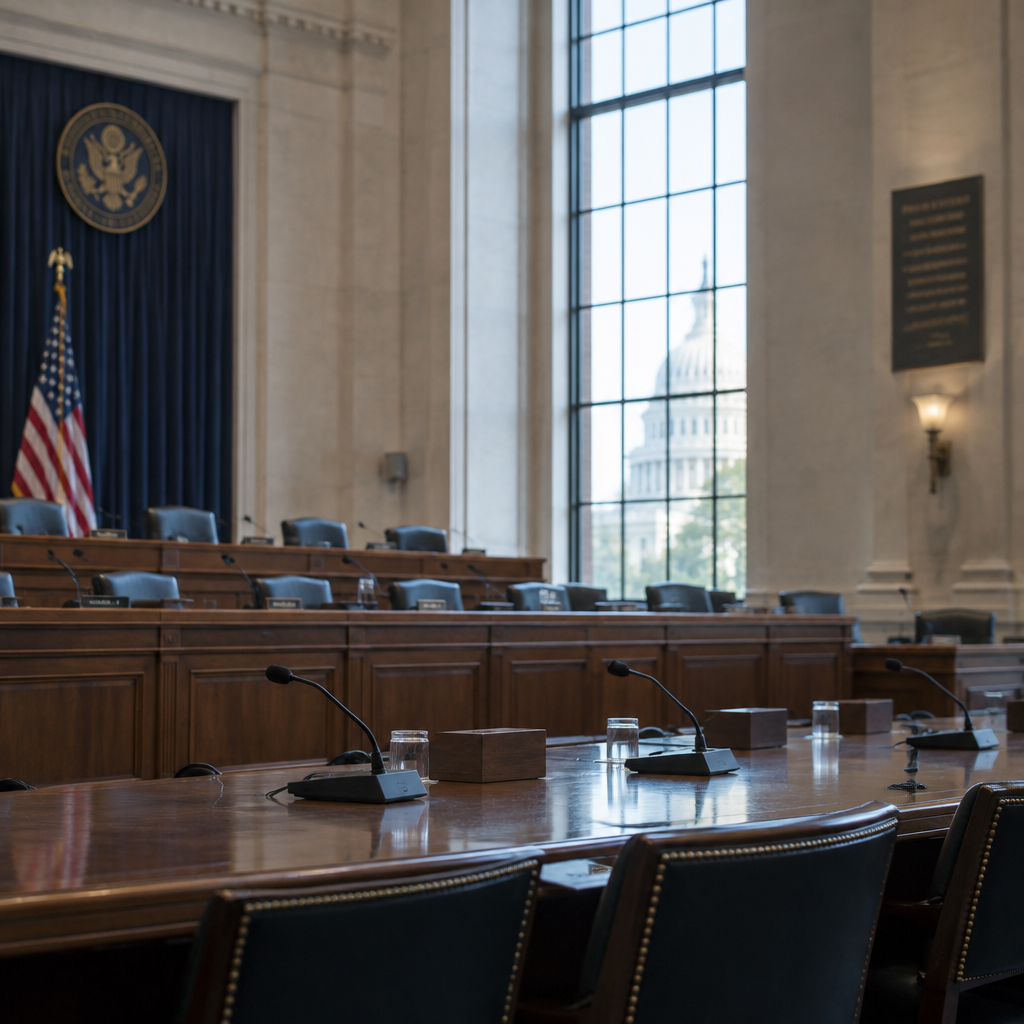
"We will investigate the administration weaponizing DHS against Americans, its out of control immigration policies, and its blatantly corrupt self-dealing," Rep. Bennie Thompson declared to Nextgov/FCW.
Rep. Bennie Thompson’s House Homeland Security agenda
With Democrats set to control both chambers in January, Rep. Bennie Thompson, D-Miss., said his incoming House Homeland Security Committee will mount broad oversight of the Department of Homeland Security. Thompson named immigration enforcement, the department’s use of its authorities against Americans, surveillance of Americans engaged in protected speech, treatment of whistleblowers, and whether federal officials steered contracts to political allies as explicit targets for investigation.
On cybersecurity specifically, Thompson and Rep. Delia Ramirez, D-Ill.—positioned to chair the Homeland Security cyber subcommittee—have already asked the congressional watchdog to assess the impact of staffing cuts at the Cybersecurity and Infrastructure Security Agency (CISA). Lawmakers will examine how DHS is preparing for attacks aided by artificial intelligence and what became of services the department scaled back.
CISA’s workforce losses and rehiring effort
The reporting states CISA lost roughly a third of its workforce after Trump retook office. Acting Director Nick Andersen told reporters that by September about 250 prospective hires had tentative offers but were waiting for security clearances, part of an effort under DHS Secretary Markwayne Mullin to recant some of the cuts made to the cyberdefense agency over the last two years.
Rep. Delia Ramirez gave positive feedback on CISA’s rehiring plans but said they may not be enough. After the election she posted on X a message directed at Secretary Markwayne Mullin, White House aide Stephen Miller and others involved in immigration enforcement: “Clear your schedule.”

Audit-ready is a season. It shouldn't be.
Evidence in spreadsheets, controls drifting between audits, frameworks multiplying on flat headcount. Nubivance runs continuous compliance on Rapid7 Cyber GRC - SOC 2, HIPAA, ISO 27001, PCI, CMMC.
End the scrambleSenate oversight: Maggie Hassan, record preservation, and security lapses
Senate Democrats will control confirmation hearings and records requests in their chamber. Sen. Maggie Hassan, D-N.H., moves up in seniority among Democrats on the Homeland Security and Governmental Affairs Committee after Michigan Democrat Gary Peters’ retirement; Hassan and Peters have already asked DHS to preserve records belonging to former Secretary Kristi Noem and her adviser Corey Lewandowski.
Hassan has also pressed CISA on its security practices after reports that a contractor left agency account information and passwords in a public database—an episode cited as a prompt for further inquiry. Separately, a law protecting companies from lawsuits when they share information about cyber threats is operating under a temporary extension through Dec. 11, creating an early policy item that could land in the laps of incoming committee chairs if no longer-term renewal is passed.
Intelligence committees: Himes, Warner, and clashes over analytic independence
Rep. Jim Himes, D-Conn., and Sen. Mark Warner, D-Va., are positioned to lead the intelligence panels after two years of disputes over whether intelligence agencies can deliver findings that contradict the president without putting analysts’ jobs at risk. The article highlights several flashpoints.
- Most U.S. intelligence agencies assessed that Venezuela’s Tren de Aragua was not operating at the direction of Nicolás Maduro’s government; then-Director of National Intelligence Tulsi Gabbard subsequently fired two leaders of the National Intelligence Council, which produced the assessment.
- Warner challenged Gabbard over Iran during a March hearing, focusing on a passage in her written testimony saying Iran had made no effort to rebuild its uranium enrichment capability after U.S. strikes the previous June—an assessment that bore on presidential claims about imminent threat.
- Joe Kent, Trump’s director of the National Counterterrorism Center, resigned over the war, saying he did not believe Iran posed such a threat; and the Defense Intelligence Agency’s preliminary assessment last June suggested U.S. strikes might have set Iran’s program back only a few months. In August, Defense Secretary Pete Hegseth fired DIA Director Lt. Gen. Jeffrey Kruse without explanation; Warner said the administration was “treating intelligence as a loyalty test.”
Himes has already signaled a records-and-testimony probe into donations to the White House ballroom, alerting an association of intelligence contractors in September and seeking who solicited contributions and whether companies believed payments would help secure government work or access. The intelligence panels also face a decision about Section 702 FISA authorities: the program expired in June, with certain collection procedures allowed to continue through this spring under court approvals issued in March.
Armed Services oversight: Adam Smith, Jack Reed, and cyber posture
Rep. Adam Smith, D-Wash., and Sen. Jack Reed, D-R.I., are set to lead the Armed Services committees, which write the annual defense policy bill. Smith told The Washington Post he plans to investigate military operations, politicization of the armed forces, and possible corruption in defense contracting. Both lawmakers challenged the administration over the firing of Gen. Timothy Haugh, who led the National Security Agency and U.S. Cyber Command.
Much of detailed oversight of military hacking and network defense would fall to Rep. Ro Khanna, D-Calif., and Sen. Jacky Rosen, D-Nev., if they become committee chairs. Khanna is the top Democrat on the House Armed Services cyber subcommittee, which also oversees Pentagon software purchases and AI programs; Rosen is his counterpart on the Senate cybersecurity subcommittee. A major Defense Department Cyber Strategy that was planned for release in September remains, the reporting says, “sitting in limbo.”
What this means for CISA staff, federal contractors, and private companies sharing threat data
- CISA staff will have congressional attention on staffing levels and hiring back positions that were cut; the agency’s reported loss of roughly a third of its workforce and the 250 hires waiting on clearances are concrete items lawmakers will review.
- Federal contractors can expect subpoenas or record requests: lawmakers have already sought preservation of records tied to senior aides and signaled scrutiny of whether contracts were steered to political allies, and at least one contractor’s operational lapse prompted questioning of CISA’s own security practices.
- Private companies that share cyber-threat information face policy uncertainty: the temporary extension of liability protections through Dec. 11 and Morgan Adamski’s caution that “greater oversight doesn't necessarily mean immediate legislative or regulatory change” together signal a period of continuing uncertainty about the rules that govern public–private cyber information sharing.
Congressional control by one party gives that party authority over who testifies, what documents are sought, and which nominees face confirmation scrutiny. The reporting leaves several concrete near-term hinge points: the Dec. 11 extension of liability protections for cyber information sharing, the fate of a permanent CISA director or a nominee for the National Counterterrorism Center, and whether the intelligence panels will seek new fixes or defenses for analysts whose findings clash with the White House. Each of those items now sits on the incoming Democratic majority's desk.