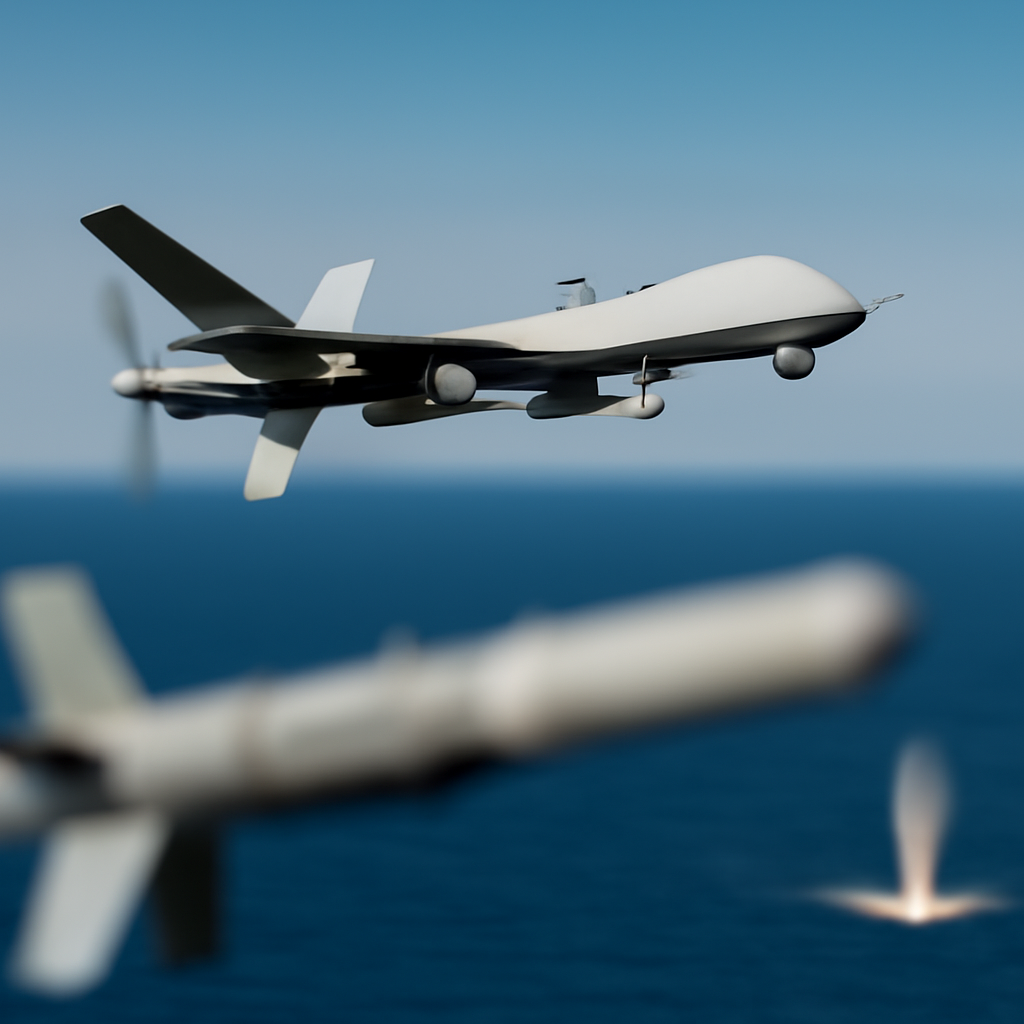
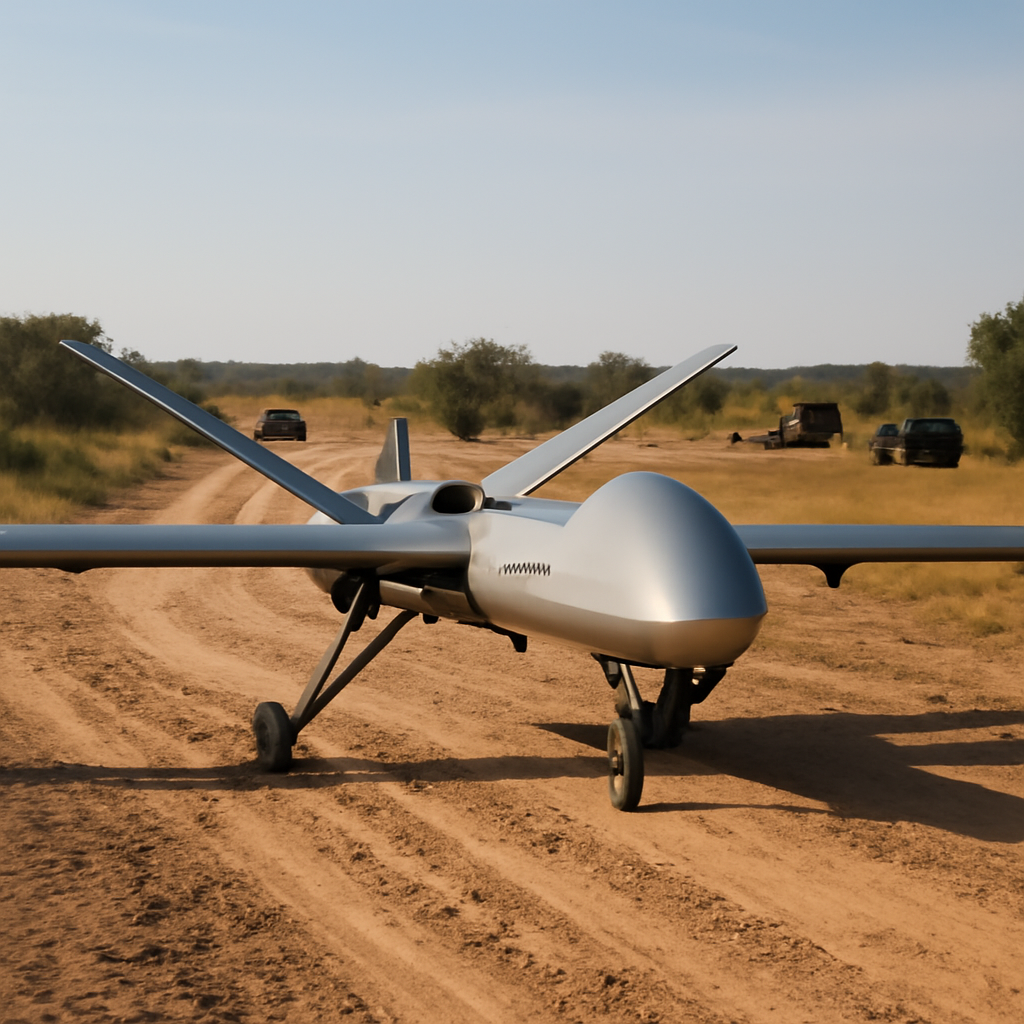
"There's a lot of interest in battery-operated, electric-driven drones…but there's also a lot of interest in heavy, fuel-based drones," Greg Thompson, president of Survice Engineering, told reporters — and his company is banking on that middle path.
Survice Engineering’s hybrid drone push: timing and capabilities
Survice Engineering has spent the past year developing a hybrid-powered drone it intends to demonstrate to defense customers later this year, company leaders said. Thompson described a product suite that will include electric-only, fuel-based hybrid, and fuel-only drones in the Group 3 and above category, and said the firm is aiming for "maybe late summer, early fall timeframe" to show at least a concept to customers.
Survice is positioning the hybrid as a bridge between battery and jet technologies: the hybrid "gen set" is described as part of what’s next, and the company is also working on a higher-level platform capable of lifting "hundreds of pounds" to enable missions such as casualty evacuation and larger payloads. Thompson and the company highlight operational advantages they expect from hybrid propulsion — quieter operation and longer range compared with gas-only systems — and they note hybrids as an alternative to battery-only drones that can lose capacity across temperature ranges.
Michael Robbins and AUVSI: why hybrid fits Indo-Pacom requirements
Michael Robbins, president and CEO of the drone trade group AUVSI, said capital is increasingly flowing into hybrid propulsion research and development. Robbins framed the investment trend around operational demands in the Indo-Pacom region: "In the Indo-Pacom theater, range is always a challenge," he said, adding that aside from "very niche use cases like pre-positioned assets on Taiwan," most use cases "are going to not rely upon battery technology alone" and will involve either jet-powered systems or some form of hybrid propulsion.
Robbins also linked the shift to the changing user base for drones: commercial growth followed by constrained FAA operations meant range was not a primary design driver for early systems, but as "the Pentagon is getting very serious about drone acquisition and different use cases…there is a growing market for companies to enter into that space."

Audit-ready is a season. It shouldn't be.
Evidence in spreadsheets, controls drifting between audits, frameworks multiplying on flat headcount. Nubivance runs continuous compliance on Rapid7 Cyber GRC - SOC 2, HIPAA, ISO 27001, PCI, CMMC.
End the scrambleNavy and Marine Corps: a push to 40 amphibious ships and a longer OPTEMPO
The Navy and Marine Corps told the Senate Armed Services Committee they need at least 40 amphibious ships — a figure Navy officials call nine more than the statutory minimum — and achieving that level would take six years if funded. That requirement emerged from an internal Amphibious Forces Readiness Board report that Acting Navy Secretary Hung Cao recommended to the defense secretary.
Cao described the board’s preferred course of action as one that would extend the Optimized Fleet Response Plan up to 56 months "allowing us to have two work up cycles, two integrated training cycles, as well as two deployments for every ship," and said that would require 40 amphibious ships versus the present force level of 31. Adm. Daryl Caudle, chief of naval operations, testified that "Forty just makes a lot of sense" to sustain a persistent three-ARG readiness posture. Background context in the hearing noted that, according to the Government Accountability Office, just about half of the Navy’s 32 amphibious ships were in deployable shape as of 2024.
Budget figures cited in testimony and documents show a 2026 procurement budget for amphibs of about $4.6 billion, with a 2027 request of roughly $8.3 billion for two amphibious ships and six Medium Landing Ships (LSMs). The Navy’s latest 30-year shipbuilding plan forecasts $29.3 billion over the next five years for five LPDs, two LHAs, and 23 LSMs.
Armada’s Leviathan and Galleon modules: $230 million to scale mobile data centers
Armada, a maker of containerized mobile data centers, closed a $230 million Series B round and now carries a valuation around $2 billion, CEO Dan Wright told reporters. Wright framed the investment as an infrastructure play for AI: "First and foremost, it's a manufacturing and infrastructure production problem: we have to be able to deploy AI both domestically and with allies faster than our adversaries or potential adversaries."
The company plans to expand manufacturing at its Arizona facility and scale production of its largest offering, the Leviathan data center (configured with three shipping containers). Wright said Armada will begin with two Leviathan units per month and scale to six per month, and that the company is currently "producing dozens of Galleons a year" — Galleons being the company's ruggedized data center modules — with a goal to reach hundreds by the end of the year, then thousands the next year, and ultimately tens of thousands.
How drone developers, naval planners, and AI infrastructure buyers will respond
- Drone developers: Firms such as Survice should continue investing in mixed propulsion architectures — electric, hybrid, and fuel-only — and plan demonstrations in the near term to capture Pentagon procurement interest tied to extended-range mission sets in Indo-Pacom.
- Naval planners and Marines: The advocacy for 40 amphibious ships and an extended 56-month OPTEMPO will hinge on congressional funding decisions tied to the 2026–2027 procurement requests and the Navy’s five‑year shipbuilding plan for LPDs, LHAs, and LSMs.
- AI infrastructure buyers and allies: Armada’s funding round and production targets signal an intent to accelerate containerized AI-capable data centers; procurement officers and allied partners will monitor the company’s ramp from dozens to hundreds of modules within a year.
Each thread in this brief — hybrid propulsion as a middle path, a specific ship-count request tied to a longer readiness cycle, and a private-sector sprint to containerized AI data centers — carries a narrow next step that is already scheduled: Survice’s late-summer/early-fall demonstration window, congressional decisions on amphibious procurement funding, and Armada’s Arizona scale-up. Those milestones will reveal whether these plans move from technical promise and budget lines to fielded capability.