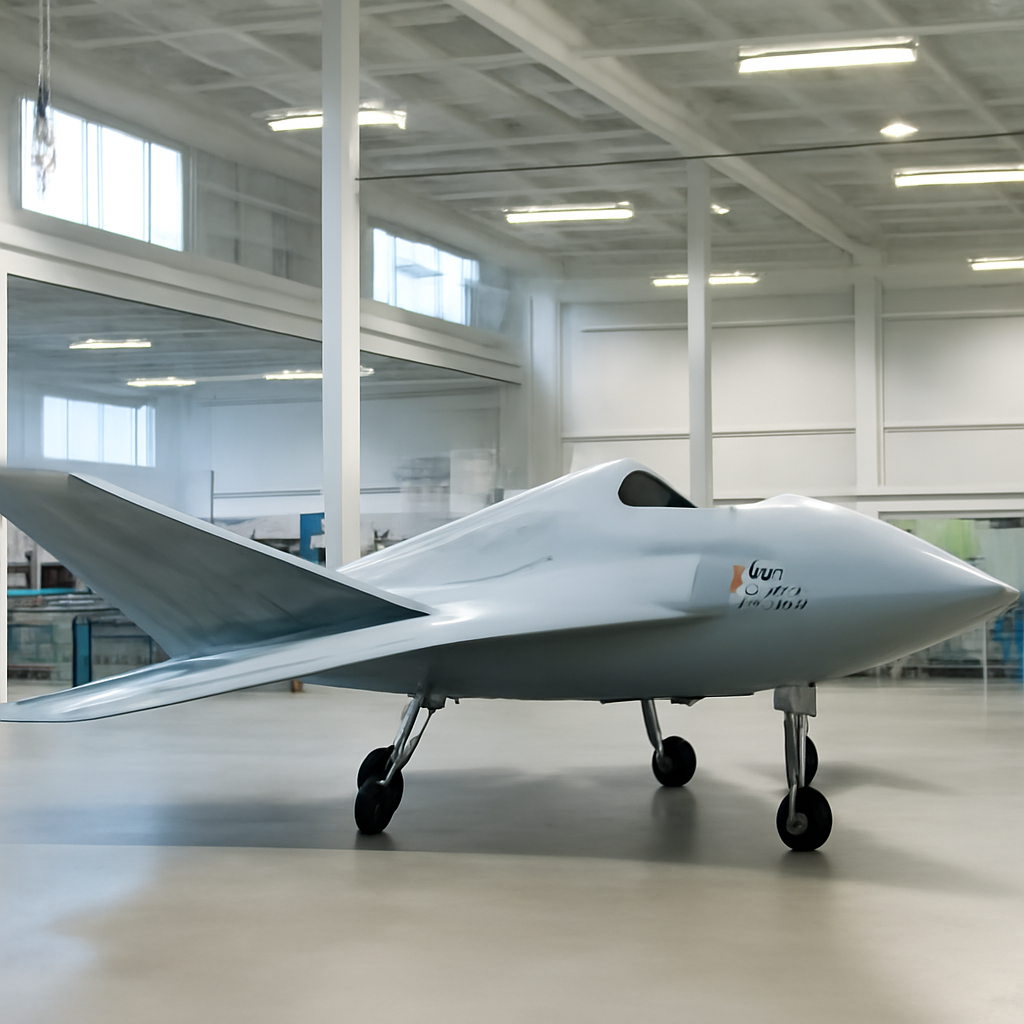
"The wings have arrived — the next big milestone for X‑65!" Aurora Flight Sciences wrote in a post on its official account on X today.
Aurora Flight Sciences and DARPA’s CRANE program
The X‑65 experimental drone is being developed under the Defense Advanced Research Projects Agency’s (DARPA) Control of Revolutionary Aircraft with Novel Effectors (CRANE) program, which kicked off in 2020. DARPA subsequently chose Aurora Flight Sciences, a subsidiary of Boeing, to proceed alone with the development of its design. Aurora moved into the latest phase of the program in 2024 and is now targeting a first flight next year.
Wings delivered: structure, planform, and what remains undisclosed
Aurora announced that the triangular wings were built at its West Virginia facility and that integration is underway in Virginia as teams push toward flight testing. The design uses a Co‑Planar Joined Wing (CJW) planform with two sets of wings that merge at the tips to form a triangular shape on each side; small extensions at the tips yield a 30‑foot wingspan. The X‑65 also features a twin vertical tail arrangement, a chin air intake under the forward fuselage, and a single exhaust. Aurora reported earlier progress in November 2025 on construction of the central fuselage and has conducted wind tunnel testing of subscale models and digital modeling in prior phases. The aircraft is said to have a gross weight of approximately 7,000 pounds. At the time of reporting, neither Aurora nor DARPA have disclosed details about the drone’s main propulsion arrangement.

This site is the portfolio.
OSINTSights runs on Cloudflare Workers, D1, R2, and Vectorize, with an AI pipeline on Hetzner ARM. Nubivance designed, built, and operates it. We do the same for clients.
See what we buildActive Flow Control (AFC): bursts of air instead of moving surfaces
The most novel feature of the X‑65 is its banks of active flow control (AFC) “effectors” that use bursts of highly pressurized air to produce roll, pitch and yaw moments instead of relying solely on conventional moving control surfaces. According to an Aurora press release, “The AFC system supplies pressurized air to fourteen AFC effectors embedded across all flying surfaces.”
DARPA has described the aircraft as dual‑equipped for risk reduction: “The X‑65 will be built with two sets of control actuators – traditional flaps and rudders as well as AFC effectors embedded across all the lifting surfaces,” a 2024 DARPA press release notes. That release and program comments explain successive tests will selectively lock down moving surfaces and use AFC effectors instead to measure comparative effectiveness.
Dr. Richard Wlezien, then the CRANE program manager at DARPA, put it succinctly: “The X‑65 conventional surfaces are like training wheels to help us understand how AFC can be used in place of traditional flaps and rudders.”
Testing approach, modularity, and prior experiments
Aurora says the triangular wing design enables active flow control testing across multiple wing sweeps and is “modular with replaceable outboard wings and swappable AFC effectors to allow for future testing of additional AFC designs.” The company and DARPA have described the platform as a test asset that can evolve through swapped components and successive trials. Wind tunnel models, subscale flights in earlier program work, and digital modeling have preceded the full‑scale build now under assembly.
The program is explicitly designed to compare performance with conventional control surfaces as a baseline and then to transition to AFC‑only control modes to gather data on control effectiveness, reliability and applicability to future airframes.
Delays, costs, and funding constraints
CRANE has experienced multiple delays and cost growth. The program originally aimed for a first flight in 2025 but was pushed back. Defense News reported in November 2025 that “The costs to produce the prototype aircraft for test flights ended up being higher than expected” and that DARPA chose to “strategically pause” the X‑65’s development to reevaluate. Aurora confirmed that technical and supply chain challenges, as well as the inherent riskiness of DARPA projects, were factors in those delays.
Pentagon budget documents show DARPA has received nearly $63 million in funding for CRANE since Fiscal Year 2024, when the program entered its third phase. DARPA is not requesting additional money for this effort in Fiscal Year 2027, a decision the agency says reflects the expectation that the effort will conclude by the end of next year.
How stealth designers, DARPA/Aurora test teams, and procurement managers will respond
- Stealth designers: The program’s emphasis on replacing moving control surfaces with AFC technology is being watched for its potential to reduce joints and gaps that can increase radar cross‑section; TWZ reporting noted AFC could be particularly significant for stealth designs.
- DARPA and Aurora test teams: The modular X‑65 is being built to allow sensors to monitor AFC performance against traditional controls, with successive tests locking down moving surfaces to isolate AFC behavior and to allow outboard wings and effectors to be swapped for follow‑on trials.
- Procurement and budget planners: The program’s earlier strategic pause, reported cost growth, and the fact that DARPA is not seeking additional Fiscal Year 2027 funds will inform how agencies weigh continued investment versus transition to follow‑on efforts using the X‑65 as a test asset.
With the wings now in place and integration under way in Virginia, the X‑65 is moving from models and wind‑tunnel work toward the flight regime the program has long aimed to reach. Whether the AFC effectors can replace moving surfaces in practice — and whether the data gathered will justify further investment by military or civilian programs — will be answered in the tests DARPA and Aurora plan to run as they push toward first flight next year.