“Launch-to-detection time in trials was less than a minute.” That concise metric — reported after a string of Defense Department field exercises — captures why a modular counter‑UAS architecture called Halo_Shield went from promising prototype to a demonstrably operational system over three events in 2025–2026.
T‑REX 25‑2 at Camp Atterbury: fielding passive fusion fast
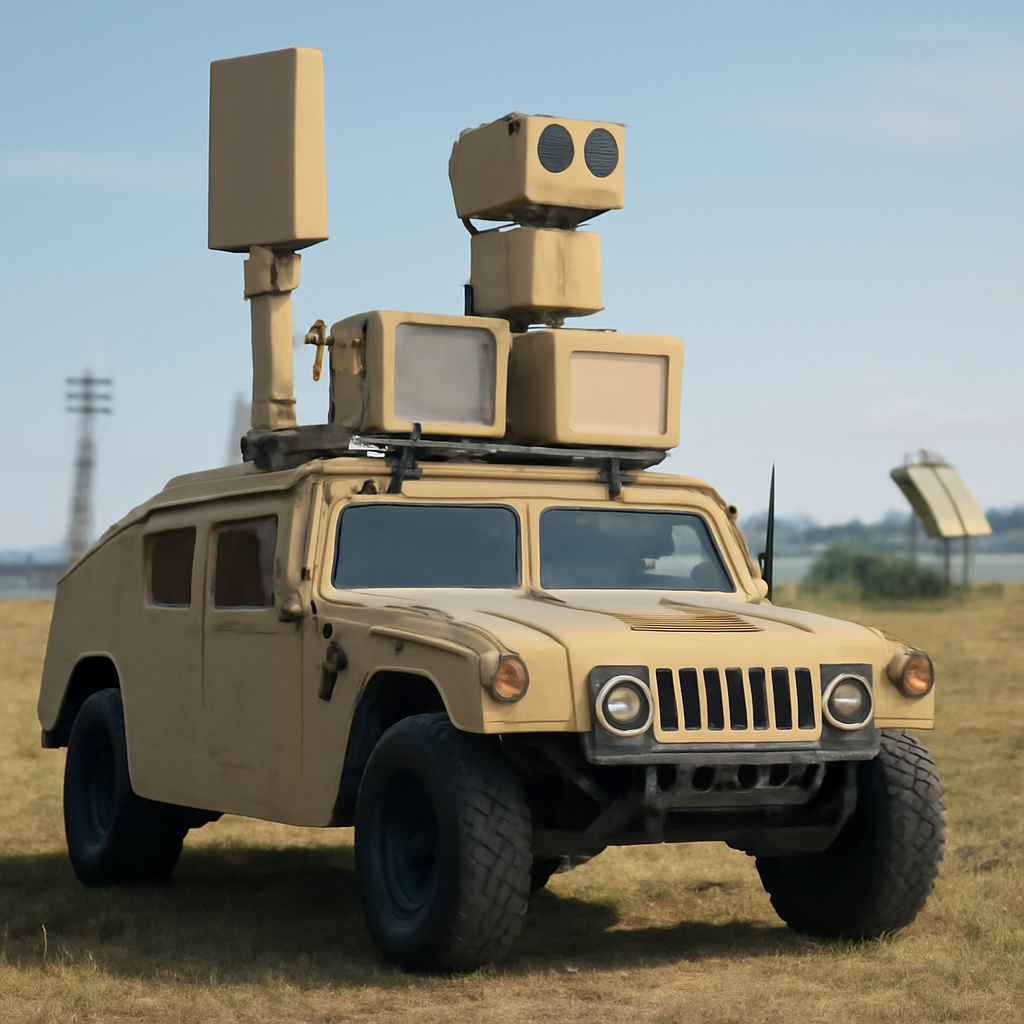
T‑REX 25‑2 was designed to test readiness for real‑world base defense. Run as a DoW and National Guard campaign with Task Force RAPTR, the event asked whether Halo_Shield could fuse passive sensors into a single common operating picture (COP), operate in contested environments, contribute to multilayer defense, and be produced and sustained realistically. Deployed as a vehicle‑mounted, multi‑server Terrestrial Tile, Halo_Shield fused acoustic and optical inputs from Walaris AirScout and Squarehead Discovair, passive RF from AV Titan SV, plus cooperative feeds into tracks displayed in the COP.
Key operational takeaways: the system achieved passive detection of small drones with fast visual confirmation and near‑100 percent uptime, could be powered and operational in about 15 minutes (with more complex configurations taking roughly another 15–20 minutes), and integrated the exercise’s OMNI messaging format to participate in Passive Multi‑Spectral Air Surveillance Kill Chains (PMASKC) and the Ninja Fusion/TRAX environment.
TWIX 2026 at Sumter, SC: proving interoperability and agility
TWIX 2026 gathered the U.S. Air Force, MITRE, DHS, the National Guard, and industry partners, with AV pre‑deploying Halo_Shield to validate deployment procedures, layered sensing, and standards‑aligned data sharing. The exercise showed Halo_Shield contributing to a broader C2 picture rather than operating in isolation: it provided central control of offensive and defensive tools, integrated acoustic, radar and RF sensors with health checks, and shared data securely using UDL and partner specifications.
Pre‑integration allowed full networking and operation on day one; remote nodes were repositioned and reconfigured with minimal downtime. TWIX also stressed human and system resilience — range outages, weather, and changing coordination demands forced rapid adaptation and surfaced actionable improvements such as making Halo_Shield more plug‑and‑play, reducing setup variability, improving tuning and fusion, and refining displays and user flows for new operators.

Audit-ready is a season. It shouldn't be.
Evidence in spreadsheets, controls drifting between audits, frameworks multiplying on flat headcount. Nubivance runs continuous compliance on Rapid7 Cyber GRC - SOC 2, HIPAA, ISO 27001, PCI, CMMC.
End the scrambleT‑REX 2026 at Grand Forks AFB: full kill‑chain and the LOCUST laser debut
T‑REX 2026 was the most demanding evaluation. AV integrated AV_Halo, Argus Perimeter Security, Titan RF C‑UAS, the LOCUST high‑energy laser (HEL), Squarehead acoustics, Axis EO/IR cameras, Walaris AirScout, and SRC Gryphon radars into an operational C‑UAS architecture. Across multiple vignettes, the team combined RF effects and HEL engagements against Group 1 and Group 2 UAS under real‑world network, safety, and operational constraints.
Measured timings were stark: launch‑to‑detection under one minute, and detection‑to‑identification plus cue‑to‑kill measured in only a few seconds each. Halo_Shield quickly defeated “easy” drones, achieved repeated kills against Group 2 platforms, neutralized a five‑ship swarm in short order, and even engaged a hovering UAS prior to its formal release. AV_Halo CORTEX and Puma ISR were used for left‑of‑launch detection by identifying potential launch sites and monitoring runway sectors.
A major milestone at Grand Forks was the first ever high‑energy laser firing at the base. Halo_Shield acted as C2 for LOCUST engagements — cueing from fused tracks, pairing weapons, scheduling assignments, and enabling commander confirmation under strict safety oversight. Notably, the exercise report says that historically laser firings had required external support; at T‑REX 2026, AV_Halo COMMAND performed that role directly.
Halo_Shield architecture: Tiles, passive‑first sensing, and modular C2
Halo_Shield is described as a modular, distributed counter‑UAS architecture that fuses passive and active sensor data and distills it into a coherent C2 picture via AV_Halo software. The system is installed as Tiles — resilient, integrated kill chains across domains that combine tactical effectors and sensors. Terrestrial and Sentinel tile operations were demonstrated in the exercises, and Celestial and Aerial Tiles were also tested live at Grand Forks. The concept emphasizes earlier detection, reduced risk versus single‑mode point defenses, rapid deployment, scalable architecture, and deep interoperability.
What this means for acquisition leaders, operators, and the National Guard
- Acquisition leaders: Halo_Shield is positioned in the report as a field‑proven, near‑term solution for integrated C‑UAS and airspace defense, with a modular path for sustainment and production supported by the T‑REX and TWIX data.
- Operators and C2 teams: the system’s short setup times, near‑continuous uptime, standards‑aligned messaging (OMNI, UDL), and layered sensor integration reduce time to detection and enable rapid engagement chains, including laser weapon employment under safety constraints.
- The National Guard and rapid response units: exercises run with Task Force RAPTR and pre‑integration lessons show Halo_Shield can be dropped into complex environments and reconfigured quickly, though TWIX highlighted the need for more plug‑and‑play behavior and simplified operator flows.
Across Camp Atterbury, Sumter, and Grand Forks, Halo_Shield was exercised from initial detection through cueing to kinetic and directed‑energy effects. The program moved from proving sensor fusion and uptime to demonstrating full kill‑chain performance and autonomous C2 responsibilities for HEL engagements. For those evaluating integrated C‑UAS options, the report concludes with an invitation to observe live operations at Grand Forks — an offer grounded in iterative, exercise‑based validation rather than laboratory claims.