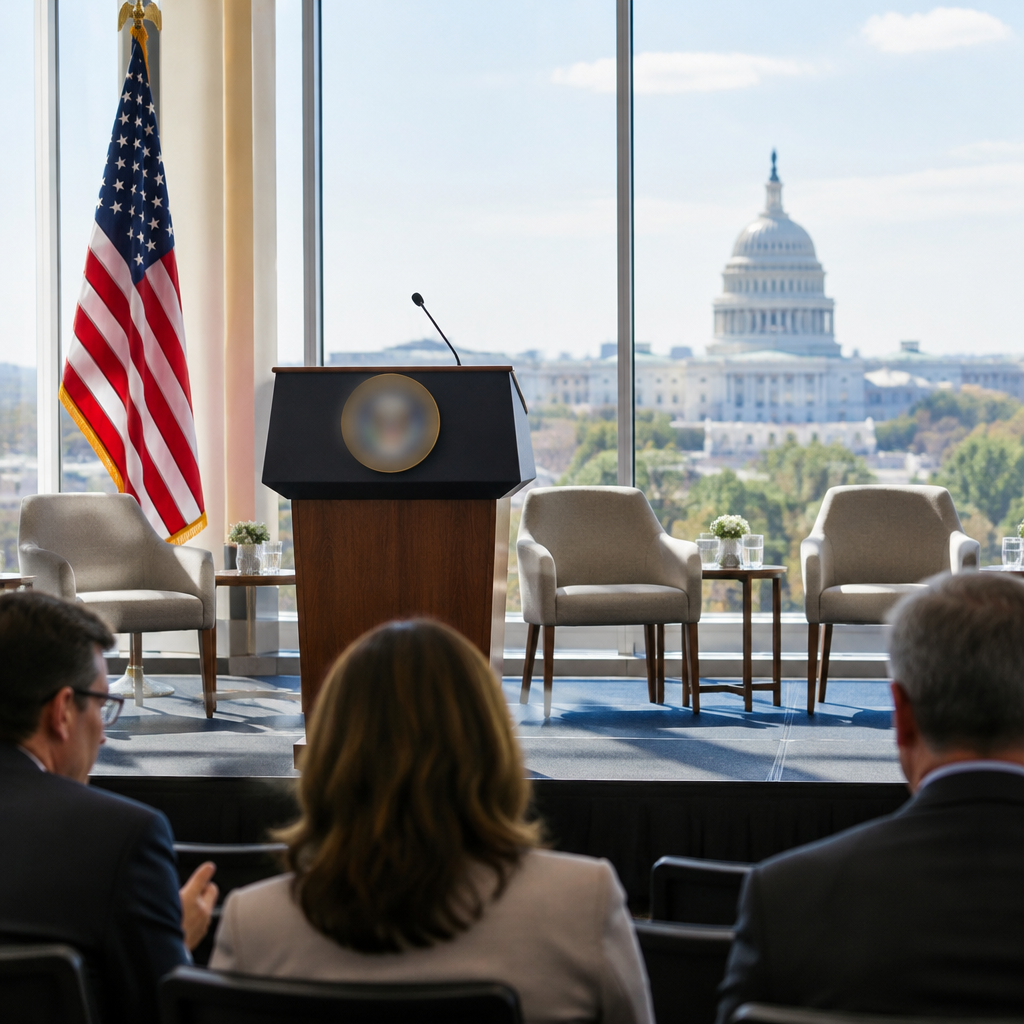
"What it looks like [is] we’re going to be able to get a reconciliation bill of some size, and by the way, $350 [billion] is not going to happen — you may have guessed that — but a reconciliation bill is still possible," Rep. Mike Rogers said at a Hudson Institute event on Nov. 19, 2026.
Rep. Mike Rogers frames the odds and his role
Rogers, the outgoing House Armed Services Committee chairman, told the audience he is not seeking a waiver to remain the top Republican on HASC. He quipped that a full $350 billion reconciliation vehicle tied to the fiscal 2027 defense request is unlikely, but he allowed that a smaller, "skinnied down" package could still be assembled. Two House Republicans — Rep. Trent Kelly of Mississippi and Rep. Ronny Jackson of Texas — are lobbying to succeed him as the committee's top GOP member.
Three fiscal pieces on a tight timetable
Lawmakers are juggling three separate budget items on a compressed calendar. The continuing resolution now funding the Pentagon runs out on Dec. 11. Democrats are set to take control of both chambers on Jan. 3. Meanwhile, the administration's FY27 defense request totals $1.5 trillion as presented to Congress: $1.15 trillion in the base budget and a proposed $350 billion in a reconciliation bill.
Separately, the government is holding an $87.6 billion supplemental request that includes $67.1 billion in defense funds tied to expenses associated with the war in Iran. Those three moving pieces — the base, reconciliation, and supplemental — could be combined or reshuffled in different ways in the coming weeks.

This site is the portfolio.
OSINTSights runs on Cloudflare Workers, D1, R2, and Vectorize, with an AI pipeline on Hetzner ARM. Nubivance designed, built, and operates it. We do the same for clients.
See what we buildAppropriations workarounds and competing spending figures
With reconciliation’s large items at risk, defense appropriators are reworking the base fiscal 2027 defense spending bill to absorb chief priorities. Rogers specifically cited attempts to find "alternatives" to move big-ticket reconciliation items such as Golden Dome and multi‑year munitions buys into the base budget.
There are competing drafts already on the table: Senate appropriators circulated a plan centered on roughly a $1.1 trillion spending bill, while the House Appropriations Committee released a $1 trillion defense spending bill earlier this summer. Neither draft has cleared its full chamber and both could change before any final action.
Reconciliation’s shrinking scope — and the policy debates inside the NDAA
Rogers said a pared-back reconciliation package would have to target “the hole in the defense budget that Venezuela and Iran have created,” fund munitions stockpiles, and address an FAA issue and an agriculture matter he did not detail. He suggested a possible reduction “from $350 [billion] down to $100 [billion] or somewhere in that nature,” saying that size would create “a path” for passage.
Members of the Senate had a closed-door briefing with Deputy Defense Secretary Steven Feinberg about the need for reconciliation; afterward, Republicans told Punchbowl News that a decision on whether to press a serious push for the defense portion of reconciliation could come shortly. Rogers also noted that reconciliation flows through authorizers sitting on the House and Senate Armed Services Committees — underscoring the role of those panels in any discharge of the proposal.
Separately, the FY27 National Defense Authorization Act — which traditionally sets defense policy and contains provisions ranging from troop pay raises to acquisition reform — has not yet passed. Rogers predicted that if the NDAA reaches President Donald Trump’s desk by Jan. 3, it would not include a green light for a proposed new Autonomous Warfare Command (AUTOWARCOM) pushed by Defense Secretary Pete Hegseth. “Autonomy is going to be here to stay, but it’s too premature to say that we need a command for that,” Rogers said. “I could be wrong… I mean, I’m one vote, but I have not seen it mature enough to to think that it’s going to happen this year.”
What this means for defense appropriators, the Senate Armed Services Committees, and the Pentagon
- Defense appropriators: They are actively revising the base FY27 bill to capture priorities that had been placed in reconciliation — notably multi‑year munitions buys and programs labeled "Golden Dome" — to avoid losing them if reconciliation fails.
- House and Senate Armed Services Committees: As authorizers, they will control the procedural route for any reconciliation defense dollars and also shape the NDAA language that could accept or stall proposals like AUTOWARCOM.
- The Pentagon: Senior Defense officials are pressing lawmakers for reconciliation funds, evidenced by a closed briefing with Deputy Secretary Steven Feinberg; the department will be watching whether munitions stockpile funding and other line items migrate into the base budget or are left for a stand‑alone reconciliation vehicle.
Rogers’ blunt assessment — that $350 billion is "not going to happen" but that a smaller reconciliation package might — crystallizes the arithmetic and political trade-offs ahead. With a funding cliff on Dec. 11 and a transfer of chamber control on Jan. 3, the immediate task is less an abstract policy fight than a compressed exercise in reallocating dollars and deciding which priorities to protect through the annual appropriations process, the NDAA, or a shrunken reconciliation bill.
https://breakingdefense.com/2026/11/350-billion-reconciliation-bill-not-going-to-happen-hasc-chair/