$500,000 apiece and at least 1,000 produced per year: those are the explicit cost and production targets the U.S. Air Force has set for its Counter-Air Missile Program (CAMP), an effort now moving from concept toward multiple prototype contracts.
Sierra Nevada Corporation and Specter Aerospace win a $124 million award
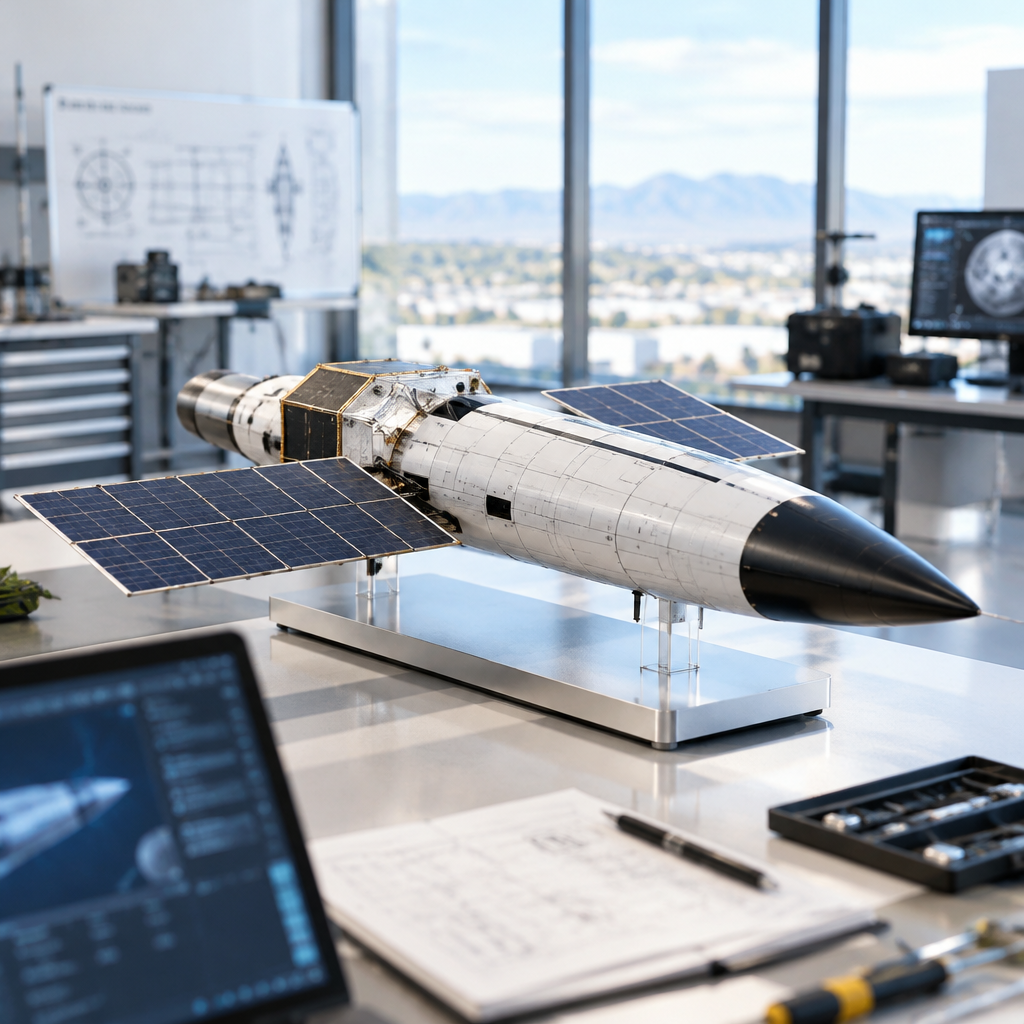
Sierra Nevada Corporation (SNC), in partnership with Specter Aerospace, announced a $124 million award from the Air Force to develop an anti-air missile under CAMP. SNC framed the effort as “designed to deliver a long-range offensive missile, capable of production at a fraction of the cost of legacy systems, while enabling the higher production volumes needed to restore affordable mass to the U.S. arsenal,” in its press release. Specter’s Chief Technology Officer, Arun Chundru, said the missile under development “will be able to reach supersonic speeds,” and described the work as reflective of Specter’s “vertically integrated approach to developing high-speed air-breathing weapons.”
The SNC–Specter announcement follows earlier public plans by the pair to develop a ramjet-powered Low-Cost Air-to-Air Missile (LCAAM); the company’s most recent release, however, does not explicitly include the previously released LCAAM rendering or name that design.
Castelion and Anduril pursuing interceptors and containerized launchers
Castelion disclosed that it received two separate CAMP contracts, covering work on an interceptor and on a launch pod to load those interceptors into a containerized launcher, and released a graphic alongside its announcement. Anduril Industries shared last week that it had secured a deal to develop a launcher in support of CAMP; a company tweet on November 16, 2026, noted the Air Force selected Anduril to develop the containerized launcher and showed internally funded Menace-based hardware and software.
Anduril’s press release described a launcher “that could integrate missiles from different companies and can operate across dispersed locations for extended periods with minimal personnel support,” and said the company is “incorporating manufacturing requirements into the design from the outset, including component selection, assembly, supply chain, testing, and tooling.” Anduril added that, if the Air Force selects the launcher for production, that work will “reduce production costs and allow us to rapidly scale deliveries.”

The cyber insurance questionnaire just landed. Now what?
SOC 2, HIPAA, insurance renewals - someone has to own security strategy. Nubivance provides fractional CISO leadership without the full-time salary.
Get a security leadCAMP’s spelled-out trades: cost, producibility, and the M‑Series modular approach
The Air Force’s contracting notice — and subsequent program descriptions — emphasize tradeoffs between “performance, affordability, modularity, and producibility.” The program’s All-Up Round (AUR) cost goal is “below $500K, at a production quantity of at least 1,000 units,” and the government stated desire to deliver quantities of “1,000–3,500 per year in full rate production.”
The program adopts the Modular Weapon M‑Series approach, which stresses open architecture, use of digital design tools, and U.S. ownership of data rights to ease future upgrades and foster competitive markets beyond the original manufacturer. The Air Force has also characterized the initial phase as ground-launch risk reduction to mature missile designs and accelerate evaluation for potential future air-to-air derivatives.
How CAMP connects to ERAM, FAMM, ETV and the broader missile landscape
CAMP is described in Air Force materials as an offshoot of a “family” of lower-cost, producible missile efforts that have focused primarily on cruise munitions — notably the Extended Range Attack Munition (ERAM) program and the Family of Affordable Mass Missiles (FAMM). ERAM munitions have already been provided to Ukraine, the public record says.
The Air Force has framed a ground-launched CAMP prototype as a new class of Enterprise Test Vehicle (ETV), a term used to describe “air vehicles” that blur lines among cruise missiles, long-range one-way attack drones, and decoys. TWZ’s prior reporting cited comparisons across existing systems: the latest AIM-9X Sidewinder unit costs are “around $500,000,” short-range interceptors such as Raytheon’s Coyote Block 2 and APKWS II‑based approaches occupy a lower-cost, drone-focused niche, while Patriot-class interceptors sit at the far higher end of the cost and capability spectrum.
What this means for the Air Force, the U.S. Army, and industry partners
- The Air Force: CAMP advances the service’s push to expand its organic ground-based air defenses and to field containerized, mobile launch options that can be rapidly moved by truck, rail, cargo aircraft, and ships. Ground-launched prototypes are intended to shorten the path to evaluation and to create a base for a formal Program of Record.
- The U.S. Army: Historically responsible for ground-based air defense, the Army remains the service that has provided many such systems; the program notes that ERAM and other lower-cost efforts could produce capabilities that flow to other services, implying cross-service uptake is possible.
- Industry partners (SNC, Specter, Castelion, Anduril): contractors are being asked to prioritize manufacturability, modular open architectures, and control of technical data rights. Anduril in particular is designing for launcher interoperability and low-personnel operation, while SNC and Specter are advancing high-speed, air‑breathing propulsion approaches.
Multiple prototype contracts now in hand mean the clearest near-term metric for CAMP will be what the initial ground‑launched demonstrations deliver over the roughly ten‑month initial phase described in recent program statements. From the facts released so far, the program’s central tension remains explicit: can interceptors that reach supersonic speeds and meet useful performance envelopes be manufactured at or below the $500,000 AUR target and produced at scale? The answers that emerge from the upcoming demonstrations will determine whether CAMP becomes a single Program of Record or a family of competitively sourced weapons and launchers.