"We did this in a time when we’re reducing flag and general officers and looking for ways to streamline," Acting Secretary of the Navy Hung Cao said in October, "But this is so important that we move the flag officer up here in order to focus on two critical weapon systems that will bring capability to our ships and aircraft."
Rear Adm. Patrick Finney: the first leader at Crane
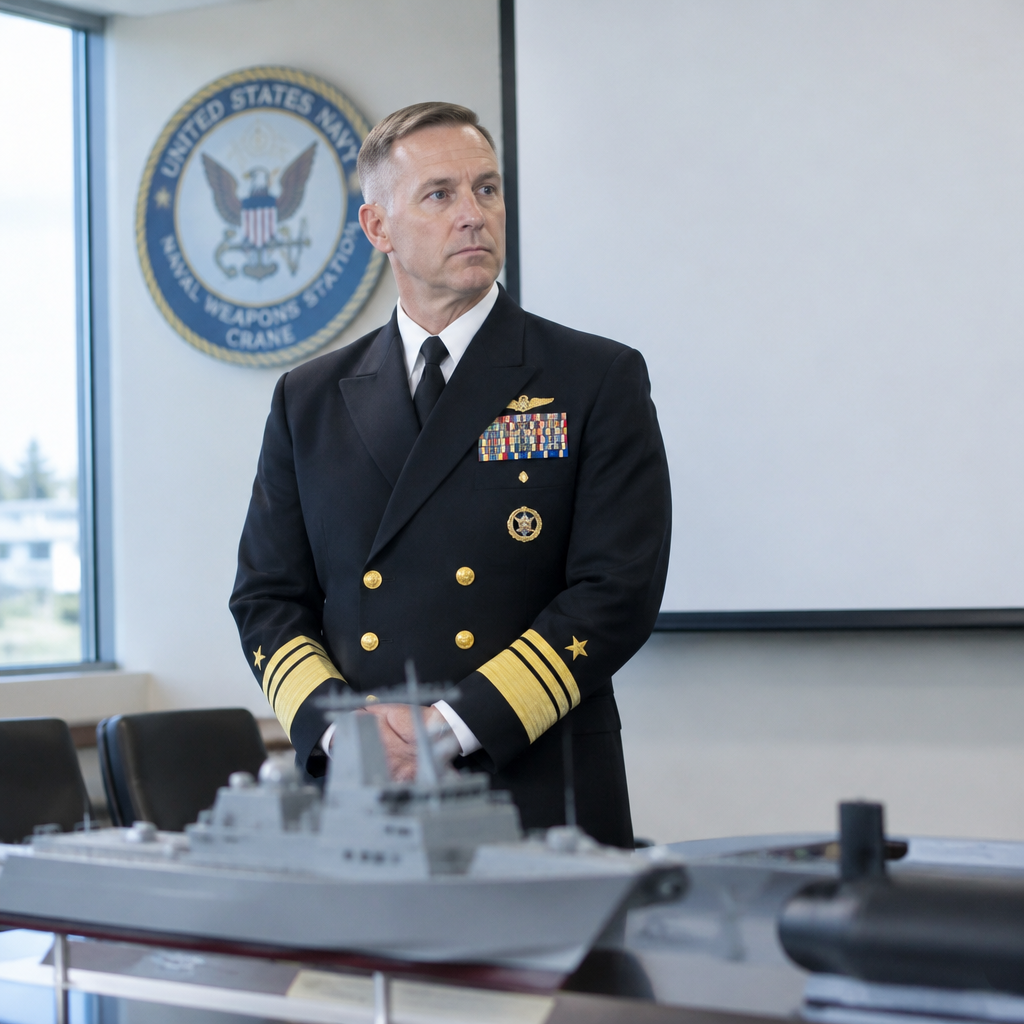
The Navy has selected Rear Adm. Patrick Finney to lead a new program management office based at Naval Weapons Station Crane in Indiana, charged with advancing integration of two weapons efforts onto surface ships and submarines. Finney is the first person named to the post and reports to Vice Adm. Douglas Williams, the director of Portfolio Acquisition Executive Strategic Systems Programs. Sen. Jim Banks, R-Ind., publicly identified Finney during a Senate Armed Services Committee hearing, noting Finney had arrived at his post in October. The Navy did not issue a formal announcement when Banks spoke.
Finney’s official Navy biography lists prior service aboard the Los Angeles-class submarines Atlanta and Dallas, tours with Submarine Group 10 and Fleet Forces Command, command of the submarine tender Emory S. Land, and commands of units assigned to US European Command and Submarine Force Atlantic.
Mission focus: integrate SLCM-N and Conventional Prompt Strike (CPS)
The new office’s explicit task is to advance the integration of the Nuclear Sea Launched Cruise Missile (SLCM-N) and the hypersonic Conventional Prompt Strike (CPS) weapons systems onto surface vessels and submarines. Crane hosts a hypersonics research, development, test and evaluation facility, which factored into the decision to base the program management office there; Sen. Banks had earlier announced the creation of a one-star admiral position in his home state to support those efforts.

Audit-ready is a season. It shouldn't be.
Evidence in spreadsheets, controls drifting between audits, frameworks multiplying on flat headcount. Nubivance runs continuous compliance on Rapid7 Cyber GRC - SOC 2, HIPAA, ISO 27001, PCI, CMMC.
End the scramblePlatforms, joint development, and program interlock
The Navy is modifying its Zumwalt-class destroyers with a vertical launch system to accommodate CPS missiles and plans to equip some Virginia-class submarines with the system as well. CPS is being developed jointly with the Army, which is pursuing a ground-launched variant of the weapon under the Long-Range Hypersonic Weapon program, also known as Dark Eagle. The SLCM-N program officially launched in 2025 with plans to deploy the missile aboard Virginia-class submarines and the proposed Trump-class battleship.
Funding, timelines, and risk as reported by the GAO
Both services are seeking substantial investment in hypersonics work: a Government Accountability Office report from July said the Army and Navy are seeking to pour more than $50 billion into the hypersonic effort. A separate GAO report released in July placed the SLCM-N program’s total acquisition cost at an estimated $15 billion to $20 billion and noted the Navy is targeting an initial operational capability by 2034 — a timeline that program officials acknowledged is "aggressive," according to the GAO.
How the Navy, the Army, and Congress are positioned
- The Navy: has placed a dedicated flag officer at Crane to centralize and accelerate integration work for SLCM-N and CPS and to leverage Crane’s hypersonics RDT&E facilities.
- The Army: remains a co-developer of CPS through its Long-Range Hypersonic Weapon/Dark Eagle effort and is pursuing a separate ground-launched variant, tying Army and Navy schedules and budgets together.
- Congress and local advocates: Sen. Jim Banks publicly flagged Finney’s assignment and earlier pushed for a one-star position in Indiana; Defense leadership — Secretary of Defense Pete Hegseth and Acting Secretary Cao — approved creation of the role despite broader Pentagon efforts to reduce flag officers.
The Navy’s decision to station a one-star admiral at Crane crystallizes a series of program choices: centralize hypersonics work where test and development infrastructure exists, marshal a senior officer to navigate complex ship and submarine integrations, and press ahead on timelines that GAO cautions are ambitious. The next concrete milestones will include the Zumwalt-class vertical launch modifications, selective outfitting of Virginia-class submarines, and the SLCM-N program’s march toward an initial operational capability by 2034 — a schedule the services and Congress will now have to defend, fund, and manage.