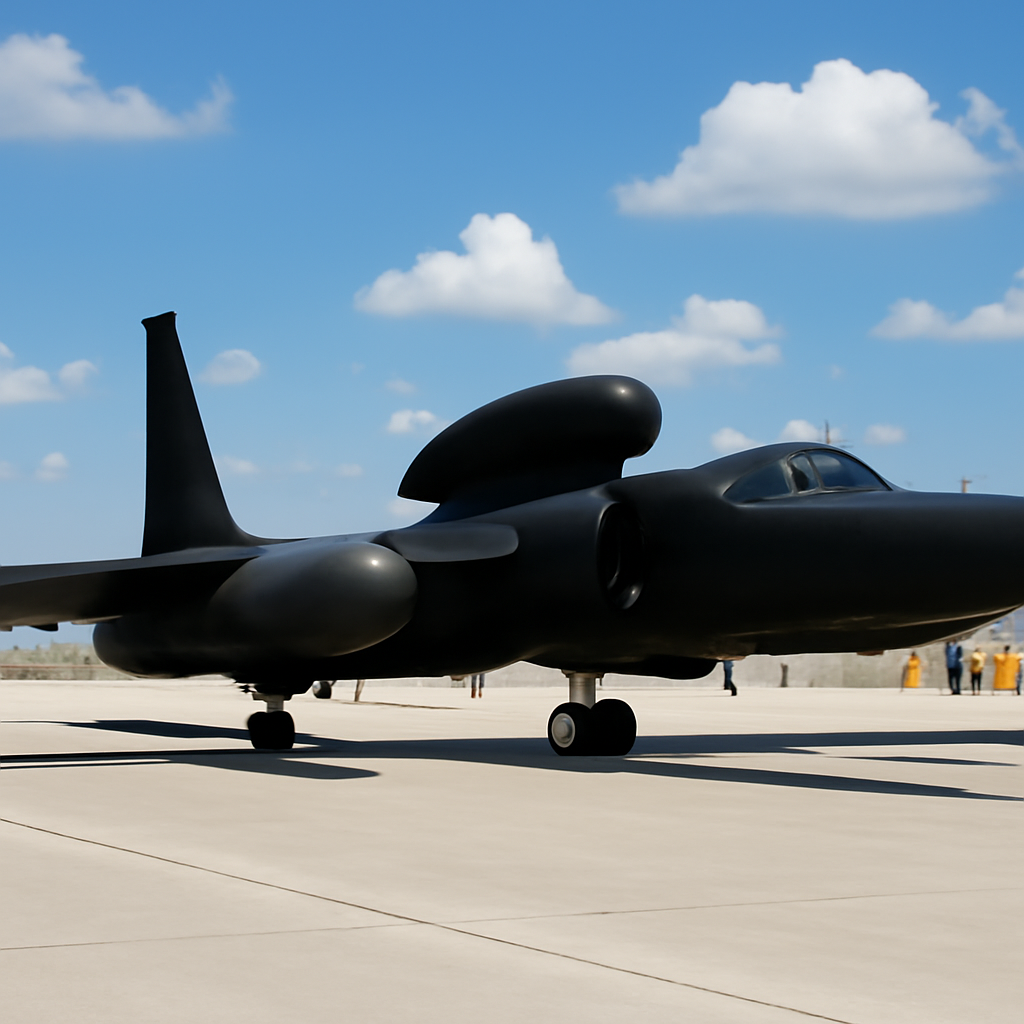
"The Air Force will retire the entire 23-ship U-2 fleet, as the platform is no longer viable for future high-end conflicts," the Pentagon's annual force structure report released in May says.
House Appropriations Committee draft bill would limit retirements and fund depot work
Yesterday the House Appropriations Committee released a draft defense spending bill for Fiscal Year 2027 that would prevent the Air Force from retiring more than two U-2S aircraft during that fiscal cycle. The same draft includes " $81 million for U-2 programmed depot maintenance to fully restore four aircraft," a provision described in the bill summary. Those items are embedded within $335.3 billion in total operation and maintenance (O&M) funding across the services that the draft would appropriate for FY2027.
The bill is still a draft. It must be finalized, reconciled with Senate legislation, passed by both chambers of Congress, and signed by the President before becoming law — a process the source notes contains "many opportunities" for change. Congress has repeatedly intervened in recent years to block the Air Force from fully divesting the U-2 fleet.
Air Force case for retiring the Dragon Lady
The Pentagon's force structure report sets out a concise rationale: continued U-2 operation "presents significant safety, logistical, and financial risks that outweigh the platform’s remaining utility in contested environments." The report adds that retirement would "allow for the strategic reallocation of fiscal resources to fund more critical, high-priority service requirements and accelerate modernization efforts in other key areas."
It also lists systemic sustainment problems: diminishing manufacturing capacity, material shortages, and safety risks inherent in an aging platform. Those concerns are echoed by the Air Force's FY2027 proposed budget, which the source says "completely zeroes out the line for U-2 O&M, to include depot maintenance," signaling the service's intent to retire the fleet unless Congress acts otherwise.

The cyber insurance questionnaire just landed. Now what?
SOC 2, HIPAA, insurance renewals - someone has to own security strategy. Nubivance provides fractional CISO leadership without the full-time salary.
Get a security leadWhat the U-2 still does — high-altitude ISR and flexible payloads
The U-2 retains capabilities that the source describes as unique among non-orbital platforms in U.S. service. The aircraft can fly higher than any other operational non-orbital platform, crewed or uncrewed, and can carry a wide array of imaging, signals intelligence, communications payloads, and other sensors simultaneously. From those altitudes, the U-2 can use slant angles to peer into denied areas while remaining in international airspace.
The source cites a high-profile example: the U-2 was used to gather intelligence about a Chinese spy balloon that traversed parts of the United States and Canada in 2023, flying above it to collect data. The Dragon Lady is also described as readily deployable to forward locations and capable of long-duration sorties, attributes that contrast with satellite constellations whose orbits restrict dwell time over a given area.
Outside combat tasks, the U-2 has supported enhanced southern border security missions, counter-narcotics operations, humanitarian assistance, and disaster relief. NASA operates a pair of ER-2 aircraft — another version of the Dragon Lady — for high-flying scientific research.
Complementary programs: classified drones and space-based surveillance
The Air Force and Department of Defense are pursuing alternatives the source links to the retirement argument. The story refers to a classified, stealthy high-altitude drone commonly and unofficially called the RQ-180 — a design "which first emerged publicly just earlier this year" and whose emergence in Greece was reported this spring. The source also says the U.S. military is pushing new space-based ground and air surveillance capabilities, noting the U.S. Space Force recently announced a target of 2028 for early fielding of at least some new space-based surveillance assets.
Those developments are presented in the source as the intended mix of capabilities to supplant the U-2 in contested environments: classified high-altitude drones and new on-orbit constellations. The source also cautions that questions remain about how many such drones or satellites will be operational and exactly when they will deliver persistent coverage.
What this means for Congress, the Air Force, and operational users
- Congress: By restricting retirements to no more than two U-2Ss in FY2027 and funding $81 million of depot maintenance to "fully restore" four aircraft, lawmakers are again preserving a high-altitude, crewed ISR capability while buying time for alternatives to mature.
- The Air Force: The service's FY2027 budgetary choice to zero out U-2 O&M reflects a push to divest the fleet and reallocate funds toward modernization — including classified drone programs and space-based surveillance — citing safety, sustainment, and survivability concerns.
- Operational users (border security, counter-narcotics, NASA): Continued congressional protection of the fleet would sustain an asset the source identifies as valuable for long-duration, high-altitude missions and for carrying diverse payloads useful in missions ranging from border security to scientific research.
The House draft would not end the debate; it begins another chapter. Lawmakers have again put Congress on a collision course with Air Force planners: $81 million to rebuild four aircraft sits alongside an Air Force budget that would eliminate U-2 O&M, while parallel investments in classified drones and new satellites are still maturing and targeted for initial fielding on timelines stretching into 2028. Which path — sustain and modernize the Dragon Lady now, or accelerate transition to stealthy drones and space systems — will ultimately determine whether the U-2 fleet continues to fly or its missions move aloft in other forms.