"The explosive-carrying drones are 'inexpensive, easy to acquire and useful for monitoring security forces and protecting illicit operations,'" Rebecca Bill Chavez told Breaking Defense.
Recent lethal drone strikes: Santa Rosa del Sur, Guapi River, La Jagua de Ibirico
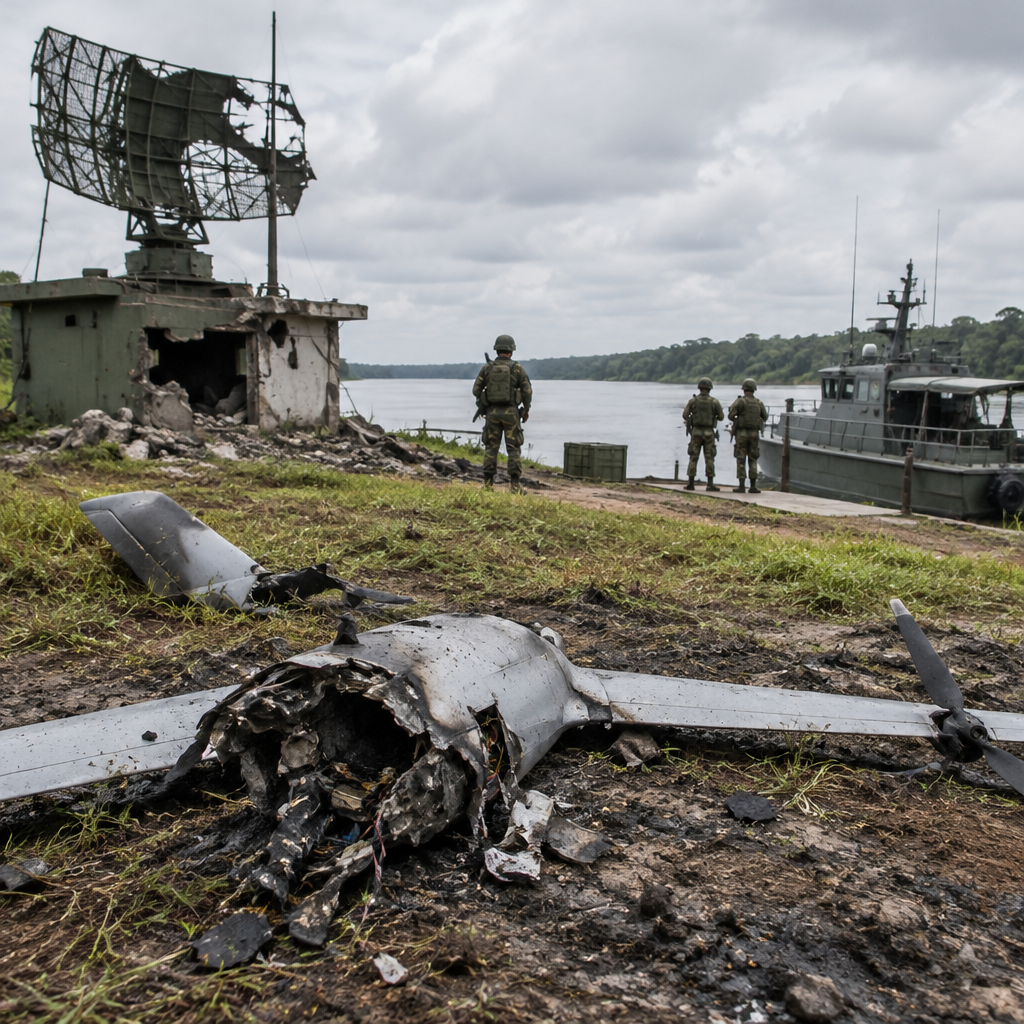
This month alone, Colombia has seen a string of deadly incidents involving small, explosive-carrying drones. Earlier in November drones flew over a military base in Santa Rosa del Sur, Bolívar department, dropping explosives that detonated and killed three soldiers. In October, a vessel assigned to Riverine Marine Battalion No. 42 was attacked on the Guapi River, killing one Marine and wounding four others. A September collision with what was reported as an explosive-laden drone damaged a civilian radar in Valle del Cauca. Most recently, on Saturday evening a battalion headquarters in La Jagua de Ibirico, César department, was struck by drones carrying explosives; one soldier died and at least 12 were wounded.
Militant tactics: from surveillance to coordinated multi-drone attacks
Experts quoted in the reporting describe an evolution in militant drone use. Small unmanned systems were initially tools for monitoring troop movements; operators now reportedly conduct coordinated attacks using multiple drones and, in some cases, systems employing fiber-optic guidance. The Colombian Ministry of Defense recovered a Clan del Golfo weapons cache that included one drone and 35 grenades "conditioned to be dropped by this [uncrewed] aircraft," evidence that armed groups are still investing in and preparing explosive-delivery systems.

This site is the portfolio.
OSINTSights runs on Cloudflare Workers, D1, R2, and Vectorize, with an AI pipeline on Hetzner ARM. Nubivance designed, built, and operates it. We do the same for clients.
See what we buildColombia's counter-drone tools and the intelligence gap
Colombia's armed forces already operate some counter-unmanned aerial system capabilities, and the Defense Ministry released images on Nov. 8 of soldiers in the Chocó department neutralizing a drone with jamming rifles to prevent grenades from being dropped on troops. Yet a retired Colombian colonel told Breaking Defense there is no "conventional drone warfare" in the country — rather, sporadic frontline attacks against units "which have no c-UAS protection." The previous administration under Gustavo Petro announced plans for an "anti-drone shield" incorporating fixed, mobile and man-portable systems, but Defense Minister Jorge Eduardo Mora said by the time the new government arrived that effort had not amounted to much.
Both Chavez and the retired colonel emphasized that technical defenses alone are insufficient. Chavez warned that governments need stronger intelligence and investigative capabilities so they do not remain trapped in a reactive cycle of shooting down airborne threats without dismantling the criminal networks that supply, modify and train operators for these drones.
International cooperation: the US-run marketplace and diplomatic strains
One potential path to faster acquisition is participation in the US-run drone and counter-drone marketplace, which Henry Ziemer of the Center for Strategic and International Studies' Americas Program said could help Colombia in the way Argentina, Mexico and Panama have reportedly joined. The US military sent an initial "tranche" of invitations to "selected international partners" in August, with a second tranche planned. At the same time, relations between Washington and Bogotá have shown signs of complication: The New York Times reported that President Abelardo de la Espriella rebuffed an American offer of joint counter-drug operations, a report the president denied. On a recent regional tour, US Defense Secretary Pete Hegseth praised the closeness of US and Colombian militaries, illustrating both ongoing cooperation and diplomatic sensitivities.
What this means for the Colombian armed forces, the de la Espriella government, and US/regional partners
- The Colombian armed forces: Face urgent operational needs for both mobile and fixed air-defense systems tailored to drone threats and for training in their use; soldiers already rely on jamming rifles in some operations but commanders say broader c-UAS deployment is lacking.
- The de la Espriella government: With a "mano dura" policy toward cartels and armed groups, the administration has overseen intensive operations including air strikes; this security posture appears correlated with an uptick in drone attacks during the first 100 days of the president's term, when Caracol Radio reported at least 93 attacks involving drones and at least 11 of 26 Army fatalities were attributed to drone-dropped explosives.
- US and regional partners: Can offer procurement pathways through the US-led marketplace and training support, but diplomatic frictions over the scope of joint operations could complicate assistance; experts stress that external help must be paired with strengthened Colombian intelligence and investigative capacity to target the logistics behind drone use.
Colombia is increasingly described in the reporting as a testing ground for a new phase of low-cost air-delivered violence in South and Central America. As Henry Ziemer put it, "As knowledge of drone tactics proliferates faster than governments deploy countermeasures, it seems likely we will begin to see them crop up in more countries in the region." The key policy and operational question raised by officials quoted in the coverage is not whether to shoot down drones — that capability exists in part — but how to locate and dismantle the suppliers, modification facilities and training networks that make these attacks possible. "Who is supplying and modifying these drones? Who is training the operators?" Chavez asked — a line that frames the tactical problem and the strategic challenge ahead.