"This year’s displays will place greater emphasis on operational readiness and training, with active-duty equipment that regularly participates in exercises and maritime security missions taking precedence over purely exhibition-oriented displays," the People’s Liberation Army Navy (PLAN) says.
From December 7–13 the 16th China International Aviation & Aerospace Exhibition in Zhuhai will for the first time include a dedicated maritime equipment exhibition area at nearby Gaolan Port and an expanded naval component afloat and aloft. The biennial show—first held in 1996 and commonly called Airshow China—has become Beijing’s principal public venue for revealing advanced aviation and military hardware. This year’s lineup announced or widely reported in advance highlights carrier aviation, uncrewed systems, and an uncommon public display of surface warships.
Carrier aviation: J-15T, J-35, KJ-600 and the JL-15 trainer
The PLAN’s planned Zhuhai presence puts particular emphasis on carrier aviation. Expected aircraft include the J-15T carrier-based fighter, the operational J-35 stealth fighter, the KJ-600 carrier-based airborne early warning and control (AEW&C) aircraft, and several naval variants of the Z-20 helicopter family.
The J-15T will attract attention if exhibited with the indigenous WS-10H2 engine, a configuration the source says would shed light on China’s move toward greater domestic support for its carrier air wing. The J-35’s presence would offer another public view of a fifth‑generation naval fighter that the PLAN has been integrating into carrier trials.
The KJ-600—a twin‑engine turboprop designed to deliver AEW&C and battle‑management capability—appears to be a central piece of the carrier ecosystem the PLAN intends to display. Also notable is the JL-15, the carrier-capable development of the land-based JL-10 (exported as the L-15 Falcon). A tailhook-equipped JL-15 mockup was spotted alongside the aircraft carrier Fujian in 2024, though the aircraft’s operational status remains unclear; the source also notes prior structural problems with the JL-9G trainer’s tailhook.
Uncrewed aircraft and collaborative combat concepts
The exhibition will include a broad uncrewed systems component: aerial drones, uncrewed underwater vehicles, and other autonomous platforms. Chinese media reports indicate a planned public debut for the WZ-2 uncrewed helicopter. The PLAN has also announced it successfully launched and recovered a GJ-21 stealthy flying‑wing UCAV aboard the Type 076 amphibious assault ship Sichuan, and Zhuhai would be an opportunity to show the system up close.
Adoption of electromagnetic aircraft launch system (EMALS) catapults is described in the source as opening new possibilities for uncrewed aircraft to operate as part of a carrier air wing. The show may surface more navalized collaborative combat aircraft (CCA) concepts, a mysterious MQ‑25‑like drone discussed in recent reporting, and lower-end attritable designs used for distributed operations. Ongoing CCA testing at locations such as Malan is cited as evidence there may be more to see than the official highlights alone.

Audit-ready is a season. It shouldn't be.
Evidence in spreadsheets, controls drifting between audits, frameworks multiplying on flat headcount. Nubivance runs continuous compliance on Rapid7 Cyber GRC - SOC 2, HIPAA, ISO 27001, PCI, CMMC.
End the scrambleSurface fleet at Gaolan Port: Type 075, Type 055 and Type 054A
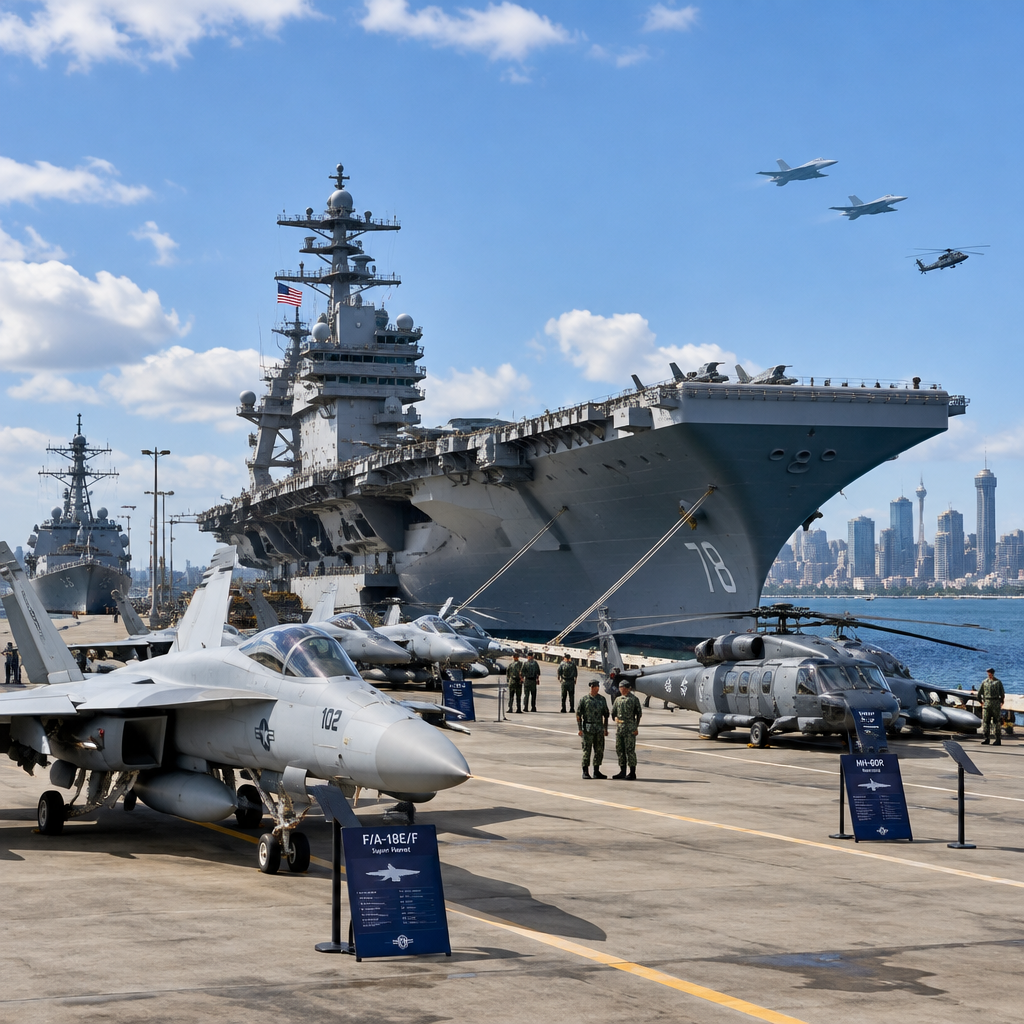
For the first time the exhibition will include a substantial surface-fleet component using Gaolan Port’s docks. Vessels expected to be on public display include a Type 075 amphibious assault ship, a Type 055 guided‑missile destroyer, and a Type 054A guided‑missile frigate. The choice of Gaolan Port is also notable because it was where at least one Chinese uncrewed surface vessel—a distinctive trimaran craft—was first spotted.
Operational readiness, demonstrations, and public messaging
Beyond static displays, the PLAN plans flight demonstrations, formation flights, and simulated operational exercises intended to show how individual platforms operate together in complex maritime environments. Rehearsal photos circulating online reportedly show two J‑15s, two J‑35s and a KJ‑600 preparing for a formation fly‑over. The PLAN’s stated emphasis on active‑duty equipment and training signals a desire to present these systems as part of a functioning, deployable force rather than as exhibition pieces.
What this means for technologists, procurement leaders, and regional observers
- Technologists and security teams: Expect detailed imagery and operational demonstrations of AEW&C (KJ‑600) and carrier-capable unmanned systems (GJ‑21, WZ‑2), which will inform assessments of sensor integration, command-and-control concepts, and the role of attritable systems in carrier operations.
- Procurement leaders and training planners: The JL‑15’s presence—or lack of an operational standard—will be a concrete data point about how the PLAN intends to train carrier pilots, especially compared with programs cited in the source that are evolving along different training paradigms.
- Regional navies and informed public: Visible surface units (Type 075, Type 055, Type 054A) and demonstrations framed around readiness and sustained missions provide a public measure of China’s ability to project and coordinate maritime forces.
Zhuhai’s history of revealing operational milestones—J‑20 first public flight in 2016, internal weapons‑bay demonstrations in 2018, static J‑20 and Y‑20 appearances in 2022, and the 2024 debuts of the J‑35A and catapult‑capable J‑15T—means the December 7–13 exhibition will be watched closely for further surprises. With a new Gaolan Port maritime display and a program explicitly focused on operational readiness, this edition looks set to be an unusually broad public showcase of the PLAN’s evolving carrier and naval ecosystems.