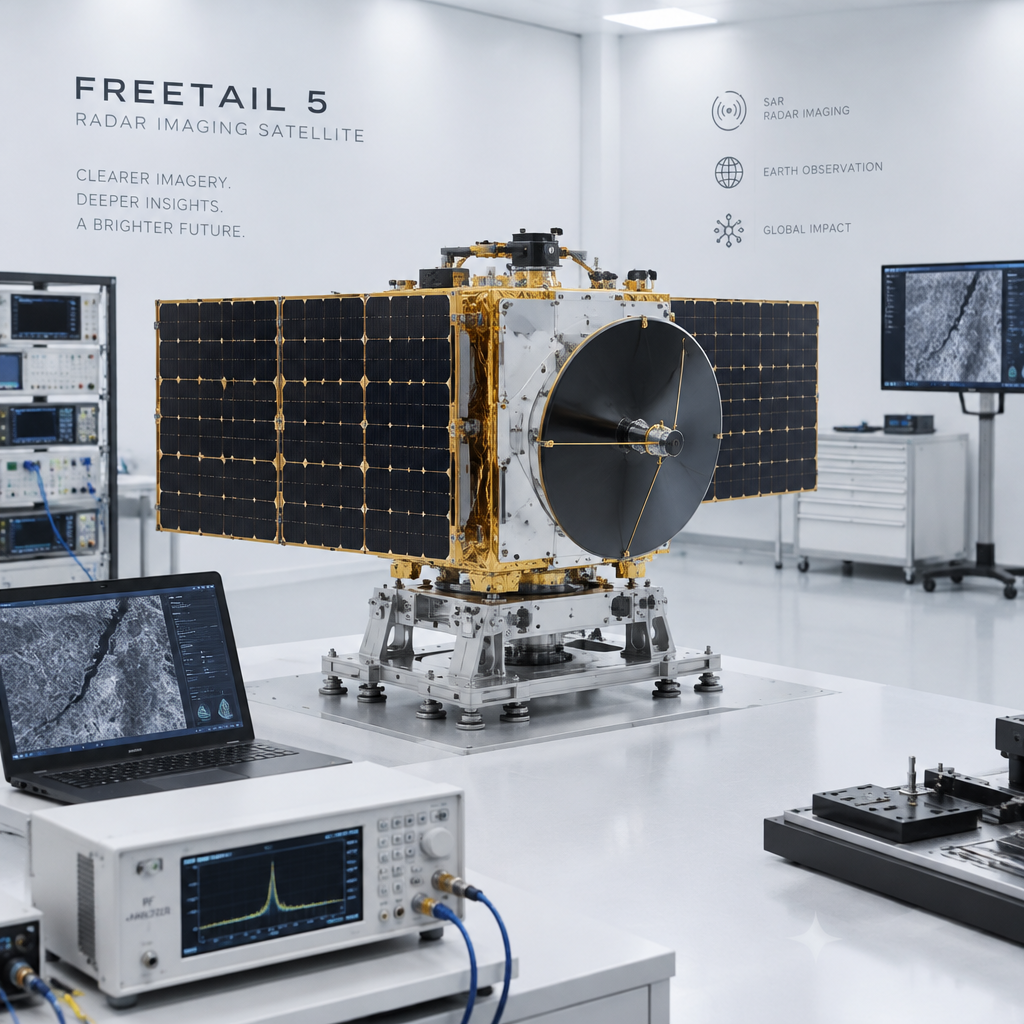
"With four times the radar power, twice the antenna area and hourly global revisit, Freetail 5 is designed to collect more across greater areas to deliver unprecedented operational value," Umbra CEO David Langan said.
Umbra's Freetail 5
Umbra unveiled a new satellite family, the Freetail model, promising performance "commensurate with much larger satellites" in a spacecraft that weighs 200 kilograms (about 441 pounds). The company says the satellites will be able to produce images with resolutions down to five centimeters. Umbra identified the first of these new satellites as Freetail 5 and said it is slated to fly in 2028. The company explicitly framed the product toward the United States and its allies, calling Freetail 5 "a new standard for space-based intelligence" that will create "significant advantage for the United States and its allies."
ICEYE's Gen5
Finnish SAR-maker ICEYE announced its Gen5 satellites on Nov. 16. ICEYE says Gen5 can provide government customers imagery at resolutions as fine as 11 centimeters, with availability subject to regional spectrum management rules set by the International Telecommunication Union. The company told customers it will offer commercial clients SAR images at 16 centimeter resolution, "with services expected to begin next year," according to the announcement. ICEYE is pitching Gen5 to a broad set of customers — civil, commercial and military — and emphasized an onboard artificial intelligence processor as a future capability.

This site is the portfolio.
OSINTSights runs on Cloudflare Workers, D1, R2, and Vectorize, with an AI pipeline on Hetzner ARM. Nubivance designed, built, and operates it. We do the same for clients.
See what we buildOnboard processing, reprogrammable software, and revisit cadence
Both firms highlighted software-defined functionality and onboard processing as core elements of their next-generation systems. The announcements say the satellites will be reprogrammable in orbit and will increase "the number of times an image can be processed during each satellite's orbit." ICEYE described plans for an onboard AI processor that will "unlock screening, pre-processing and tip-and-cue directly on the satellite, rather than waiting for data to reach the ground." Umbra quantified several platform advantages — four times the radar power, twice the antenna area and hourly global revisit for Freetail 5 — tying those attributes to operational collection and area coverage.
European demand and the operational advantage of SAR
The announcements arrive as the international market for Earth-imaging services expands and governments — the story singles out European purchasers — rush to acquire sovereign capabilities. The companies and the reporting stress why SAR matters for Europe: SAR can operate through frequent cloud cover that limits optical satellites, making radar imaging especially useful in regions with persistent clouds. That demand environment forms part of Umbra's pitch to U.S. and allied customers and ICEYE's broader civil, commercial and military outreach.
What this means for military and intelligence services, European governments, and commercial customers
- Military and intelligence services: Umbra explicitly targeted those customers, and its performance claims — five-centimeter resolution and hourly global revisit — are presented as operational advantages for space-based intelligence collection.
- European governments: The story cites European governments' rush to acquire sovereign imagery capabilities and notes SAR's usefulness under frequent cloud cover, underscoring why higher-resolution radar systems are being marketed to that region.
- Commercial and civil users: ICEYE is marketing Gen5 across civil and commercial segments as well as military markets, and its emphasis on an onboard AI processor is pitched to shorten "time to decision" by enabling screening and pre-processing in orbit.
Both companies are staking competitive claims: Umbra by compressing larger-satellite performance into a 200 kg platform and tying Freetail 5 to allied intelligence advantage; ICEYE by promising broad-market access, sub-16-centimeter commercial imagery and in-orbit AI-driven preprocessing. Key operational and regulatory constraints remain part of the factual record the companies themselves cited — notably the International Telecommunication Union's regional spectrum-management rules that affect where finer government-grade imagery can be offered.
The coming milestones are concrete: ICEYE has announced availability timelines and onboard-AI plans, while Umbra's Freetail 5 is slated for a 2028 launch. How operators, purchasers and regulators reconcile technical performance, spectrum rules, and customer access will determine who benefits first from sub-decimeter SAR imagery.