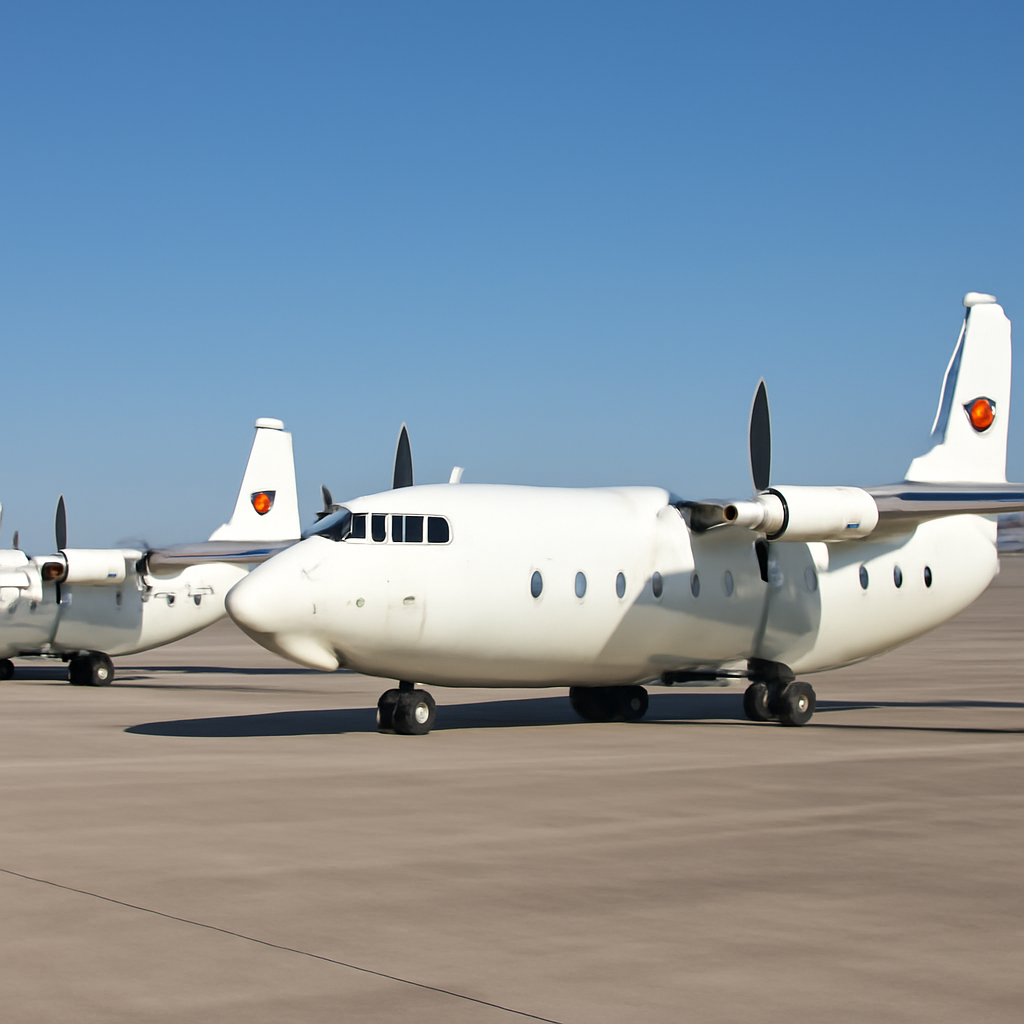
Two newly produced Myanmar Air Force Y‑8F‑200 transports — tail numbers MAF 5923 and 5924 — were recently spotted in China, suggesting delivery has been completed.
Myanmar Air Force: fresh Y‑8F‑200s to shore up airlift
Photographs of MAF 5923 and MAF 5924 in China point to the arrival of two new Y‑8F‑200 transports for the Myanmar Air Force. The report recalls a January 2025 account that "The Myanmar Air Force has inducted at least eight new aircraft to partly replace losses in aircraft incurred since 2021," and that one of those aircraft was identified as a Y‑8F200 transport. The source frames Myanmar’s choice in stark operational terms: budgets are tight, runways are rough, and Western procurement channels have long since closed — making a new Y‑8 an immediately practical option rather than a gamble on "ancient Antonovs" that may have been spending years "dissolving in a leaky warehouse."
Kazakhstan National Guard: three Y‑8 Pegasus arrive in 2025, total six
The Kazakhstan National Guard expanded its Y‑8 fleet with three additional Y‑8 Pegasus aircraft arriving in 2025, bringing its operational total to six. That increment underscores the pattern of incremental, practical purchases rather than headline-grabbing platform upgrades — a steady build-out of capability in mid‑size transport and maritime patrol roles.

The cyber insurance questionnaire just landed. Now what?
SOC 2, HIPAA, insurance renewals - someone has to own security strategy. Nubivance provides fractional CISO leadership without the full-time salary.
Get a security leadSri Lanka: Y‑8s for maritime patrol and transport, with Chinese support
Sri Lanka continues to operate Y‑8s for maritime patrol and transport roles. The source explains the rationale plainly: Western maritime patrol aircraft are "priced into the stratosphere," and China "provides support without the geopolitical fine print." For Sri Lanka, the combination of cost and uncomplicated support has kept the Y‑8 in service for these demanding missions.
Why the Y‑8 keeps winning: price, ruggedness, and delivery
The report lists three simple, repeatable selling points behind the Y‑8’s export successes. First, "price and politics": for buyers who are under sanctions or "just not on Washington’s Christmas card list," the Y‑8 is among the few tactical transports readily available. Second, "ruggedness over refinement": the Y‑8 is explicitly identified as not being a C‑130J but instead "a medium‑lift truck with wings," which is precisely what many of its customers need. Third, China "delivers fast and without drama": purchases avoid "congressional hearings," "export‑control purgatory," and "multi‑year wait times." Taken together, these points explain why — in a niche market where buyers can choose between a newly made mid‑size transport and a "lightly used" ex‑Soviet airframe that has deteriorated in storage — "new beats questionable used every time."
China’s production posture: restarting an older line to meet demand
The Y‑8, a Soviet‑era Antonov An‑12 derivative, has "kept up its quiet, steady export run" and is "somehow still in production." The source emphasizes that China can restart older aircraft manufacturing lines when there is a market for them; the Y‑8’s continued assembly-line output demonstrates how an unglamorous but dependable design can stay commercially viable so long as there are buyers who value immediacy, simplicity, and political accessibility.
What this means for procurement leaders, military operators, and diplomatically isolated states
- Procurement leaders and defense planners: Expect cost and political risk to weigh as heavily as capability in some markets — for these buyers, a new Y‑8 can be preferable to an uncertain second‑hand airframe.
- Military aircrews and maintenance teams: The Y‑8’s "ruggedness over refinement" profile implies tradeoffs — simpler logistics and faster fielding at the expense of advanced avionics or higher-end performance.
- Diplomatically isolated or sanctioned states: The availability of a new tactical transport without the procedural delays and geopolitical conditions of Western sales makes the Y‑8 a durable option for preserving national airlift and maritime patrol capability.
The Y‑8’s market survival is a study in practical economics: modest capability, low political friction, and immediate availability keep the line humming. One unanswered operational choice highlighted by the report is Myanmar’s apparent decision not to upgrade to the newer Y‑9 — a judgment the source frames as open to interpretation ("Is this a cost‑saving measure? To maintain consistency in training, logistics and maintenance across their Y‑8 transport fleet? Your guess is as good as mine"). For now, buyers who need dependable medium‑lift capacity quickly and without geopolitical strings are keeping the Y‑8 production line alive.