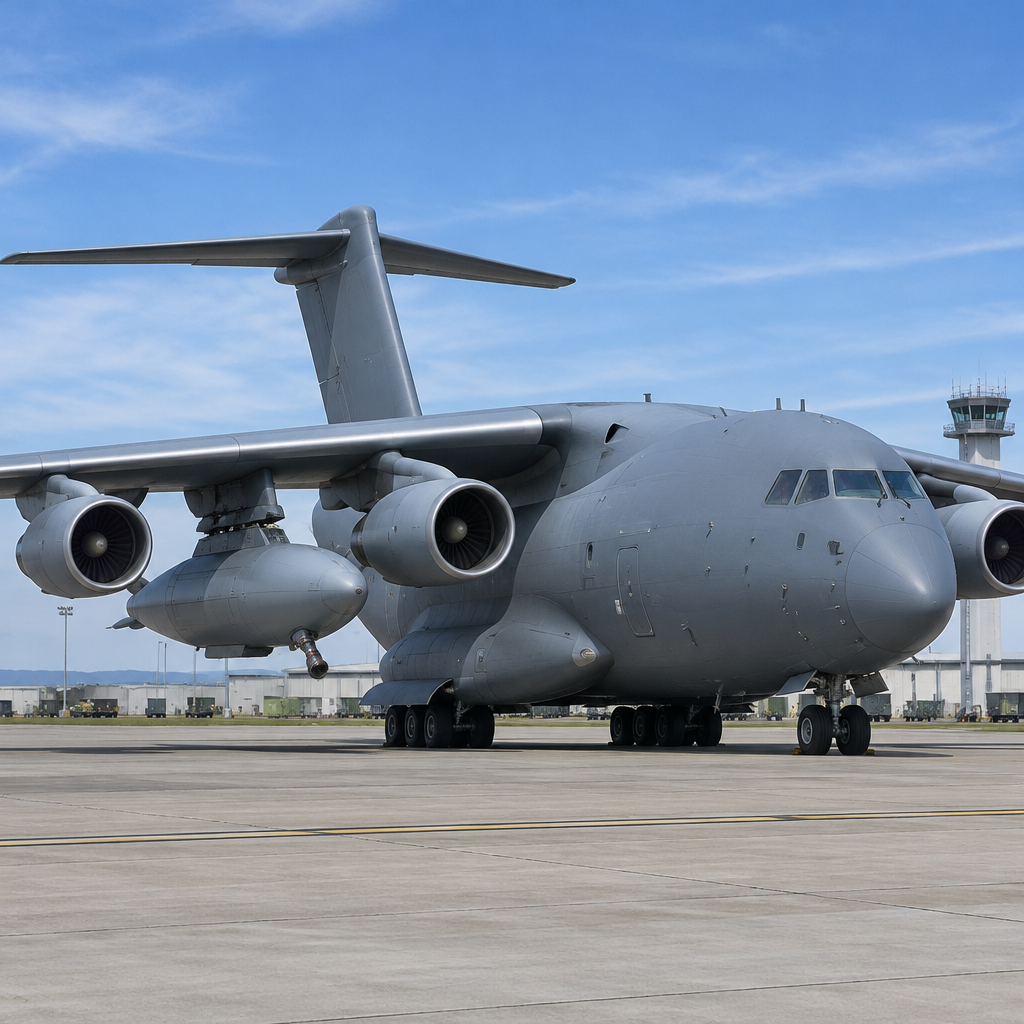
"The Y-20 is increasingly looking like a military version of "Platform as a Service" (PaaS)," the China Defense Blog wrote, and then unfolded why that characterization matters.
The Y-20 as "Platform as a Service"
The central observation in the source material is explicit: the Y-20 airlifter is evolving into a flexible platform whose value lies less in a single role than in the range of payloads it can carry. The author draws a direct analogy to cloud computing's Platform as a Service model — the airframe is the product, and the mission systems are interchangeable payloads. Reported variants include an AWACS role, a multi-role tanker transport (MRTT) configuration labelled Y-20B with modular underwing refueling pods, and conventional cargo versions. The blog contrasts this approach with dedicated U.S. tanker fleets such as the KC-135, KC-10, and KC-46, noting that those platforms were developed as tankers first rather than modular transports that can pivot to refueling.
The 2005 Il-76/Il-78 deal and its collapse
The account traces the Y-20’s origins to China’s earlier reliance on the Russian Il-76 family. In 2005 China signed for 34 Il-76MDs and four Il-78s — a package the source dates to September 2005 and notes was evaluated at roughly $1.5 billion — intended to expand strategic airlift and aerial refueling. That contract never delivered because the original Il-76 plant in Tashkent was in severe decline and unable to build the contracted aircraft. The production shortfall, and the subsequent suspension of that supply line, left China with a capability gap and dependence on external factors beyond its control.

This site is the portfolio.
OSINTSights runs on Cloudflare Workers, D1, R2, and Vectorize, with an AI pipeline on Hetzner ARM. Nubivance designed, built, and operates it. We do the same for clients.
See what we buildThe decision to build an indigenous heavy-transport ecosystem
According to the source, after the failed Il‑76 follow-on and later Russian offers related to the Il‑476, China "doubled down" on domestic development and produced the Y-20. The author frames this as a strategic trade-off: accept near-term transport shortfalls in exchange for long-term independence. The result, the source argues, is an aircraft available on Beijing's timelines, modifiable for domestic requirements, and not subject to foreign export policies or production bottlenecks. The blog calls the Y-20 "one of the clearest examples" of that decision paying off.
Operational appearances: tanker refueling, AWACS speculation, and humanitarian missions
The source catalogs public sightings and reported missions that illustrate the Y-20 family's expanding roles. It cites a Y-20 tanker refueling an Egyptian MiG-29 during Eagles of Civilization 2026 as an example of the aircraft performing MRTT duties. The blog also mentions satellite-driven speculation about AWACS variants and production rates, and notes the Y-20's presence in humanitarian assistance and disaster relief, including Chinese aid to the Nepal flood. The piece emphasizes modularity — for example, underwing refueling pods that allow the Y-20B to switch between cargo and aerial refueling duties — as a practical expression of the platform-as-product idea.
How PLAAF planners, Rosoboronexport, and procurement leaders are affected
- PLAAF planners and Chinese defense authorities: The source frames their payoff as tangible — the Y-20 is "available when China needs it," customizable to Chinese requirements, and deployable across transport, tanker, and specialized missions, including recruitment messaging that now features the aircraft.
- Rosoboronexport and Russian suppliers: The source reproduces historical interaction — at Airshow China 2010 Rosoboronexport promoted the Il‑476 and its return to production in Ulyanovsk. Sergei Kornev is quoted saying Il‑476 would be offered as "a plane of completely new quality" and that D‑30KP engines had been delivered, but the earlier 2005 contract via the Tashkent plant was suspended because the plant could not build the aircraft. That history helps explain why China shifted toward indigenous options.
- Procurement leaders in other countries: The blog cautions that China's path reflects "unique" circumstances — budget scale, industrial base, engineering workforce, threat perception, political system, and a long-term willingness to invest — and warns that those conditions are not universal. The author explicitly says the choice to indigenize is "a Chinese approach to a Chinese problem," not a universal template.
The story in the source ends on two connected notes: the Y-20 has migrated beyond a single-role transport into a family of platforms, and the design choice behind that migration was driven by risk experienced in the 1990s and 2000s when foreign supply and politics constrained capability. The blog also flags a market-facing question it does not resolve: "If China eventually offers export versions, I would not be surprised at all." That line underscores the strategic arc traced in the piece — from dependence on foreign airframes to an evolving, modular national platform that can be fielded, modified, and potentially exported on Beijing's terms.