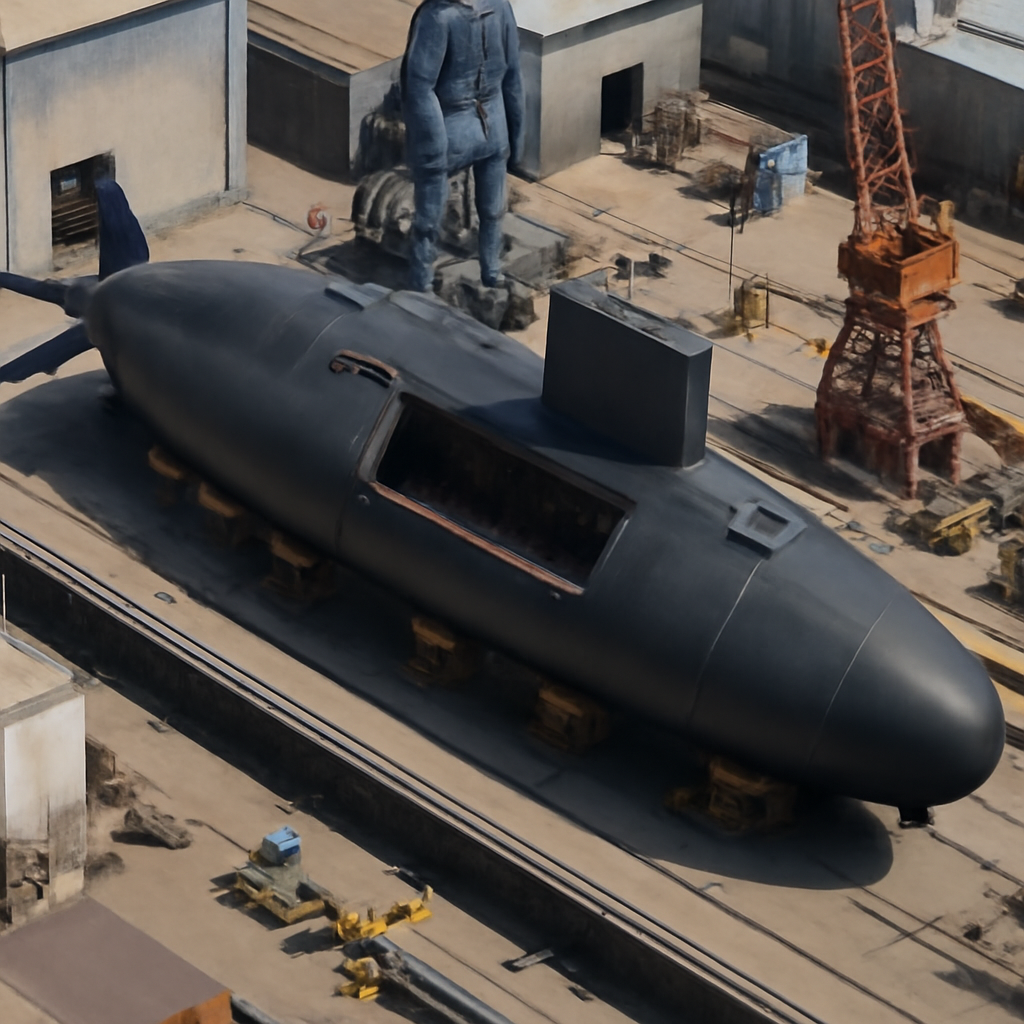
That caution, from a naval analyst who follows Chinese submarine developments closely, frames the new satellite view of a large nuclear-powered attack submarine under construction at the Bohai Shipyard in Huludao. Vantor supplied an image dated September 18, 2026, that shows several notable features — a pumpjet propulsor, an X-shaped stern plane arrangement, a large rectangular open section aft of a relatively small sail, and at least two prominent circular openings forward of the sail — all of which fuel questions about the boat’s role and capabilities.
Pumpjet propulsor and X-shaped stern on the Bohai hull
The September 18 Vantor image clearly shows a pumpjet propulsor — a propulsion approach also seen on the Type 093B — and an X-shaped stern-plane layout. TWZ reports the pumpjet is understood to be a feature of the 093B, a significantly improved variant that first emerged in the early 2020s, while the X-shaped stern is not found on the 093B and instead suggests a further evolution. The reporting notes X-stern arrangements can enhance maneuverability, efficiency, and safety in littoral environments and may help reduce acoustic signature across parts of a submarine’s operating envelope.
Unusual bow openings and the question of vertical launch systems
The image also shows at least two large circular openings side-by-side on the bow, in front of the sail. TWZ flags that the purpose of these openings is not immediately clear; they could be for vertically launched munitions or related to the submarine’s sonar array, since their position is close to where the main sonar would be installed. The article draws a direct comparison to the U.S. Virginia-class Block III submarines, which have two large-diameter Virginia Payload Tubes in the bow.
Midships, a conspicuous rectangular open section aft of the sail appears in earlier imagery (a September 1 Vantor image reported by Janes). That space has been variously interpreted: it could be a vertical launch system (VLS) bay able to carry anti-ship, land-attack, or hypersonic cruise missiles — a capability widely expected on the notional Type 095 — or it could be access for reactor compartment work. Alex Luck explicitly warned against assuming the rectangle is definitively a VLS, noting fitting-out practices can change and earlier boats revealed VLS launchers only later in the process. A social-media post cited in the reporting suggested one chamber could physically fit about 18–24 VLS cells and estimated total counts from 24–48+, but TWZ presents that as a speculative assessment rather than confirmed fact.

This site is the portfolio.
OSINTSights runs on Cloudflare Workers, D1, R2, and Vectorize, with an AI pipeline on Hetzner ARM. Nubivance designed, built, and operates it. We do the same for clients.
See what we buildMultiple hulls, varying lengths, and a small-sail variant
Planet Labs archive imagery reviewed by TWZ indicates the Huludao hull in the September 18 image measures about 394 feet (120 meters) long. By contrast, the first example assessed to be a Type 095 that emerged at Bohai in February was estimated at roughly 361 feet (110 meters). TWZ also reports a small-sail design that appeared earlier this year at the Jiangnan (JN) Shipyard in Shanghai is similarly estimated at about 394 feet/120 meters but appears narrower than the Huludao hull. Alex Luck suggests the fleet may be seeing a two-step development approach — different hulls representing stages toward a final configuration — and he wrote that the February boat might have been a one-off lacking the full specifications seen on later hulls launched in late May.
What this means for the PLAN, the U.S. Navy (ONI), and naval analysts
- People’s Liberation Army Navy (PLAN): The imagery shows continued investment in more modern submarine designs across several distinct classes, consistent with TWZ’s reporting that the PLAN is expanding both the size and capability of its submarine force with an eye toward operations farther from China’s shores.
- U.S. Navy / Office of Naval Intelligence (ONI): Rear Adm. Mike Brookes of ONI has publicly characterized the PLAN’s shipbuilding shift toward nuclear construction as a significant strategic change, and has identified the Type 095 and Type 096 as next-generation platforms expected to enter service in the late 2020s through the 2030s that will incorporate advances in reactors, sensors, weapons integration, and noise quieting.
- Naval analysts and open-source observers: The different hull forms, the interplay of visible features such as pumpjets and X-stern planes, and the ambiguous aft and bow openings underscore why analysts like Alex Luck are urging caution — more and higher-resolution imagery during fitting-out will be required to confirm VLS arrangements, sensor placement, and the final role of each hull.
Next steps: imagery, fitting-out, and open questions
The September 18 image additionally shows a structure placed over the rectangular section aft of the sail, obscuring ongoing work and reinforcing that the current public record is a snapshot in a multistep construction process. TWZ and other observers have highlighted three key unresolved points that future imagery or on-the-water sightings would help clarify: whether the midships rectangular space is a VLS array, the function of the bow circular openings, and whether the differing hulls represent convergent variants or sequential developmental steps toward a single Type 095 family. As Alex Luck put it, it is simply too early to be definitive on the VLS configuration from publicly available imagery.
For now, the pictures from Bohai, recent launches at Bohai and Jiangnan, and the earlier Type 041 emergence in 2024 together document an accelerating pace of submarine experimentation and construction in China — and make clear that observers will be watching subsequent images closely for evidence that differentiates prototypes from operational designs.
Source: TWZ — Chinese Next-Generation Submarine Developments Spotted In New Satellite Imagery