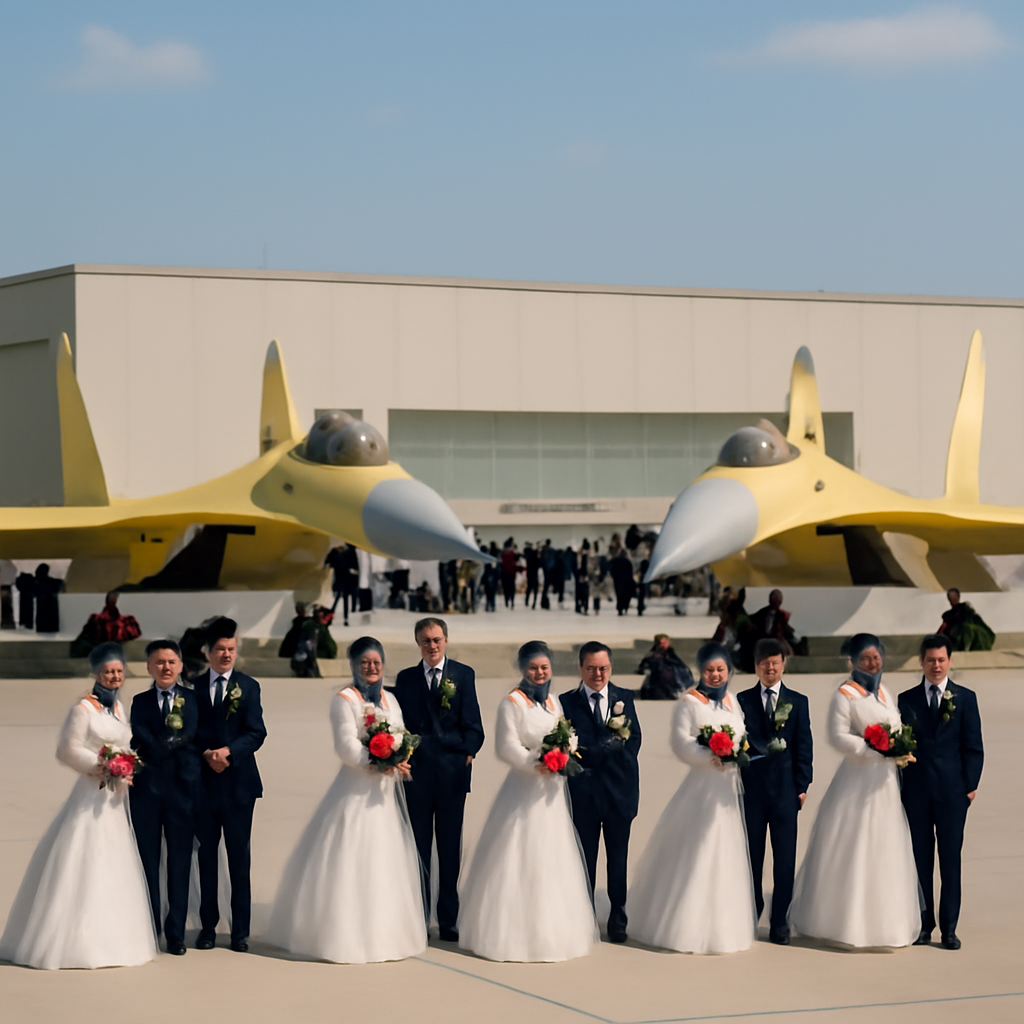
Behind the newlyweds sat two factory‑fresh J‑15T carrier fighters, a detail in a People’s Liberation Army Navy (PLAN) publicity photo that has quietly stirred debate among Chinese military watchers.
The image: a land‑based brigade and carrier‑configured fighters
The photograph accompanied a group wedding ceremony and showed the former PLANAF 4th Aviation Division — long associated with the East China Sea and Taiwan Strait directions and known by the nickname "海空雄鹰团" — posed in front of two new J‑15T aircraft. Open‑source reporting cited in the material notes that the brigade reportedly received J‑11BH fighters around 2020 and is now appearing publicly with brand‑new J‑15Ts.
What makes the J‑15T notable
The J‑15T is not described as merely another Flanker variant. According to the reporting, it was specifically developed for catapult carrier operations and includes strengthened landing gear, structural reinforcement, carrier‑compatible avionics, and other modifications intended to survive repeated arrested recoveries and catapult launches. Those design elements make the J‑15T an unconventional fit for a land‑based unit whose historical mission has been shore‑based naval aviation.

The cyber insurance questionnaire just landed. Now what?
SOC 2, HIPAA, insurance renewals - someone has to own security strategy. Nubivance provides fractional CISO leadership without the full-time salary.
Get a security leadTwo dominant theories circulating in Chinese milblog circles
- Preparing for Carrier Number Four: One theory holds the brigade may be being groomed as the nucleus of a future carrier air wing. The reporting notes China currently operates the carriers Liaoning and Shandong, while Fujian continues flight testing and operational workups, and that a fourth carrier is widely expected. Converting an experienced fighter brigade years ahead of a new carrier’s commissioning could be a long‑term investment in people rather than hardware.
- An interim step before J‑35 adoption: A competing theory argues the J‑15T may serve as a bridge. Observers quoted in the source suggest it could be too early to field the J‑35 at scale; existing carrier‑configured J‑35s may take years to reach quantities sufficient for multiple carrier air wings. Under this scenario, the J‑15T trains pilots in carrier procedures now so they can later transition more readily to the J‑35 when it becomes available.
Training pipelines, not just aircraft, shape carrier aviation
The reporting stresses that producing carrier aviators takes far longer than producing carrier aircraft. It cites the U.S. Navy as a comparator, noting a pilot there typically requires roughly 18 to 24 months from the beginning of flight training before becoming carrier qualified, followed by additional fleet training and accumulation of operational experience. Drawing that contrast, the piece highlights Chinese efforts to expand the naval aviator pipeline — broadening recruitment into naval aviation schools, universities, military academies, and developing training programs through the Naval Aviation University — and frames assigning J‑15Ts to a land‑based brigade as a way to grow a pool of pilots familiar with carrier‑compatible procedures.
What this means for the PLAN's carrier aviation community, defense planners, and military watchers
- The PLAN's carrier aviation community: The assignment of J‑15Ts to a high‑readiness, land‑based brigade could create a reservoir of pilots and maintainers versed in carrier procedures, easing future transitions to embarked operations or to a new airframe.
- Defense planners overseeing future carriers: If the goal is to staff additional carriers — including a widely expected fourth ship — converting an experienced brigade ahead of time would be consistent with a strategy that prioritizes people and institutional experience over rapid aircraft transfers.
- Military watchers and open‑source analysts: The photograph and the brigade’s apparent rapid transition from J‑11BHs to J‑15Ts provide concrete evidence to feed competing interpretations; analysts will likely watch for follow‑on indicators such as deployments, carrier qualifications, or formal reassignments to an embarked wing.
For now, the reporting is explicit: there is no public evidence that the "海空雄风" brigade is becoming a carrier air wing tomorrow — and there is also no public evidence that it is not. Whether the J‑15Ts prove to be preparatory steps for Carrier No. 4, stopgaps ahead of wider J‑35 adoption, or simply tools to expand carrier‑qualified pilot numbers, the sudden appearance of carrier‑configured fighters in front of a traditionally land‑based naval aviation brigade has given quieter institutional moves a public face.