"Well, it turns out I was wrong," the blog author wrote, conceding that the recently retired PLAN frigate Luoyang (hull 527) did not vanish into the scrapyard but instead began a second career — delivered to the Navy of the Republic of Mozambique in Guangzhou in November 2026.
Delivery to the Navy of the Republic of Mozambique, November 2026
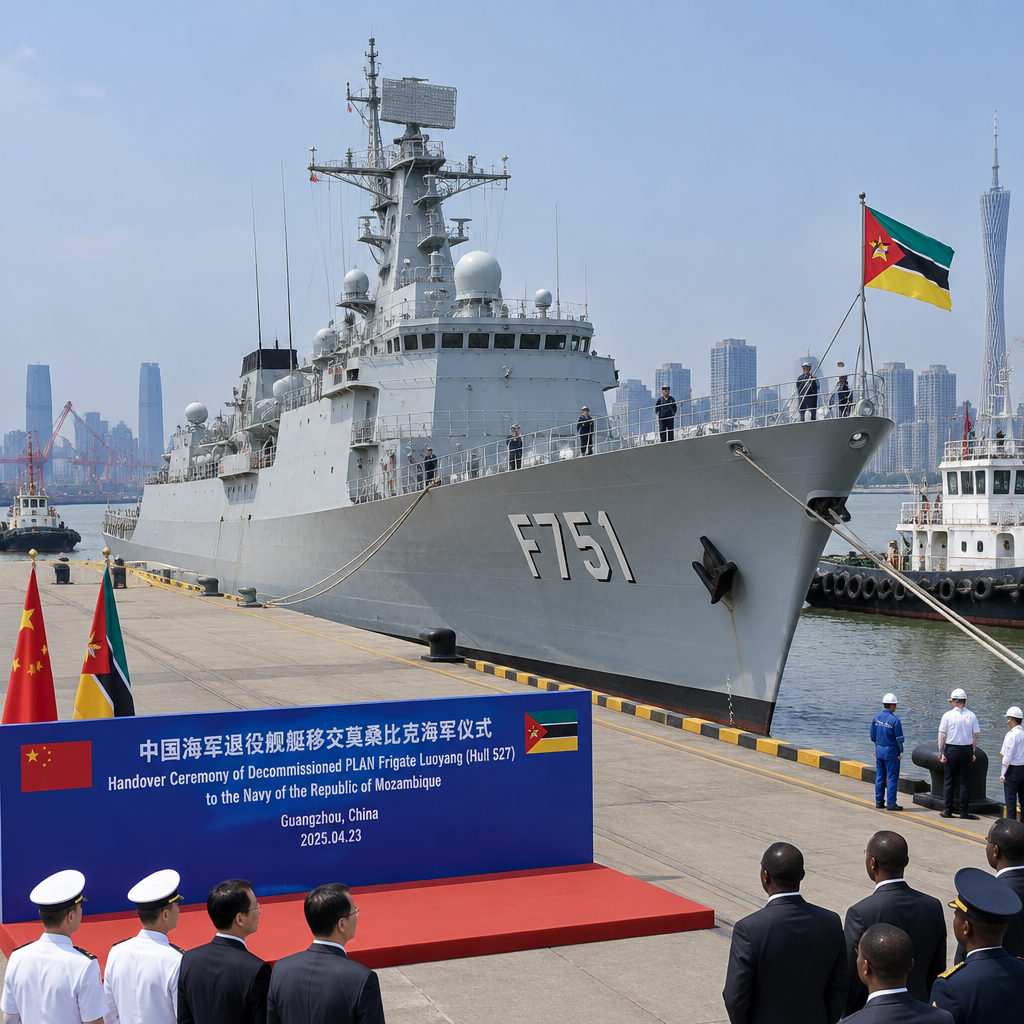
On a day in November 2026 in Guangzhou, the Navy of the Republic of Mozambique officially took delivery of the former People's Liberation Army Navy Type 053H3 frigate Luoyang (FFG-527). A photograph circulating after the transfer shows the ship carrying the marking F751; observers had earlier speculated the hull might be bound for Bangladesh, but the transfer was to Mozambique.
Visible demilitarization: missiles and HQ-10 system removed
Judging by the photograph's background, Luoyang appears to have undergone demilitarization before delivery. Most noticeably, the midship anti-ship missile launchers are absent and the HQ-10 (Haihongqi-10) short-range air defense missile system has been removed. The blog notes this is hardly unusual: exported or transferred warships are often stripped of sensitive weapons, electronics, or combat systems prior to handover.

Audit-ready is a season. It shouldn't be.
Evidence in spreadsheets, controls drifting between audits, frameworks multiplying on flat headcount. Nubivance runs continuous compliance on Rapid7 Cyber GRC - SOC 2, HIPAA, ISO 27001, PCI, CMMC.
End the scrambleWhy Bangladesh was a plausible buyer
Earlier speculation that Luoyang might be headed to Bangladesh rested on concrete, public facts: the Bangladesh Navy already operates two ex-PLAN Type 053H3 frigates — BNS Umar Farooq (F-16), formerly PLAN FFG-522 Lianyungang, and BNS Abu Ubaidah (F-19), formerly PLAN FFG-523 Putian — both of which entered Bangladeshi service in 2020. Bangladesh also operates three ex-PLAN Type 053H1 frigates. The blog argued that adding a third Type 053H3 would bring immediate benefits such as existing training pipelines, maintenance facilities, spare-parts commonality, sensor and weapons familiarity, and minimal integration risk.
How the PLAN is handling older ships: transfer, training, export
The Luoyang transfer fits into a broader pattern the author describes for the People's Liberation Army Navy as it fields modern warships. The blog outlines three primary paths for older vessels:
- Transfer to the China Coast Guard — already underway: twenty-two Type 056 corvettes have been moved to the Coast Guard for maritime law-enforcement duties.
- Conversion into training ships — several former combatants have been reassigned to training and support roles; the former Type 051C destroyer DDG-115 Shenyang has been photographed in an apparent training configuration with its long-range SAM removed.
- Export to foreign navies — older frigates and destroyers that are becoming logistical outliers are candidates for foreign transfer.
The author frames exports as a practical fleet-management tool rather than merely diplomacy or commerce: maintaining a handful of aging subclasses requires unique spare parts, separate maintenance programs, dedicated technical expertise and training resources. Exporting those ships reduces that burden while giving buyers capable platforms for another 15–20 years of service.
What this means for Mozambique, Bangladesh, and the PLAN
- Mozambique: receives a former PLAN Type 053H3 frigate that appears to have been demilitarized prior to delivery, giving the Mozambican navy a platform beginning a second career.
- Bangladesh: remains a logical and experienced operator of ex-PLAN Type 053 frigates — having already integrated two Type 053H3s and three Type 053H1s — which explains why observers flagged Luoyang as a likely candidate for Bangladeshi acquisition.
- The PLAN: exporting, transferring, or converting older hulls allows the navy to simplify logistics and maintenance, consolidate training, free up dockyard capacity, and reassign experienced sailors to newer classes such as the Type 052D, Type 055, Type 054A, and Type 054B, all cited by the author as entering service and driving the need to streamline older subclasses.
Luoyang's handover to Mozambique is a small, concrete example of a larger organizational choice: ships retired after roughly 20 years of service can still be useful if repurposed, transferred, or demilitarized and exported. Whether seen as fleet hygiene, diplomatic tool, or an economical reuse of hulls, the transfer underscores a pragmatic approach to managing an expanding, modernizing fleet — and shows that a ship's end in one navy can be the start of another's operational chapter.