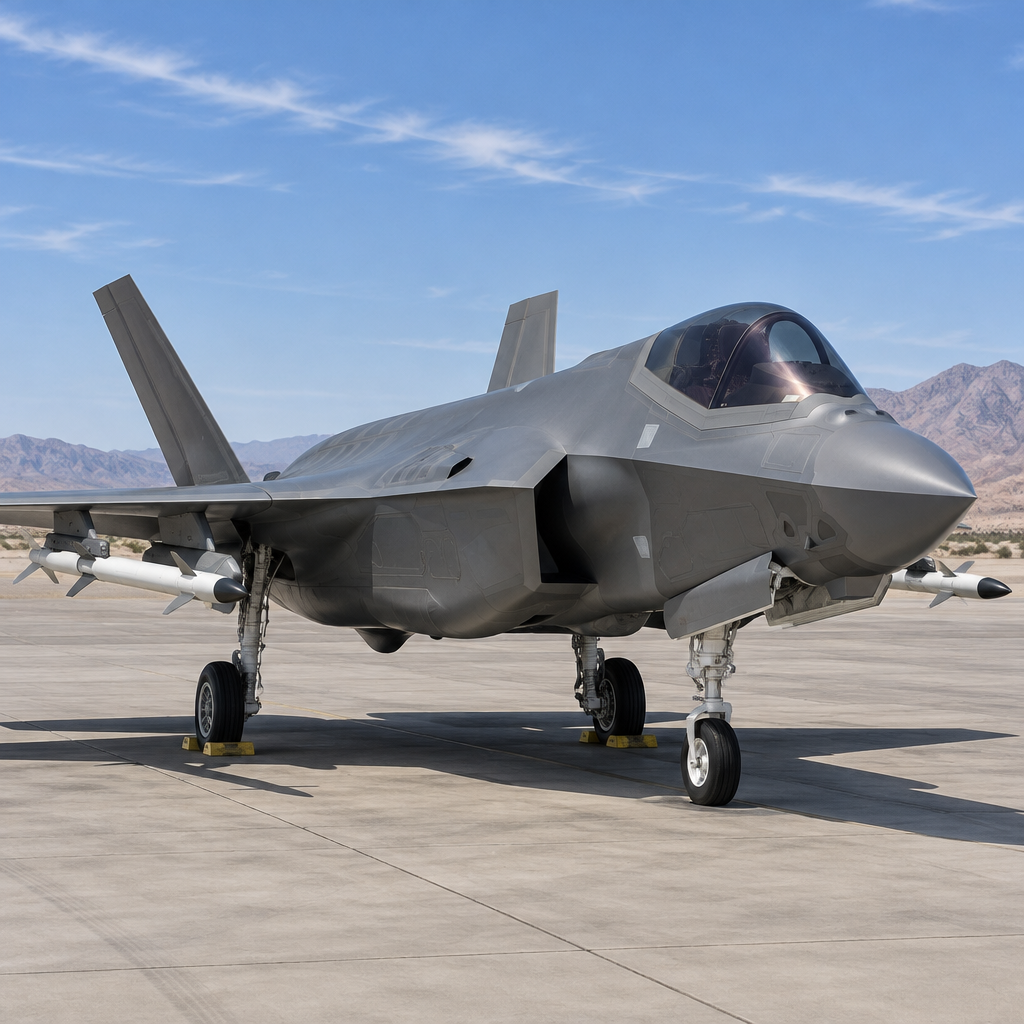
"[The AIM-9X Block II+] incorporates specialized external materials to enhance aircraft platform survivability," the U.S. Navy has said — a description that now appears in plain sight on F-35As flying in the U.S. Central Command area of responsibility.
Visual change seen on USAF F-35As in the Middle East
Since at least November 3, 2026, U.S. Air Force F-35A Lightning IIs operating in the CENTCOM area of responsibility have been photographed and filmed carrying AIM-9X Sidewinders painted almost entirely white or very light gray. The images include a November 14 sortie photo and a DVIDS video dated November 4 that offers a close-up of the missiles; the footage appears to blur out certain markings. In the new scheme only the very tip of the nose — where the seeker sits — remains darkly colored, while the rest of the body and the fins are a uniform lighter shade. In some photos the missiles look largely white; in others they appear very light gray, a difference the reporting notes could be explained by lighting and contrast.
Why the change could point to the AIM-9X Block II+ (AIM-9X-3)
The U.S. Navy, which is the lead service on the Sidewinder program, has previously described the Block II+ or AIM-9X-3 as a variant that “incorporates specialized external materials to enhance aircraft platform survivability” and said it was developed to “satisfy the requirements of the Joint Strike Fighter platform.” The Block II+ retains improvements found on the Block II AIM-9X-2, including a data‑link that enables lock-on-after-launch targeting. The baseline AIM-9X family already brought high-off‑boresight targeting, thrust vectoring, and an advanced imaging infrared seeker to the missile line.
The U.S. military ordered its first Block II+ AIM-9Xs in December 2017, and those missiles have been in inventory for years. That raises the question — recorded in the reporting — of why this distinct paint scheme on Air Force F-35As has only been observed in CENTCOM recently.

Audit-ready is a season. It shouldn't be.
Evidence in spreadsheets, controls drifting between audits, frameworks multiplying on flat headcount. Nubivance runs continuous compliance on Rapid7 Cyber GRC - SOC 2, HIPAA, ISO 27001, PCI, CMMC.
End the scrambleOther technical and programmatic explanations in the record
Reporters and analysts working from available materials outline several non‑mutually exclusive possibilities drawn from program documents and prior reporting. The new paint may be a serviceability or supply decision to make missiles designated for F-35 use visually distinct; it may reflect coatings or structural changes intended to reduce radar signature; or it may mark a further subvariant not publicly designated. The story notes the Air Force previously released a June picture of an F-35A carrying an AIM-9X marked “F-35 USE ONLY” while displaying the standard paint scheme.
Multiple further AIM-9X developments are described in publicly available Pentagon materials: the System Improvement Plan III (SIP III) family (AIM-9X-4 and -5) includes hardware and software upgrades and incorporation of an Application Specific Integrated Circuit (ASIC) processor. An unclassified Modernized Selected Acquisition Report dated April 21, 2026, states that ASIC integration into the AIM-9X-4 has “impacted missile reliability and halted testing,” and that Non-Ready-For-Issue assets have negatively affected operational availability and available material rates, with recovery tied to fielding in September 2027. Work is also underway on SIP IV (AIM-9X-6). The Compact Variant (AIM-9X CV) and longer‑range propulsion work related to highly loaded grain motors appear elsewhere in the program record.
Missiles, counter‑drone tactics, and related weapons in the region
The reporting places the paint-change question alongside operational trends in the Middle East. Analysts note that new threat intelligence could have prompted use of Block II+ rather than older AIM-9Xs, and that Iran and Houthi militants have air‑defense capabilities that can present risks to F-35s in certain circumstances. The piece also highlights that the Air Force and other services have used laser‑guided 70mm APKWS II rockets as an air‑to‑air option against drones — rockets that F-35s currently cannot employ — and that APKWS II has particular limitations (continuous target designation and limited maneuver capability). F-15E and F-16 aircraft in the region have been observed carrying mixed loads of APKWS II rockets, AIM-9Ms, AIM-9Xs, and AIM-120s, and a U.S. Marine Corps F/A-18D Hornet was photographed on November 11, 2026, with AIM-9M and AIM-9X Sidewinders and AIM-120s.
What this means for the U.S. Air Force, the U.S. Navy, and regional opponents
- U.S. Air Force: The appearance of distinctly painted AIM-9Xs on F-35As in CENTCOM suggests a service decision to deploy missiles — possibly Block II+ or a subvariant — that are either tailored to the Joint Strike Fighter or being staged specifically for F-35 employment in the region.
- U.S. Navy: As the Sidewinder program lead, the Navy’s prior public characterization of the Block II+ as having “specialized external materials” aligns with the observable changes; program-level developments across SIP III and SIP IV continue to shape the missile family’s roadmap.
- Iran and Houthi militants: The reporting cites their air‑defense capabilities as one potential driver for switching to or marking a missile variant optimized for survivability and platform integration against evolving regional threats.
At present, the record cannot definitively link the new light‑colored paint job to a single technical change. TWZ has reached out to the F-35 Joint Program Office and Raytheon for additional information; the public materials cited in the reporting point to both longstanding Block II+ inventory and continuing developmental work on SIP III/IV variants that could explain recent operational choices. The concrete, observable fact is straightforward: U.S. Air Force F-35As operating in CENTCOM are flying with AIM-9Xs in a paint scheme not previously seen on that missile family in public photos, and that change is now part of the program record observers will track.