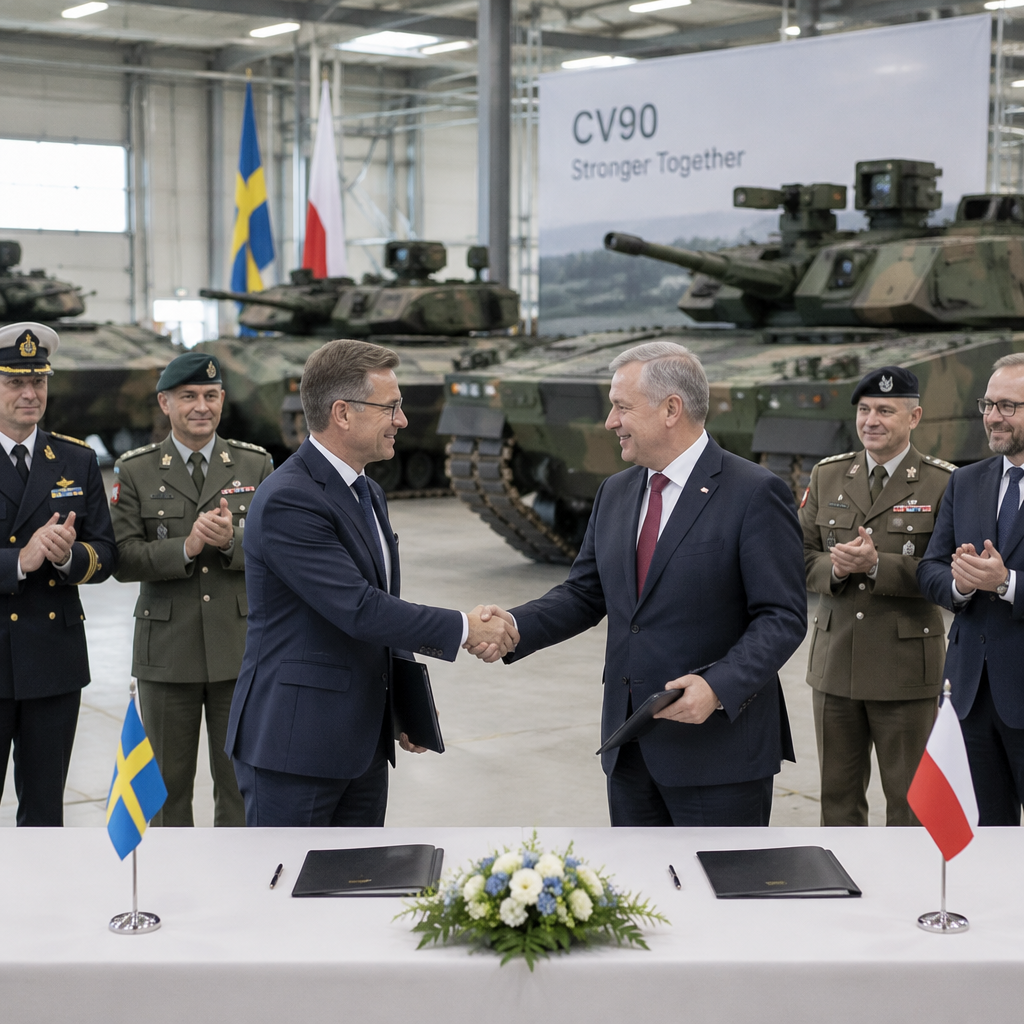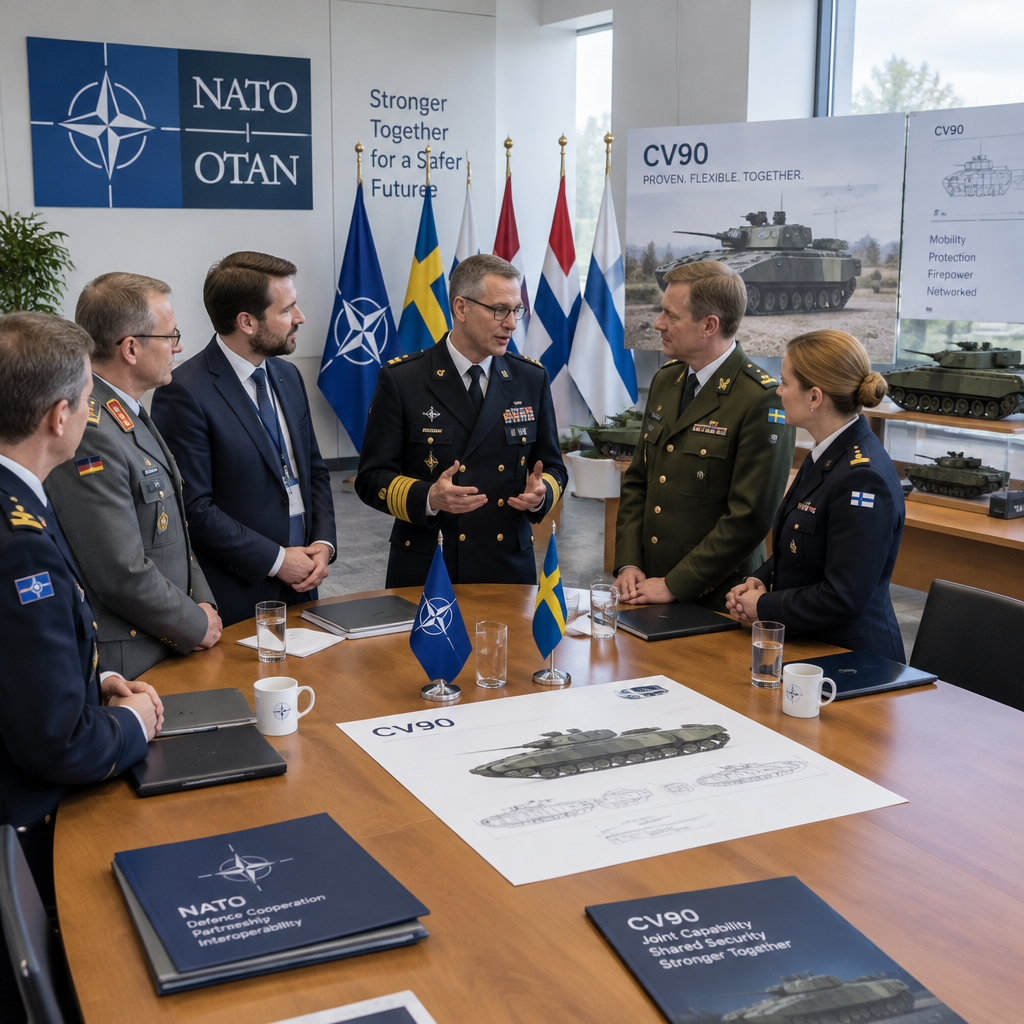
“This joint procurement of the CV90 strengthens NATO’s capabilities and creates opportunities for both effective and close cooperation around the system between our five countries,” Swedish Minister of Defense Pål Jonson said.
Sweden, Finland, Norway, Lithuania and the Netherlands: the deal and quantities
Five European NATO members have signed a landmark agreement to jointly procure more than 400 CV90 series infantry fighting vehicles in a program worth approximately $6 billion. The contracts were signed at the Swedish Army Museum in Stockholm and commit Sweden, Finland, Norway, Lithuania, and the Netherlands to a common CV9035 MkIV Nordic Edition baseline while allowing each country to retain national differences in communications, electronic warfare, and battle management systems.
Under the agreement Sweden will acquire 60 CV90 MkIVs. Finland is purchasing 160 vehicles in a deal described in the reporting as worth approximately $2.15 billion — a contract elsewhere cited at €1.955 billion — that includes maintenance kits, testing equipment, technical documentation, training, and licenses. Lithuania earlier announced plans to acquire 100 vehicles as part of the multinational program. Norway and the Netherlands’ individual quantities were not publicly detailed, though the combined initial order exceeds 400 vehicles. Finland also holds an option for an additional 100 vehicles in future phases.
The CV9035 MkIV: mobility, protection, and digital architecture
The CV9035 MkIV represents the latest iteration of a family that has evolved since the 1990s. BAE Systems describes the MkIV as a fifth-generation CV90 with notable drivetrain and electronic upgrades designed to meet modern battlefield demands. Key technical elements cited in the reporting include a Scania diesel engine producing up to 1,000 horsepower paired with an upgraded Allison heavy-duty transmission; active damping technology to improve suspension and handling; and a gross vehicle weight rating raised from 35 to 37 tonnes to increase payload capacity for protection, sensors, and mission equipment.
On the systems side, the vehicle incorporates a NATO-standard electronic architecture and BAE Systems’ iFighting concept to enhance crew situational awareness through digital integration, augmented reality elements, and autonomous support technologies. The armament package for the baseline configuration includes a 35mm cannon (the Northrop Grumman Bushmaster III is named among major components), a co-axial machine gun, and anti-tank guided missiles. The MkIV’s greater payload and open electronic architecture are explicitly highlighted as making it easier to integrate future defensive systems such as anti-drone equipment — a capability Finland has specifically stressed for its procurement.

Audit-ready is a season. It shouldn't be.
Evidence in spreadsheets, controls drifting between audits, frameworks multiplying on flat headcount. Nubivance runs continuous compliance on Rapid7 Cyber GRC - SOC 2, HIPAA, ISO 27001, PCI, CMMC.
End the scrambleProduction, industrial workshare, and projected savings
Production will be concentrated around BAE Systems Hägglunds’ manufacturing operations in Örnsköldsvik, Sweden, where structural welding for chassis and turrets will reportedly be performed. Portions of chassis assembly and component production will take place in customer countries, creating a distributed industrial network across the five participants. Major components identified include the Bushmaster III 35mm cannon, the Scania 1,000-horsepower engine, and the Allison transmission.
The Finnish procurement provides a concrete example of national industrial participation: roughly 30 percent of the value of its €1.955 billion contract is expected to remain in Finland, with more than 10 Finnish companies involved and Patria playing a major role. EDR Online is cited as estimating procurement savings of about 10–15 percent through bulk purchasing, common components, reduced transportation costs, and standardized production. Shared training, maintenance, and logistics across the participating countries are expected to generate further lifecycle efficiencies.
What this means for Finland, Sweden, and BAE Systems Hägglunds
- Finland: The CV90 purchase is framed as a replacement path for Finland’s aging Soviet-era BMP-2 infantry fighting vehicles, which the reporting says have become increasingly difficult to support. Finnish deliveries are expected to begin entering service from around 2030, with broader program deliveries possibly starting as early as 2029.
- Sweden: Sweden’s 60-vehicle acquisition and role as the signing host reinforce the country’s continued investment in the CV90 family and its defense-industrial position within the multinational arrangement.
- BAE Systems Hägglunds: The agreement strengthens Hägglunds’ market position for the CV90 family. The platform has already surpassed 2,300 vehicles delivered or on order, and the multinational procurement both secures substantial production volumes and extends Hägglunds’ role as the central manufacturer for structural assembly.
Strategic significance and the limits of commonality
The deal is being presented in the reporting as one of the largest multinational land-systems procurements in recent European history and as a potential model for reducing fragmentation in European armored vehicle procurement. Rather than attempt a new common design, the participating countries built cooperation around an existing, mature platform and a shared technical baseline — a pragmatic approach intended to avoid the historic failures of transnational tank-development efforts.
Yet the reporting also notes clear limits: national variations in communications, electronic warfare, battle management systems, and operational doctrine mean that a single technical baseline will not erase interoperability challenges. Major European powers outside this group continue to pursue separate programs, and political and industrial priorities will remain a factor in any wider adoption of this procurement model. The real test, the article concludes, will be whether other countries adopt similar arrangements and whether the approach can scale to other major land systems.