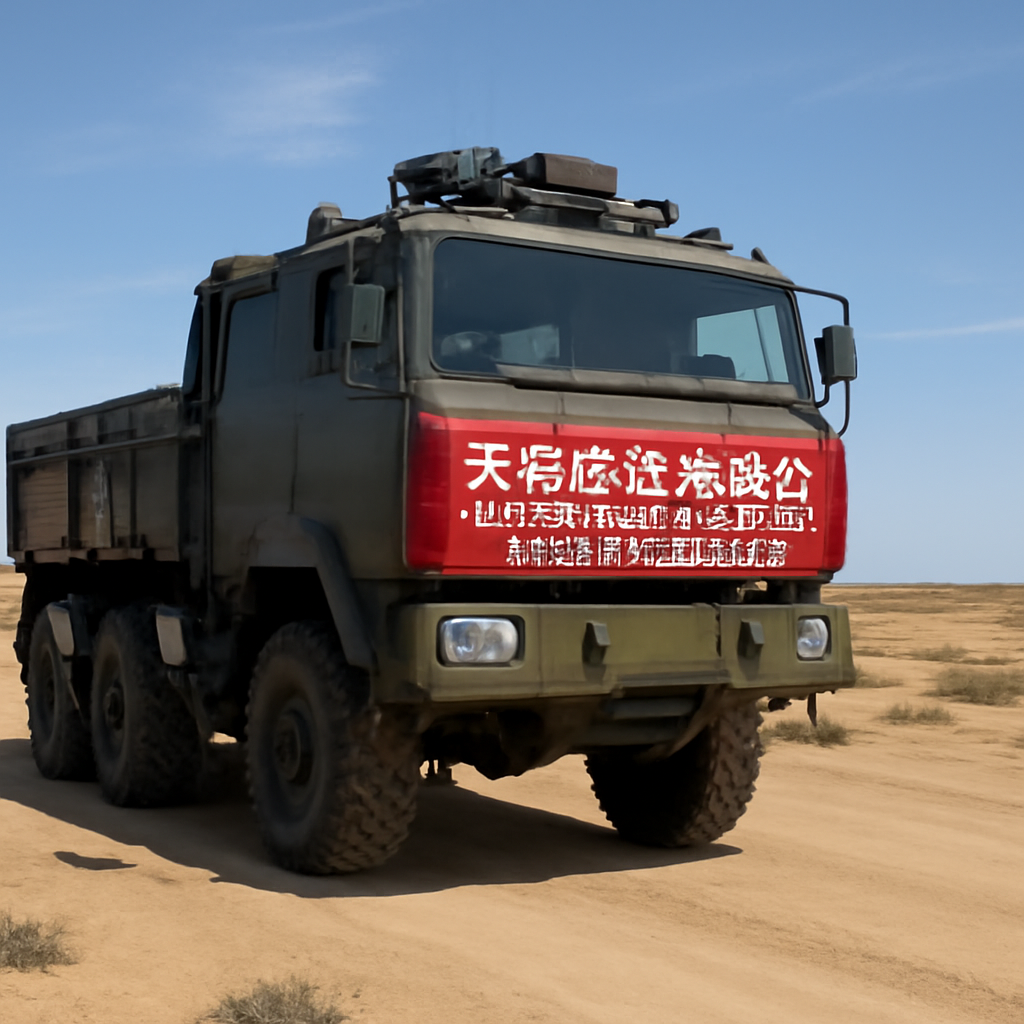
“Unmanned test vehicle, do not approach.” A red banner with those exact words is draped across a Shaanxi Auto HMV3 heavy‑duty high‑mobility tactical truck in a photograph that accompanies reporting on the People’s Liberation Army’s wider autonomy push.
Shaanxi Auto HMV3 unmanned testing in Inner Mongolia
The photograph and accompanying text place modified HMV3 trucks into the category of platforms being trialed as unmanned vehicles. The report notes that a single image cannot reveal program scale or maturity, but the image is presented as an observable data point: prototypes are circulating around test ranges, including ones in Inner Mongolia. The banner’s blunt instruction — do not approach — is the clearest public indicator in that visual record that these are being treated as autonomous or remotely operated testbeds rather than ordinary logistic trucks.
PLA autonomy is force‑wide, not limited to drones
The reporting situates the HMV3 trials within a broader pattern: autonomy work in the PLA extends beyond headline systems such as “loyal wingman” drones into the practical logistics backbone that sustains operations. The piece emphasizes that autonomy efforts are not siloed into discrete categories; instead, air systems and ground logistics are both on a trajectory for adoption. The HMV3 testing is framed as one visible sign of that cross‑domain effort.

This site is the portfolio.
OSINTSights runs on Cloudflare Workers, D1, R2, and Vectorize, with an AI pipeline on Hetzner ARM. Nubivance designed, built, and operates it. We do the same for clients.
See what we buildFAW MV3 armored troop transport variant: insulation, heating, and armor
Alongside unmanned trials, the report highlights a new armored troop transport built on the FAW MV3 chassis. Key, specific features are noted: the vehicle is large enough to carry 22 fully armed PLA infantry, the cabin is enclosed and insulated, and it includes heating (HVAC). It is armored for protection but — importantly — “not armed”: the vehicle has no weapon stations, no pintle mounts, and no remote turrets. In short, the modification is designed to move troops in relative comfort and safety rather than to add direct firepower.
From canvas covers to a “rolling metal thermos”: operational tradeoffs
The report contrasts the MV3 variant with traditional 6×6 military trucks that use canvas covers. It restates the familiar logistic argument supporting canvas — lighter, cheaper, modular, easier to repair and transport — summarized in the quoted phrase “logistical modularity.” But the reporting presses the operational tradeoff in stark terms: in cold, high‑altitude environments such as Tibet, canvas leaves troops exposed to freezing winds and ice. The FAW MV3 modification addresses those environmental vulnerabilities with a sealed, heated, armored cabin — described in the piece as a “rolling metal thermos” aimed at preserving soldier survivability and readiness.
What this means for technologists, procurement leaders, and PLA infantry
- Technologists and security teams: will see the HMV3 photo as evidence that autonomy integration is reaching mature platforms in logistics and will watch for telemetry, sensor suites, and command‑and‑control integrations that are not visible in images alone.
- Procurement leaders and logistics planners: are shown a concrete example of field‑driven modification — taking an existing FAW MV3 chassis and adapting it for climate, armor, and capacity — which suggests a path for incremental upgrades rather than wholesale platform replacement.
- PLA infantry and unit commanders: are the intended beneficiaries of the MV3 transport variant; the report implies that enclosed, heated, armored movement will materially improve troop comfort and reduce environmental casualties in cold, high‑altitude theaters like Tibet.
The photograph of an HMV3 marked as an “Unmanned test vehicle” and the parallel description of a heated, armored FAW MV3 troop carrier together sketch two complementary directions: one toward autonomous logistics platforms, the other toward pragmatic, survivability‑focused upgrades to existing chassis. Both moves are incremental, operationally rational adaptations — less the flash of new weapon concepts than the steady, workaday engineering that keeps units mobile and functional in harsh climates. The public record presented here answers some questions and leaves others open: how many prototypes are in circulation, what sensor and control suites they use, and how quickly such modifications will move from test ranges into widespread service.
https://china-defense.blogspot.com/2026/07/covering-existing-trucks-into.html