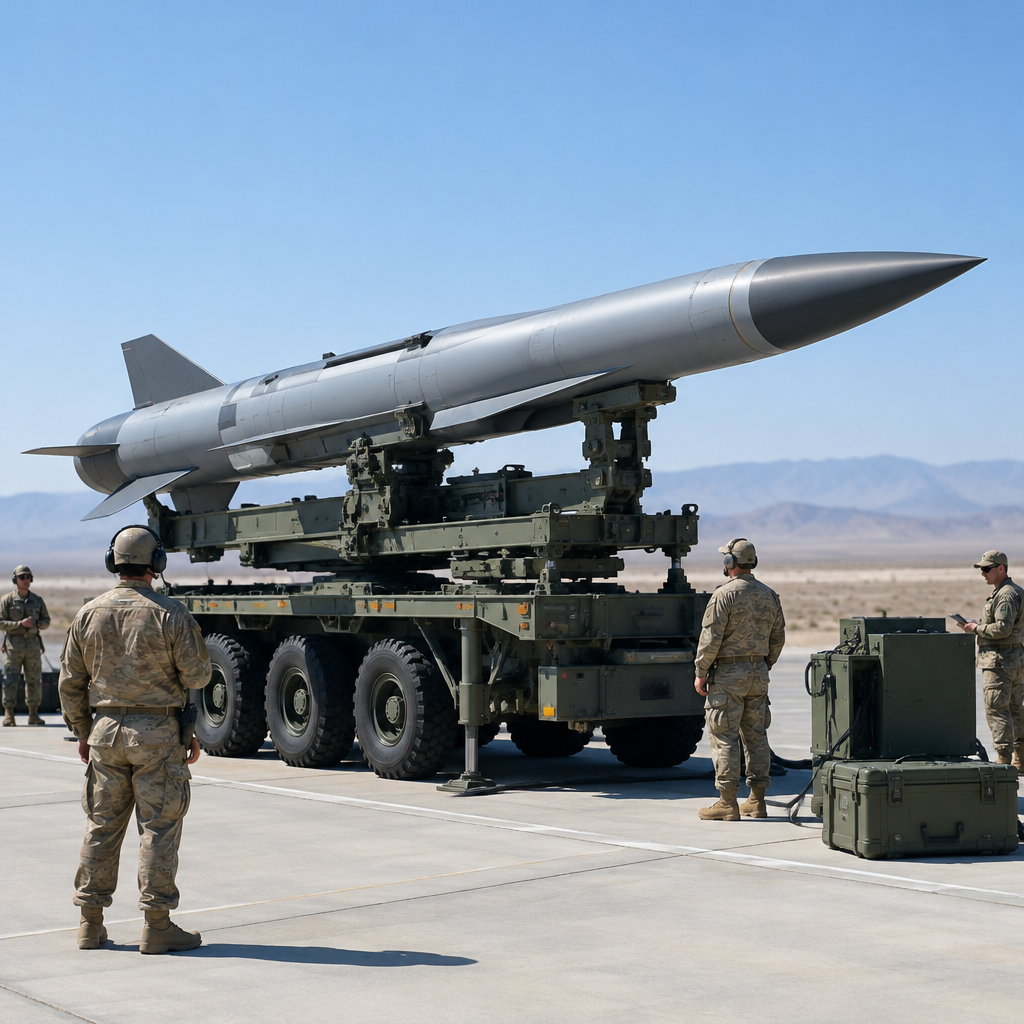
"What can we bolt onto that?" the blog post asks, and then answers by showing a pair of Red Arrow 10 (HJ-10) heavy anti‑tank missiles mounted on an MV3 chassis.
The PLA habit: repurpose the chassis
The China Defense Blog frames this change as part of a familiar pattern: whenever the People's Liberation Army spots an available chassis, the question is whether it can carry something new. The post uses that motif to introduce a specific instance — a pairing of Red Arrow 10 (HJ-10) heavy anti‑tank missiles with an MV3 chassis. The account presents this as another example in a line of adaptations rather than an isolated experiment.
What the pictured configuration shows
The post identifies the weapon system as the Red Arrow 10 (HJ‑10) and reports it appearing in a two‑launcher arrangement on an MV3 chassis. The language in the post describes the HJ‑10 as a "heavy anti‑tank" missile and characterizes the observation as a winner among the many ideas that present themselves when engineers look at spare chassis. Beyond noting the pair of HJ‑10s and the MV3 host, the piece frames the combination as a deliberate mounting choice rather than a casual field modification.

The cyber insurance questionnaire just landed. Now what?
SOC 2, HIPAA, insurance renewals - someone has to own security strategy. Nubivance provides fractional CISO leadership without the full-time salary.
Get a security leadWhy the MV3 matters in this report
The post's headline and narrative center the MV3 as the chassis that "finds a home" for the HJ‑10 pair. The MV3 is presented in the post as the available platform on which the Red Arrow 10 was bolted; the report implicitly treats the MV3 as a practical, ready platform for mounting heavier weapons. The post stops short of detailing the conversion process, numbers of vehicles, or the operational context in which the pictured configuration was taken, focusing instead on the visible result: HJ‑10s on an MV3.
How technologists, procurement leaders, and military planners should read this
- Technologists and maintenance teams: The blog post signals continued emphasis on modular use of chassis. Teams responsible for vehicle integration will likely note the simple logic the post highlights — reuse available chassis to host existing systems — and watch for further examples that reveal mounting points, power or interface additions, and repeated design choices.
- Procurement leaders and logistics planners: The pictured pairing underscores the potential for existing fleets to be adapted for new roles. The post's framing — that this is one of many chassis‑repurposing moves — suggests procurement and sustainment decisions should account for dual uses of platforms already in service.
- Military planners: The post presents the conversion as another instance of fielded creativity. Planners reading the account can treat the image and the blog's commentary as evidence of a continuing practice, and therefore as a factor to consider in force posture and countermeasure planning.
What the post leaves as the open question
The blog post presents the visual and rhetorical claim — a pair of Red Arrow 10 (HJ‑10) heavy anti‑tank missiles mounted on an MV3 chassis — but does not provide operational details, quantities, or an explicit explanation of intent. The narrative invites readers to consider the broader pattern it names: that available chassis often become carriers for new configurations. The immediate, concrete takeaway from the post is precisely that image and that motif; what follows in practice — whether this pairing becomes widespread, experimental, or purely demonstrative — is not specified in the reporting.
Link to original story: https://china-defense.blogspot.com/2026/11/every-chassis-fights-nobody-quits-red.html