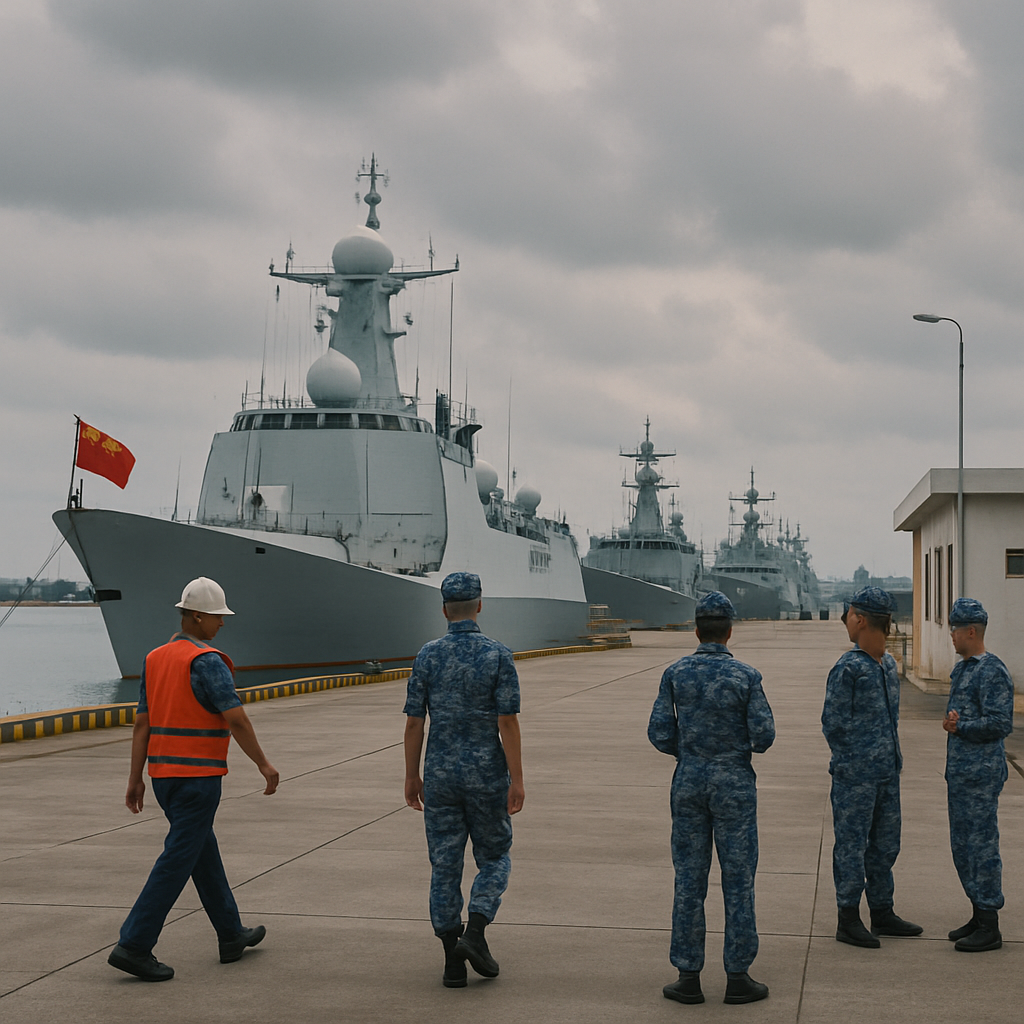
China’s movement from episodic appearances to an expected, persistent naval and intelligence footprint across the Indian and Pacific oceans is now the central strategic risk for Indo‑Pacific countries — including Australia, India and Japan — because rising frequency and normalisation reduce the political cost to Beijing of coercive behaviour.
China’s two‑ocean strategy and the Belt and Road momentum
According to the analysis, China has shifted from patrols near its own waters to a deliberate two‑ocean strategy in which fleets operate across the western Pacific and the Indian Ocean. That strategy gained “a renewed relevance and momentum” after the Belt and Road Initiative began in 2013, driving an expansion of economic and energy interests beyond China’s immediate waters. ASPI’s war‑gaming in March — which modelled how China’s defence and security agencies might extend influence through 2036 — underpins the judgment that appearances long judged isolated are becoming sustained.
Exercises, port calls and medical diplomacy: making presence routine
The report highlights a pattern of incremental steps that together make a sustained footprint more plausible. High‑profile events such as China’s 2025 live‑fire drills in the Tasman Sea are likely to be replicated elsewhere and with rising frequency, sending a message that “standing in China’s way is risky.” Rest‑and‑recreation port visits can move from episodic to rotational patterns, with ships arriving regularly for resupply and sometimes conducting surveillance and intelligence tasks while in region. Medical diplomacy — notably missions by the hospital ship Heping Fangzhou (Peace Ark) — is flagged as a pathway to deepen Chinese presence in smaller and weaker states, producing strategic benefits beyond humanitarian optics.

Audit-ready is a season. It shouldn't be.
Evidence in spreadsheets, controls drifting between audits, frameworks multiplying on flat headcount. Nubivance runs continuous compliance on Rapid7 Cyber GRC - SOC 2, HIPAA, ISO 27001, PCI, CMMC.
End the scrambleSurveillance ships, Dongdiao class and undersea mapping
ASPI’s material warns that vessels described by Beijing as research ships are operating as surveillance and intelligence platforms. Dongdiao‑class ships are singled out as being equipped with advanced radar and intelligence collection equipment. The more often such ships appear, the more they can monitor foreign military activities and multinational exercises such as Talisman Sabre. The analysis also notes existing Chinese monitoring of Indian rocket and missile launches and probable efforts to map ocean topography to support submarine operations — activities the report says are likely to expand.
Dual‑use facilities and the China Coast Guard’s extended role
The piece points to growth in dual‑use and logistics facilities tied to commercial ports — facilities that can be upgraded from purely logistical functions to directly aid naval and intelligence activity. The projection is that many more such dual‑use sites will be established across the Indian and Pacific oceans in the next decade. Parallel to this, the China Coast Guard is expected to play a larger role in Beijing’s maritime strategy. ASPI notes that China’s 2021 Coast Guard Law is “already contrary to international law,” and interprets that as an indicator of how the service may behave further afield, including the potential for extraterritorial law‑enforcement patrols and new legal justifications for interventions in others’ territorial waters.
What this means for Australia, India, and smaller Indo‑Pacific states
- Australia: The report frames Australia as a direct audience for China’s coercive message, citing exercises and persistent presence that are intended to shape Australian responses and those of allies such as the United States.
- India: ASPI records that China has been sending ships to monitor Indian rocket and missile launches, implying India will face a growing intelligence burden and maritime surveillance challenge if the pattern expands.
- Smaller and weaker Indo‑Pacific states: Medical diplomacy and port calls can open deeper strategic footholds; these countries may welcome immediate assistance while unintentionally facilitating longer‑term Chinese naval and intelligence access.
ASPI’s central prescription is diplomatic and cooperative: call out these manoeuvres before they normalise, use regional security diplomacy to highlight the emerging danger, and develop cooperative responses. Such diplomacy, the analysis argues, could deter Beijing or — if deterrence fails — form the basis for stronger collective defence measures. The argument rests on a simple premise: incremental, persistent presence erodes political resistance and changes expectations, so naming and contesting those increments early is the tactical choice the report recommends.
https://www.aspistrategist.org.au/expanding-frontiers-how-china-normalises-its-presence/