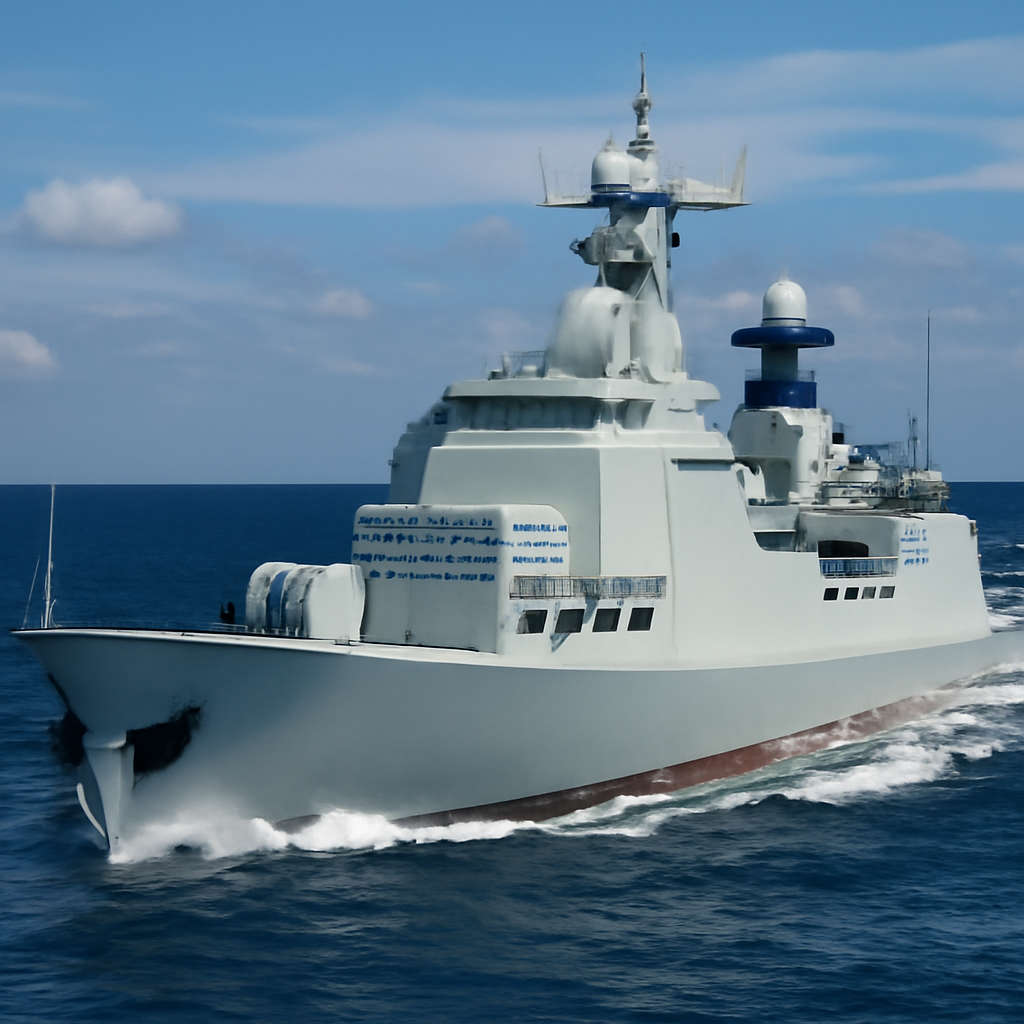
"China’s pressure on Taiwan increasingly relies on vessels that aren’t warships," the source reads — a simple line that captures a strategic shift from overt naval signalling to a more ambiguous, persistent pressure at sea.
Mass presence and swarming around Matsu
One recurring pattern described in the reporting is mass presence and swarming. Large fleets of sand dredgers and fishing vessels have repeatedly appeared near Taiwan’s outlying islands, particularly around Matsu, sometimes numbering in the hundreds and overwhelming Taiwan’s coastguard patrol capacity. Those concentrations are not framed as isolated accidents but as operational choices that create friction, saturate local enforcement, and make routine patrols difficult to sustain.
Law-enforcement encroachment near Kinmen
Another pattern is law-enforcement encroachment. The China Coast Guard (CCG) has increasingly entered waters near Taiwanese-controlled islands such as Kinmen, conducting patrols, inspections and boardings. The reporting notes that after a fatal incident involving a Chinese speedboat near Kinmen in February 2024, Beijing intensified coastguard patrols and began portraying them as routine enforcement operations. The effect is to normalise Chinese activity in waters long administered by Taiwan and to reshape the day-to-day operational environment without formally invoking naval forces.

Audit-ready is a season. It shouldn't be.
Evidence in spreadsheets, controls drifting between audits, frameworks multiplying on flat headcount. Nubivance runs continuous compliance on Rapid7 Cyber GRC - SOC 2, HIPAA, ISO 27001, PCI, CMMC.
End the scramblePressure on subsea cables and the Hong Tai 58 case
Civilian maritime activity has also targeted critical infrastructure. In early 2023 two subsea internet cables serving the outlying Matsu islands were severed within days of each other, leaving residents with severely degraded connectivity for weeks. More recently, suspected cable incidents in 2025 involved vessels flying flags of convenience and exhibiting suspicious Automatic Identification System (AIS) tracking data. In one documented instance Taiwanese authorities detained the cargo ship Hong Tai 58 and later prosecuted its captain for intentionally damaging a cable linking Taiwan and Penghu. Even where intent cannot be conclusively proven, these events expose vulnerabilities in Taiwan’s maritime digital infrastructure and show how commercial shipping networks can be leveraged for strategic signalling while remaining below a military threshold.
The "three sea forces" and the grey‑zone ecosystem
The reporting frames China’s approach not as random harassment but as an integrated maritime ecosystem. Civilian and paramilitary vessels — including maritime militia fishing boats, sand dredgers, logistics ships and commercial cargo vessels operating through opaque ownership structures — form an outer layer of activity that can be mobilised to serve state objectives while maintaining plausible deniability. That outer layer is intended to monitor, obstruct and create friction; behind it sit coastguard and naval options for escalation. This “three sea forces” structure, the article asserts, would be particularly useful in a blockade or quarantine scenario, where large numbers of civilian vessels could monitor shipping, obstruct ports or support enforcement operations while preserving the appearance of non‑military action.
What this means for Taiwan’s coastguard, security partners, and infrastructure teams
- Taiwan’s coastguard: The grey‑zone tempo — described as steadier across 2025 than the spike-driven 2024 pattern — stretches patrol capacity. The article argues the island needs strengthened surveillance tools, clearer legal frameworks for maritime enforcement, and increased operational capacity to confront large numbers of civilian vessels without escalating to conventional military confrontation.
- Taiwan’s security partners: Partners are advised to help improve maritime transparency and operational cooperation, including integrating satellite imagery, AIS tracking and radar monitoring to identify suspicious vessel behaviour and patterns of coordination.
- Infrastructure and repair teams: The reporting highlights the need to protect subsea cables by strengthening monitoring along cable routes and improving rapid repair capacity so connectivity losses from deliberate or incidental damage are shortened.
Collectively, these facts point to a deliberate strategy that does not rely solely on visible naval force but on ambiguity: normalising presence, stretching response capacity and gradually eroding Taiwanese control over near seas while keeping incidents below the threshold of open conflict. The prescription offered is equally practical and technical — better transparency through imagery and AIS, harder protections for subsea infrastructure, and upgraded coastguard capacity and legal tools.
The central question the reporting leaves front and center is operational: can ambiguity be removed in time to prevent grey‑zone pressure from becoming a permanent feature of the Taiwan Strait? The measures recommended — integrated monitoring, stronger enforcement frameworks and resilience for critical undersea infrastructure — map directly to the patterns documented between 2023 and 2025. Whether they are adopted at sufficient scale will determine if Taiwan’s control at sea remains resilient or slowly erodes under sustained, civilian‑masked pressure.
https://www.aspistrategist.org.au/chinas-grey-zone-fleet-is-eroding-taiwans-control-at-sea/