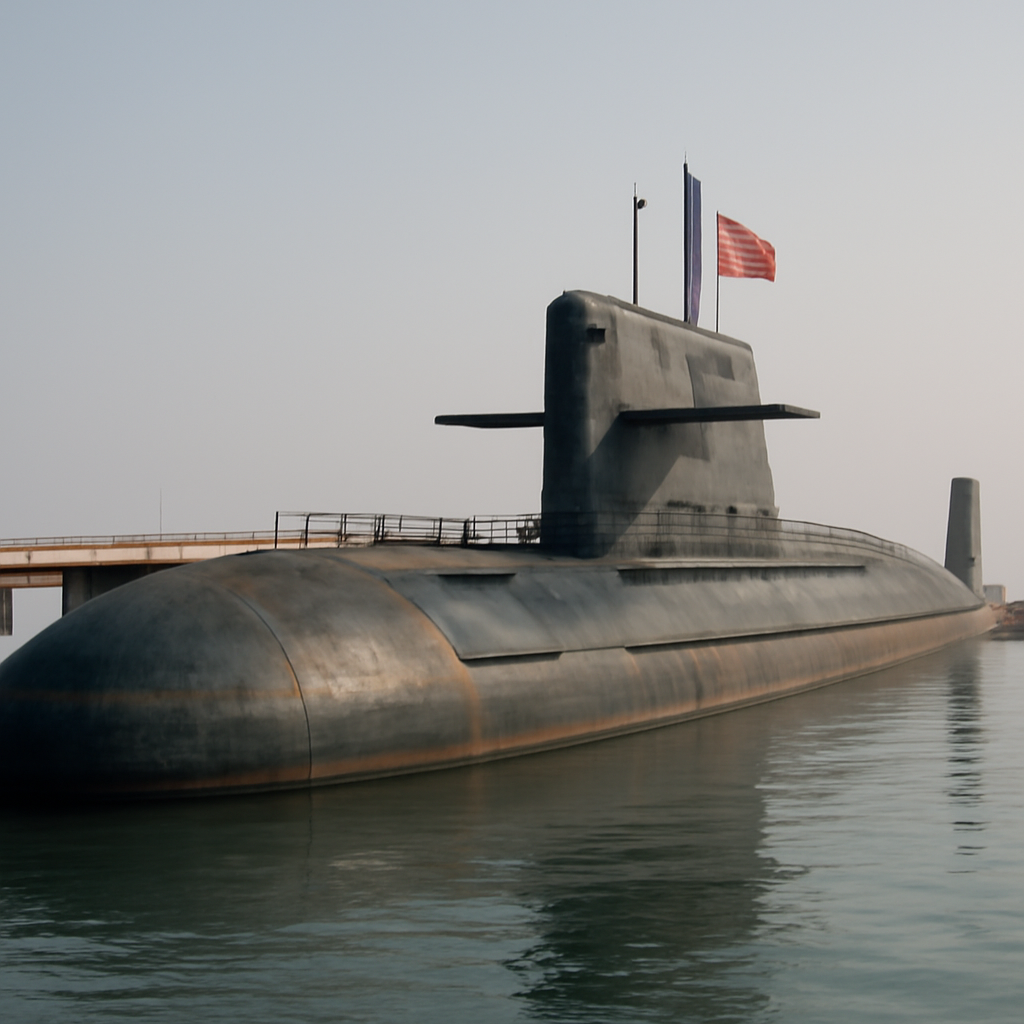
"She’s still around, still floating, and still 'supporting' the PLAN," the CCTV segment said — an odd line of celebratory copy for what the broadcaster showed: 406, the lone Xia‑class SSBN, moored and being used as a classroom.
406, the lone Xia‑class SSBN: 45 years since April 1981
406 is China’s first ballistic‑missile submarine, the Xia‑class boat launched in April 1981. At 45 years old, she is described in the source as the longest‑serving nuclear‑powered submarine "in the PLAN’s orbit." The vessel has been widely characterized elsewhere as having been "almost retired" for roughly two decades; the material in this account underscores that she remains physically present rather than operationally deployed.
CCTV’s presentation: familiarization platform and classroom model
According to a CCTV segment cited in the source, 406 is "supporting" the People’s Liberation Army Navy (PLAN) by serving as a familiarization platform for new submariners. In practice, the report says, that role is a walk‑through exhibit: "this is what a boomer looks like on the inside." The coverage included a motivational video produced to educate recruits identified in the segment as NUBs ("Non‑Useful Bodies"), turning the vessel into a training aid and propaganda tool rather than a front‑line asset.

Audit-ready is a season. It shouldn't be.
Evidence in spreadsheets, controls drifting between audits, frameworks multiplying on flat headcount. Nubivance runs continuous compliance on Rapid7 Cyber GRC - SOC 2, HIPAA, ISO 27001, PCI, CMMC.
End the scramblePhysical condition: moored, marked by rust, a true "harbor queen"
The CCTV screenshots cited in the source show 406 at the pier. The broadcaster, which is described as normally softening imagery of PLA hardware, did not mask visible rust streaks on the hull. The source says the boat "is not going anywhere" and repeatedly characterizes her as a harbor‑bound presence: a vessel that exists for familiarization and display rather than at‑sea operations.
Official messaging and the state of the PLAN’s nuclear submarine force
The source offers a blunt reading of the public relations angle: "There is absolutely nothing happening in the PLAN’s nuclear submarine force right now." That summary frames CCTV’s choice to highlight a 45‑year‑old, pier‑bound submarine as the centerpiece of a service birthday as evidence of a quiet period for the force. The coverage itself, with training walkthroughs and motivational pieces for recruits, functions as internal familiarization and external reassurance rather than an operational update.
How new submariners, the PLAN Submarine Force, and CCTV are affected
- New submariners: The coverage positions 406 as a hands‑on classroom model. For recruits, the boat provides a physical walk‑through to learn what a ballistic missile submarine looks and feels like, even if the vessel is not operational.
- The PLAN Submarine Force: Presenting 406 as a training aid allows the service to preserve institutional memory of its first "boomer" and to use a tangible platform in sailor familiarization while not committing the hull to sea operations.
- CCTV and public messaging: By featuring 406 in a service birthday segment and pairing the tour with motivational material for NUBs ("Non‑Useful Bodies"), the broadcaster repackaged a pier‑bound vessel into a narrative of continuity and education for audiences at home and in service ranks.
The simple, verifiable facts in the record are threefold: 406 is the lone Xia‑class SSBN launched in April 1981; she is being shown by CCTV as a familiarization and training platform; and she appears in official footage as a stationary, rust‑marked "harbor queen" rather than a deployed asset. CCTV’s decision to foreground that presentation for the PLAN Submarine Force’s 72nd birthday is the clearest public signal in the available material — a signal that, in the words quoted above, the boat is still present, still floating, and "supporting" the service in a non‑operational, educational capacity.