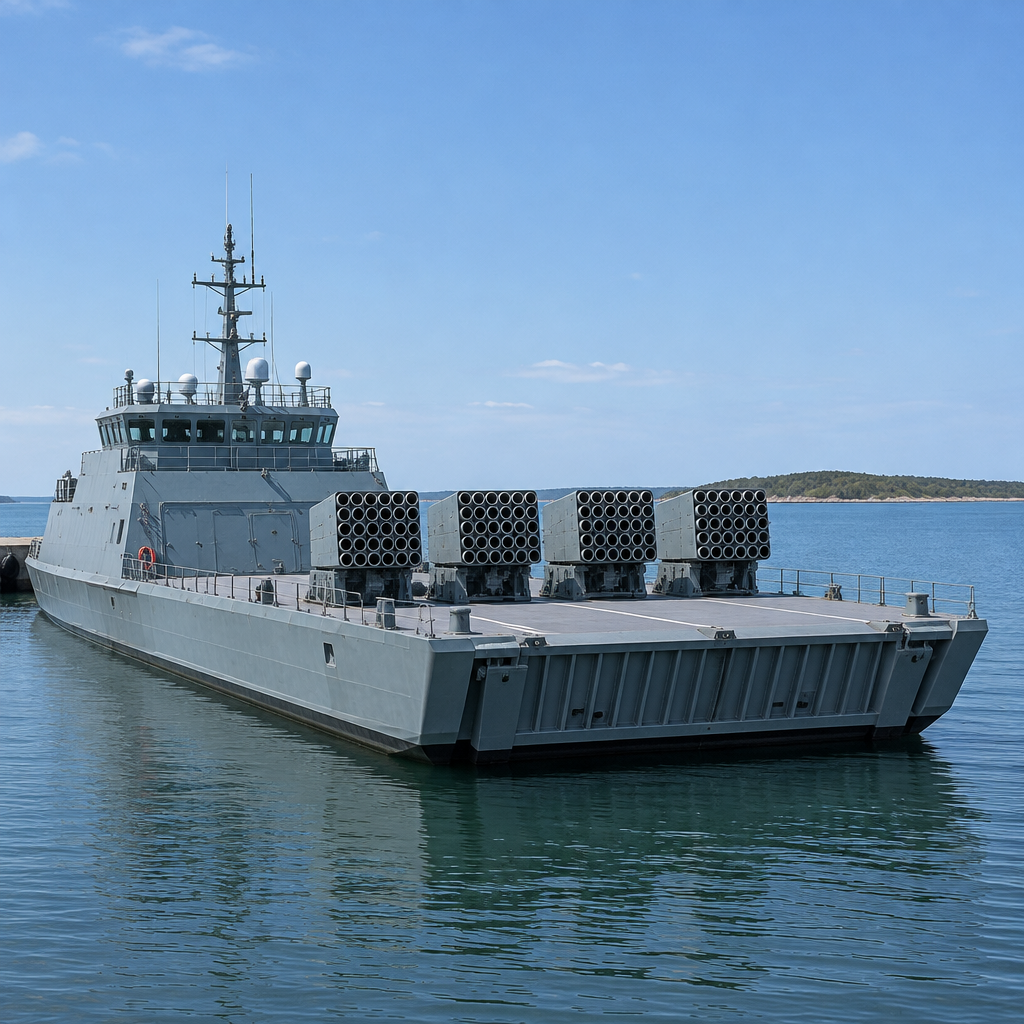
"The launchers are clearly visible and appear to be arranged in an 8x4 configuration, giving each mount 32 tubes." New images circulating on the Chinese internet have brought that fact into sharper relief, offering the best public look yet at LD903, a small but unusual vessel attributed to the PLA Ground Force.
LD903's rocket fit and what it shows
The most striking detail in the new photographs is the shipboard rocket armament. Multiple launcher mounts are visible on LD903's aft deck; the launcher panels shown appear to be arranged in an 8x4 grid, which the author of the images counts as 32 tubes per mount. The mounts themselves appear capable of traversing and elevating to different firing angles.
Two operational questions remain open in the available imagery: whether the launchers can be rapidly reloaded at sea after firing, and whether any stabilization system is present to improve firing accuracy while the ship is underway. The published pictures do not provide an obvious answer to either question.
Hull form, size and endurance
Visually, LD903 departs from classic landing-ship lines. The vessel lacks bow doors and the amphibious configuration typical of landing ships; instead it resembles a purpose-built rocket support vessel constructed around a commercial-style hull. Based on a rough visual estimate provided in the reporting, LD903 is on the order of 70–90 meters long with a displacement in the neighborhood of 1,500–3,000 tons.
The vessel appears ocean-capable rather than confined to littoral work. Weathering visible in the photos suggests LD903 has been in service for some time rather than being a recent launch.

This site is the portfolio.
OSINTSights runs on Cloudflare Workers, D1, R2, and Vectorize, with an AI pipeline on Hetzner ARM. Nubivance designed, built, and operates it. We do the same for clients.
See what we buildDefensive armament, sensors and the ship's design trade-offs
Deck arrangement emphasizes a large open cargo area aft of the superstructure where multiple rocket launchers are mounted — a layout that suggests the design prioritized salvo size over survivability. There are no obvious signs in the images of sophisticated sensor arrays, elaborate combat-systems cabinets, or heavy self‑defense suites.
Defensive weapons visible in the photographs are limited to two H/PJ-17 single-barrel 30mm guns, the same weapon commonly seen aboard many Chinese auxiliary vessels. That sparse defensive fit aligns with the author's characterization of LD903 as a relatively cheap, highly specialized bombardment platform rather than a multi-mission combatant.
Range and a coastal geometry to watch: Fujian and offshore fires
The reported rockets associated with these mounts are believed to be a navalized 122mm multiple-rocket system. Assuming those rockets reach their advertised performance, the author calculates that a vessel of this type could provide fire support from as far as 68 nautical miles (126–130 km) east of Fujian — a position described as outside the "immediate coastal battlespace." The point underscores a design philosophy that trades platform protection and sensor sophistication for standoff volume of fire.
How the PLA intends to employ such platforms is not determined by the photographs. The reporting notes the potential missions under consideration include suppressing beach defenses, attacking coastal targets, or providing sustained fire support during an amphibious operation; the specific operational role remains an open question.
What this means for the PLA Ground Force, the Eastern Theater Command, and coastal defense planners
- PLA Ground Force: The vessel class — designated LD, interpreted as "L" for Land Force and "D" for East in earlier reporting — appears to be a specialist tool for maritime bombardment. If employed as intended, these ships would provide a volume-of-fire capability aligned with amphibious-support doctrine.
- Eastern Theater Command: The LD prefix and earlier references to LD902 were used to suggest an Eastern Theater Command connection. For a theater commander, such platforms offer a relatively low-cost means to project rocket salvos from beyond the immediate coast, changing the geometry of supporting fires.
- Coastal defense planners and analysts: Defenders must account for a cheap, sea-based salvo generator that lacks heavy self-defense but can operate at standoff ranges. Planners will want to know reload capability and at-sea stabilization — the two technical unknowns evident in the photographs — because those factors determine sustained fires and accuracy while underway.
LD903 is not a high-end surface combatant. It reads instead as a specialist design: many tubes on a modest hull, limited defensive fits, and a clear emphasis on delivering massed rocket fires. The newly surfaced images confirm those choices and leave two narrow but consequential technical questions—reload capability at sea and launch stabilization—at the center of any future assessment of the class's operational value. If the People’s Liberation Army decides to scale production, the reporting concludes, the ship type's relatively simple design could be produced quickly and inexpensively given available industrial capacity.