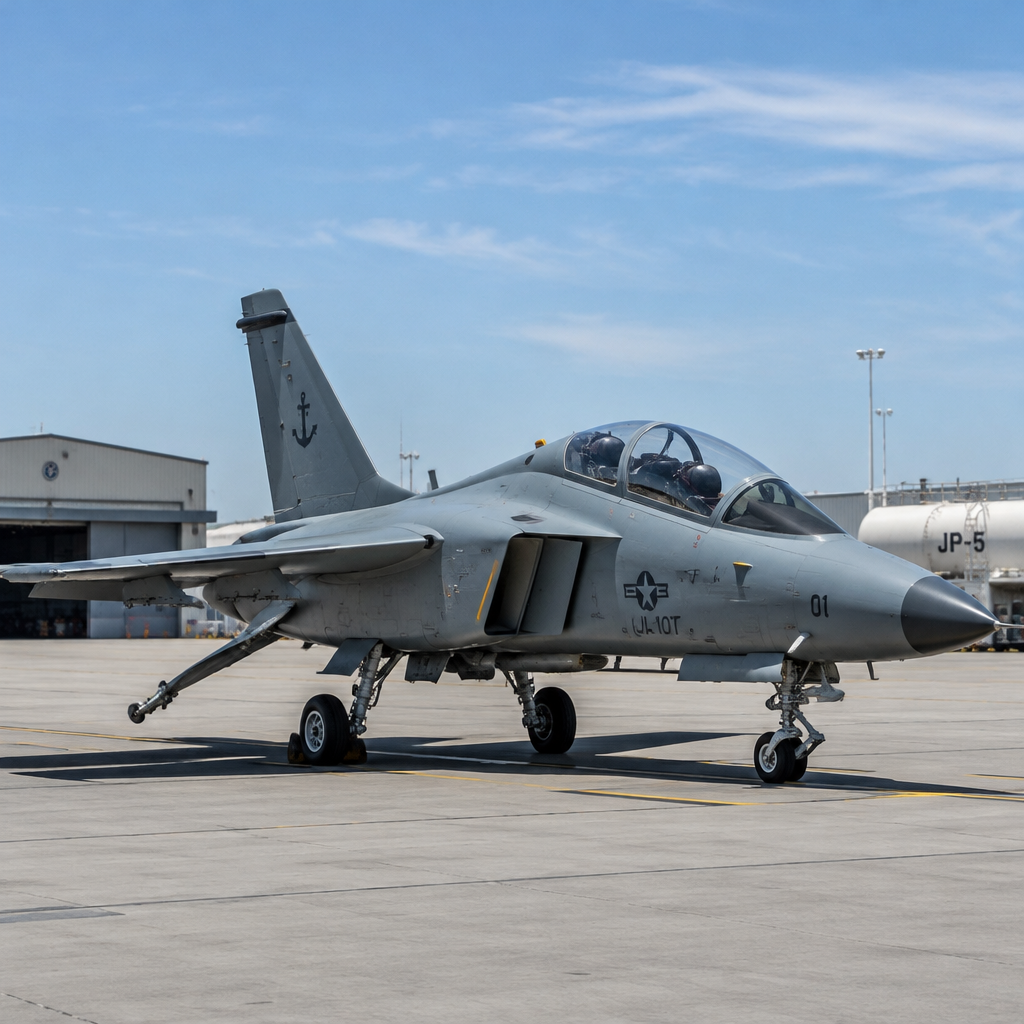
“Because in naval aviation, the most difficult hardware to manufacture has always been the one sitting in the cockpit.” That blunt observation from the reporting captures what the new JL-10T photographs make plain: Beijing is building training capacity as deliberately as it builds carriers.
The JL-10T’s carrier-ready design
The newly circulated images show a clearly navalized variant: reinforced landing gear, a strengthened tailhook section, and other carrier-specific modifications. Those visible changes leave little doubt about intent — this is an advanced trainer built to practice arrested landings and other deck operations rather than a simple shore-based jet.
How the JL-10T fits the PLAN training pipeline
The reporting outlines a likely training progression for People’s Liberation Army Navy (PLAN) carrier aviators that places the JL-10T into an intermediate but critical role. Before the JL-10T, the flow looks like this:
- Basic flight training
- JL‑8 / JL‑10 advanced jet training
- JL‑9G shore‑based carrier approach training
- J‑15 conversion unit
- Field Carrier Landing Practice (FCLP) at Huangdicun
- Carrier qualification aboard Liaoning or Shandong
In many Western carrier navies a dedicated carrier trainer routinely practices arrested landings; the JL‑10T can provide that dedicated arrested‑landing stage for the PLAN, taking some pressure off the current succession that moves pilots from the JL‑9G into two‑seat J‑15 variants for carrier work.

The cyber insurance questionnaire just landed. Now what?
SOC 2, HIPAA, insurance renewals - someone has to own security strategy. Nubivance provides fractional CISO leadership without the full-time salary.
Get a security leadJL‑9 upgrades and the twin‑engine argument
Public reporting cited in the source notes that the JL‑9G is a single‑engine trainer adapted from the JL‑9/JJ‑7 airframe, while most Chinese carrier combat aircraft are twin‑engine designs. That mismatch has been one reason observers have flagged the need for a twin‑engine lead‑in fighter trainer (LIFT). The source also records an upgraded JL‑9 that removed the drogue parachute and added wingtip split rudders — modifications said to improve stability and low‑speed performance and to act as air brakes useful for carrier-approach practice. The upgraded JL‑9 reportedly made its maiden test flight in May 2020.
Those JL‑9 improvements were shown in an official exercise report carried by China Bugle — described in the source as “an official media account affiliated with the PLA News Media Center” — and Song Zhongping, identified as a Chinese military affairs expert, was quoted explaining the role of split rudders and potential applications for future stealth designs.
Dual‑track development: JL‑10T and JL‑10 Twin‑Tail
The appearance of the JL‑10T comes alongside sightings of a JL‑10 “Twin‑Tail” program. The reporting presents this as a familiar PLA approach: run parallel or complementary programs rather than place a single bet. At this stage the relationship is unclear — competitor, primary and backup, or complementary — but the practical effect is explicit: redundancy in pilot production pathways. The source frames that as a deliberate hedge against training bottlenecks as carrier numbers expand.
What this means for the PLAN, the Naval Aviation University, and outside observers
- PLAN leadership: The JL‑10T offers additional, carrier‑specific instructor capacity that could accelerate the pace at which pilots achieve arrested‑landing qualifications and reduce reliance on conversion in frontline two‑seat fighters.
- Naval Aviation University and training units: The official exercises and the presence of upgraded JL‑9s in university-affiliated regiments suggest an institutional push to institutionalize carrier‑approach skills across multiple airframes and ranges such as Huangdicun FCLP.
- YouTube and open-source observers: With images and program sightings multiplying — JL‑9 upgrades, JL‑10T photos, and the JL‑10 Twin‑Tail — public counting of hardware (catapults, VLS, airframes) must be matched by attention to the training pipeline that actually staffs those platforms.
The first clear photos of the JL‑10T sharpen an argument already visible in official reporting: carriers and aircraft matter, but so do the pilots who fly them. The PLAN’s visible response — a navalized trainer plus a parallel JL‑10 Twin‑Tail track and upgraded JL‑9s — signals a concerted attempt to routinize carrier qualifications rather than treat them as an ad‑hoc step. What remains open in the material is how the two JL‑10 variants will divide labor and scale across the fleet; the next visible milestones to watch are flight‑test results, unit assignments within training regiments, and the degree to which the JL‑10T enters routine FCLP and carrier‑qual cycles.
https://china-defense.blogspot.com/2026/11/first-clear-photos-of-advanced-carrier.html