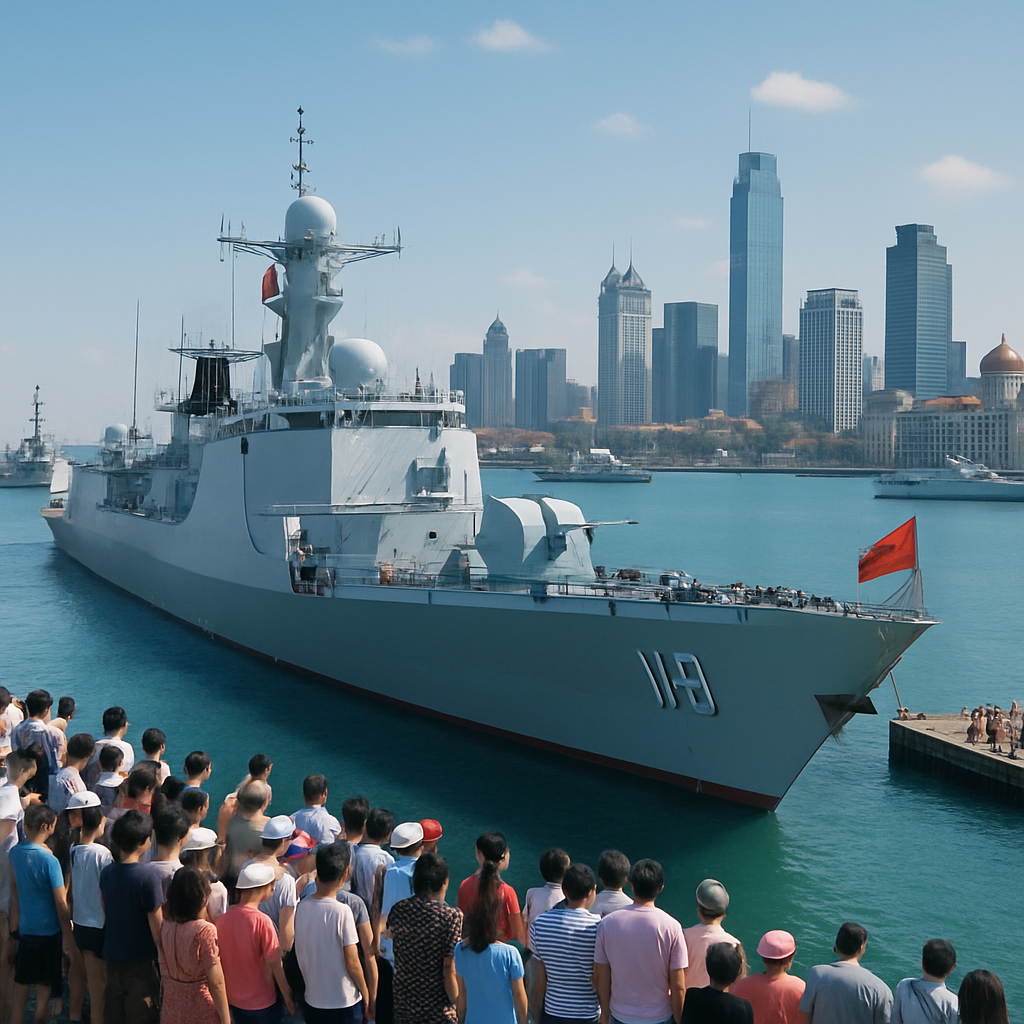
Some 40 warships participated in anniversary events across 10 cities, from Qingdao and Shanghai to Guangzhou and Sanya.
Scale of the April 23 anniversary and what it showed
April 23 marked the 77th anniversary of the People’s Liberation Army Navy (PLAN), and the anniversary program made an unmistakable point: the PLAN is staging large, visible events at home. The celebrations involved dozens of ships and public activities in multiple coastal population centers. The breadth of participation — forty ships, ten cities — signals a deliberate effort to place naval platforms in front of domestic audiences rather than confining major displays to fleet bases or foreign port visits.
Domestic port calls: a growing pattern
The PLAN’s use of domestic ports is not a one-off pivot. According to the reporting, PLAN port visits throughout coastal China have increased over the past two years, and at least 15 domestic visits now account for roughly 20 percent of total port calls. Where the PLAN traditionally leaned on overseas port calls to support global operations and diplomacy, the balance is shifting: domestic calls are becoming a strategic priority in themselves, intended to normalize naval presence within China and reinforce political legitimacy.

This site is the portfolio.
OSINTSights runs on Cloudflare Workers, D1, R2, and Vectorize, with an AI pipeline on Hetzner ARM. Nubivance designed, built, and operates it. We do the same for clients.
See what we buildPublic ship tours: familiarity, recruitment, and routinization
A central feature of these visits is large “open to the public” ship tours. The PLAN is using such tours to give civilians access to modern warships and crew — an approach the reporting directly compares to U.S. Navy public engagements during Fleet Weeks. Public access serves multiple purposes that the PLAN itself appears to prize: educating citizens about naval missions, boosting recruitment, and making naval power a routine, tangible part of everyday life rather than an occasional televised spectacle on CCTV-7. The PLAN 2025 anniversary illustrates this trend: thirty warships visited and hosted public tours across coastal China, including newer platforms such as the Shijiazhuang (DDG 106), the Kaifeng (FFG 124), and the Chengdu (DDG 120). The Chengdu even used an eye-catching attraction — widely reported inflatable pandas — to draw the public and link the warship to its namesake city’s famous panda reserve.
Economic and political messaging: Yulin, Beihai, and the Shandong (CV 17)
Port visits have been explicitly tied to domestic economic and political narratives. The Yulin (FFG 569) visited the new Yulin City commercial port in Beihai during the 2024 National Day Golden Week; state media used the visit to promote regional development and to emphasize maritime infrastructure as part of Belt and Road-linked initiatives. There, the PLAN became a symbol of economic integration and progress.
Political signaling appears equally deliberate. The Shandong (CV 17), identified in reporting as China’s first domestically built aircraft carrier, visited Hong Kong in July 2025 for the 28th anniversary of the handover. Public access to the carrier was framed by PLA editorials as a show of military strength and political symbolism; commentators described the carrier’s visit as highlighting the connection between national security and Hong Kong’s stability, and as promoting national identity and confidence in governance after the National Security Law. In short, these port calls are being used to project central authority and to stitch naval presence into narratives about state achievement and control.
What this means for the Chinese public, regional development officials, and the PLAN
- The Chinese public: Ship tours and high-profile visits make the PLAN’s modern platforms tangible and routine. The reporting says this familiarity is intended to build confidence in the service and to normalize the presence of naval power in civic life.
- Regional development officials: Visits like the Yulin stop in Beihai show how the PLAN’s visibility is leveraged to promote maritime infrastructure and economic integration, especially for inland cities seeking port connections as part of Belt and Road-linked initiatives.
- The PLAN and recruitment planners: The inward focus supports recruitment of technically proficient personnel to operate modern platforms, according to the reporting, by raising public awareness of the service and its capabilities.
Collectively, these facts sketch a clear strategic choice: what was once primarily outward-facing naval diplomacy is being expanded inward. The domestic turn stitches the navy into economic messaging, political symbolism, and civic life — and, the reporting warns, it has external implications too: a public more familiar with naval power may be more supportive of its use as the PLAN continues to grow in size and operational capacity.
Original story: China’s Naval Diplomacy Turns Back Toward Home — The Diplomat, April 23, 2026