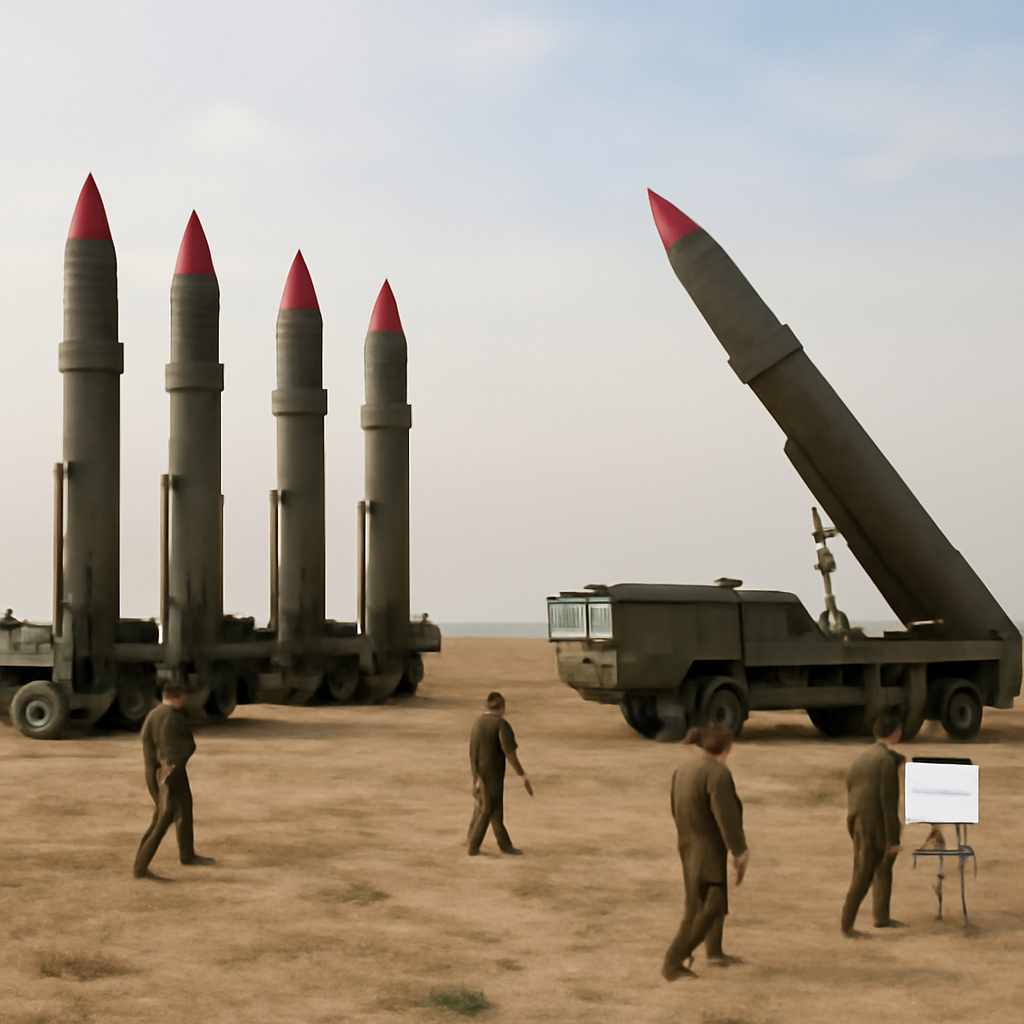
"The Pentagon has estimated that China had surpassed 600 operational nuclear warheads in its stockpile as of mid-2024 and will have over 1,000 operational warheads by 2030," a rapid growth trajectory that the unclassified U.S. reporting says will be accompanied by higher readiness levels across Beijing’s forces.
PLARF modernization and the Pentagon’s assessment
The People’s Liberation Army Rocket Force (PLARF) is central to Beijing’s rapid missile modernization. The U.S. Department of Defense has described China’s program as "the world’s most active and diverse missile development program," and the unclassified December 2024 Pentagon report warned that “over the next decade, the PRC probably will continue to modernize, diversify, and expand its nuclear forces rapidly.” The report adds that “the PLARF is advancing its long-term modernization plans to enhance its ‘strategic deterrence’ capabilities.”
Silo construction at Yumen, Hami and Ordos
Open-source researchers first publicized a surge in silo construction in 2021, documenting several hundred new missile silos clustered near three sites: Yumen (120 silos), Hami (110 silos), and Ordos (around 90). The analysts who located the new silos called it “the most significant expansion of the Chinese nuclear arsenal ever.” The U.S. State Department has said that the U.S. intelligence community believes every silo will have a missile “loaded.” The reporting notes an alternative concept — leaving some silos empty as part of a 'shell game' — but presents the State Department’s assessment as the contrasting U.S. intelligence view.

This site is the portfolio.
OSINTSights runs on Cloudflare Workers, D1, R2, and Vectorize, with an AI pipeline on Hetzner ARM. Nubivance designed, built, and operates it. We do the same for clients.
See what we buildLand-based ICBMs: DF-5, DF-31 family, DF-41 and the DF-61
- DF-5 (range: 12,000+ km): China’s oldest surviving liquid-fueled ICBM family remains in service in silo form. Western estimates list 20 known DF-5 silos. The DF-5B variant introduced MIRV capability (reportedly four re-entry vehicles per missile). The latest DF-5C is described by the Pentagon as carrying a multi-megaton-sized warhead, a profile the source characterizes as a counter-value capability.
- DF-31 / DF-31A (ranges: DF-31 7,000+ km; DF-31A 11,000+ km): The solid-fuel, road-mobile DF-31 entered service in 2006. Around eight DF-31 launchers and roughly 24 DF-31A launchers are understood to be deployed. A silo-based DF-31BJ variant and conversions to a newer DF-31AG configuration (around 30 launchers) have been observed.
- DF-41 (range: 12,000+ km): Revealed publicly in 2019, the DF-41 is the larger, longer-range solid-fuel ICBM thought capable of carrying multiple warheads. Published estimates of its MIRV capacity vary between three and 10; a Pentagon assessment said the system “is likely intended to carry no more than three warheads per missile.” Eighteen road-mobile DF-41 launchers are understood to be deployed, and the missile is assessed to have silo and rail variants under development.
- DF-61: First shown in the September 2025 parade, the DF-61 has been suggested as a potential launcher for one or more intercontinental-range hypersonic glide vehicles (HGVs). U.S. intelligence has identified a Chinese counterpart to Russia’s Avangard in Beijing’s arsenal and has linked a tested gliding re-entry vehicle used in a 2021 fractional orbital bombardment system (FOBS) trial to this class of capability.
Sea-based deterrent: JL-2, JL-3, Type 094 and Type 096
China’s sea-based leg remains under rapid transition. The Type 094 Jin-class SSBN force — first deployed in 2007 and expanded with a sixth boat by 2021 — carries JL-2 SLBMs, each submarine holding 12 missiles. The JL-2’s range (about 7,000 km) constrains operational patrol areas if Beijing wished to reach the U.S. east coast, a limitation the source highlights.
The JL-3, estimated at a 10,000 km range, is the planned follow-on SLBM expected to be deployed on the future Type 096 SSBN, which likely entered construction in the early 2020s and is expected to enter service in the 2030s. The JL-3 is presumed to be a three-stage, solid-fuel weapon carrying multiple warheads; the Pentagon has reported some older Type 094 boats may be refitted to carry JL-3s. The source also includes a July 6, 2026 photograph of an undisclosed SLBM launch by a Chinese SSBN during a test.
What this means for policymakers, the PLAN, and OSINT researchers
- Policymakers and defence planners: The Pentagon’s projection to over 1,000 operational warheads by 2030 and the observed silo expansion raise concrete questions about force size, deployment posture, and readiness — areas the U.S. State Department and U.S. intelligence statements directly address.
- The People’s Liberation Army Navy (PLAN): The transition from JL-2 to JL-3 and the introduction of Type 096 SSBNs would materially increase the reach of China’s sea-based deterrent, altering where PLAN SSBNs must operate to hold distant targets at risk.
- OSINT researchers and analysts: Satellite imagery and parade appearances have been pivotal in documenting silo fields, launcher counts, and new systems. Continued open-source monitoring remains the primary public method for tracking the pace and disposition of deployments.
The record presented in open reporting is clear on trajectory: rapid diversification and expansion of delivery systems, a major silo-building program, and simultaneous work on more survivable forces through mobile solid-fuel ICBMs, MIRVs and new sea- and air-delivery platforms. How many of the newly built silos will be occupied, how quickly additional warheads will be mated to newer missile types, and how force readiness will evolve remain explicit, consequential questions raised within the reporting itself.