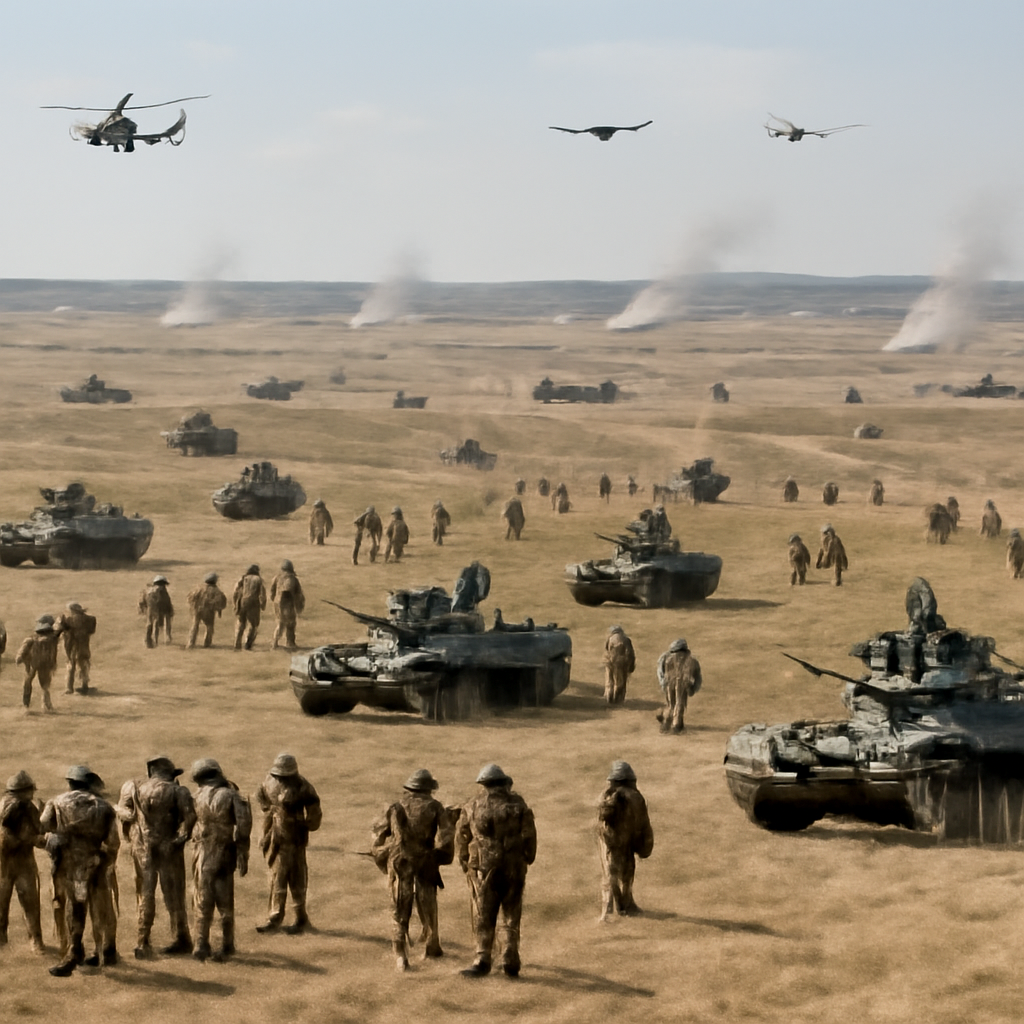
More than 30 countries sent delegations to Russia’s Tsentr exercise, held from 28 September to 3 October, where a mock battlefield modelled on Ukraine saw about 6,000 of the 47,000 troops practising amid more than 600 aerial drones.
Tsentr exercise and the People’s Liberation Army Central Theater Command
Tsentr this year was notable for its size and international footprint. The exercise ran from 28 September to 3 October and involved roughly 47,000 personnel overall, with a combined-arms character that many participants said reflected lessons from the Ukraine conflict. Six countries—Belarus, Kyrgyzstan, Mongolia, Pakistan, Tajikistan and China—contributed forces. The Chinese combined-arms contingent from the People’s Liberation Army Central Theater Command was not the largest in Tsentr’s recent history, but, according to the reporting, its predecessors hadn’t trained on an area modelled so closely on the Ukrainian combat environment.
Chebarkul: a drone-saturated mock battlefield
The component of Tsentr held at Chebarkul, in the southern Ural Mountains, was striking for its focus on unmanned aerial systems. About 6,000 troops took part in that training area, which Chinese reporting said was mocked up with trenches, gullies, shell craters and underground fortifications—together creating something like a heavily fought-over, drone-saturated rural battlefield. Observers counted more than 600 aerial drones of various types in use, underscoring how drone warfare has been folded into large-scale combined-arms drills and how states are attempting to translate battlefield experience from Ukraine into training and doctrine.

Audit-ready is a season. It shouldn't be.
Evidence in spreadsheets, controls drifting between audits, frameworks multiplying on flat headcount. Nubivance runs continuous compliance on Rapid7 Cyber GRC - SOC 2, HIPAA, ISO 27001, PCI, CMMC.
End the scrambleNorth Asia snapshots: Tapchon shipyard, F‑16Vs and hypersonic tests
New satellite imagery indicates rapid progress at a likely major North Korean naval base at Tapchon, about 20 kilometres north of Wonsan on the Sea of Japan. The yard is being expanded as Pyongyang builds bigger warships, and analysts say the still-under-construction submarine Kim Jong Un inspected last year—believed to be a ballistic missile submarine—probably informs that infrastructure investment. The reporting also noted past ship-launch problems, citing a North Korean destroyer that sank on launch in May 2025.
Meanwhile, Taiwan received two factory-new F‑16V fighter jets at Chihhang Air Base on 2 October, with 64 more expected at an unspecified future date; Lockheed Martin’s production shift and the pandemic delayed earlier deliveries that were due in 2023, and nearly US$30 billion in sales approved by Congress remain undelivered. South Korea conducted its first test launch of a hypersonic glider on 8 October—an indigenous design and build—while North Korea has been testing hypersonics since 2021 and conducted a test a few days earlier, the reporting noted.
Myanmar’s diplomatic thaw: direct US talks and regional outreach
Reuters reporting revealed that the United States opened direct talks with Myanmar’s military-backed government: US Assistant Secretary of State Michael Vance met coup leader-turned-president Min Aung Hlaing in September seeking the release of a detained American businessman. Discussions have since reportedly expanded to address online scam operations and potential access to Myanmar’s rare-earth deposits. On 9 October, Washington lifted sanctions on the daughter of a military-linked businessman, though any linkage to the talks was described as unclear.
At the same time, Min Aung Hlaing’s regional diplomatic engagements have multiplied. On 8 October he visited Malaysia, where Prime Minister Anwar Ibrahim pledged to do “whatever is possible” to facilitate Myanmar’s reintegration into the Association of Southeast Asian Nations. Since April, Min has visited Thailand, Laos, Cambodia and Vietnam, with Indonesia and Brunei reportedly next—a rapid diplomatic calendar for a leader presiding over ongoing internal conflict.
Regional maritime tensions continued elsewhere: on 1–2 October Philippine and Chinese coast guard vessels confronted each other near the Batanes Islands after Manila challenged the research ship Jia Hai Ke 7, and on 8 October Manila accused Chinese vessels of obstructing an emergency medical evacuation from Second Thomas Shoal—alleging water‑cannon use and a nearly 10‑hour delay—an allegation Beijing denied.
Fiji, Zhao Fugang and low-cost tools of influence enforcement
On 7 October the US Department of State barred prominent Fiji businessman and developer Zhao Fugang from entering the United States, alleging he had paid bribes to Fiji citizens “to advance China-based government, business, and criminal interests.” Zhao denied the allegations and has asked Washington to substantiate them, and the Fijian government likewise requested evidence. The reporting explains that Section 7031(c) visa designations are not criminal charges, need not be published, and were originally applied under an anti‑kleptocracy policy from the mid‑2000s.
Zhao’s activities described in the reporting include hosting high-level meetings on bilateral security cooperation with senior officials from China and Fiji and operating an Overseas Chinese Service Centre from his hotel in Suva—centres that were created and sponsored by a program now managed by the United Front Work Department of the Chinese Communist Party Central Committee. As ASPI put it, using 7031(c) in this context represents the US repurposing an older anti‑corruption tool to signal concern about foreign interference.
How Australia, China, and the United States are positioned
- Australia: Australian forces are deepening operational ties regionally—Exercise Keris Woomera began on 12 October with about 2,200 personnel in amphibious and maritime training with Indonesia, and Australia deployed F‑35A, P‑8A and HMAS Stalwart to Exercise Bersama Lima from 1–19 October, showcasing continuing interoperability with partners.
- China: Beijing sent a PLA contingent to Tsentr and appears focused on translating Russia’s Ukraine lessons into its own training; Chinese reporting described the Chebarkul mock battlefield and the PLA presence there. China is also connected indirectly through private actors such as Zhao Fugang and through institutional links to Overseas Chinese Service Centres.
- United States: Washington is combining diplomacy—direct talks with Myanmar and the lifting of a sanction on a businessman's daughter—with targeted tools such as the 7031(c) visa bar on Zhao, and is supporting regional defence ties through exercises and investments tied to US territories like the Northern Mariana Islands.
These episodes—large-scale exercises shaped by Ukraine, harder-to-see influence tools applied in the Pacific, and a pragmatic reopening to Myanmar—are not isolated. Together they suggest a region adjusting both its warfighting concepts and its diplomatic playbook. Which of these adjustments proves durable—new training methods, repurposed legal tools, or resumed bilateral contacts—will be a question the next set of drills, visits and enforcement actions answers.