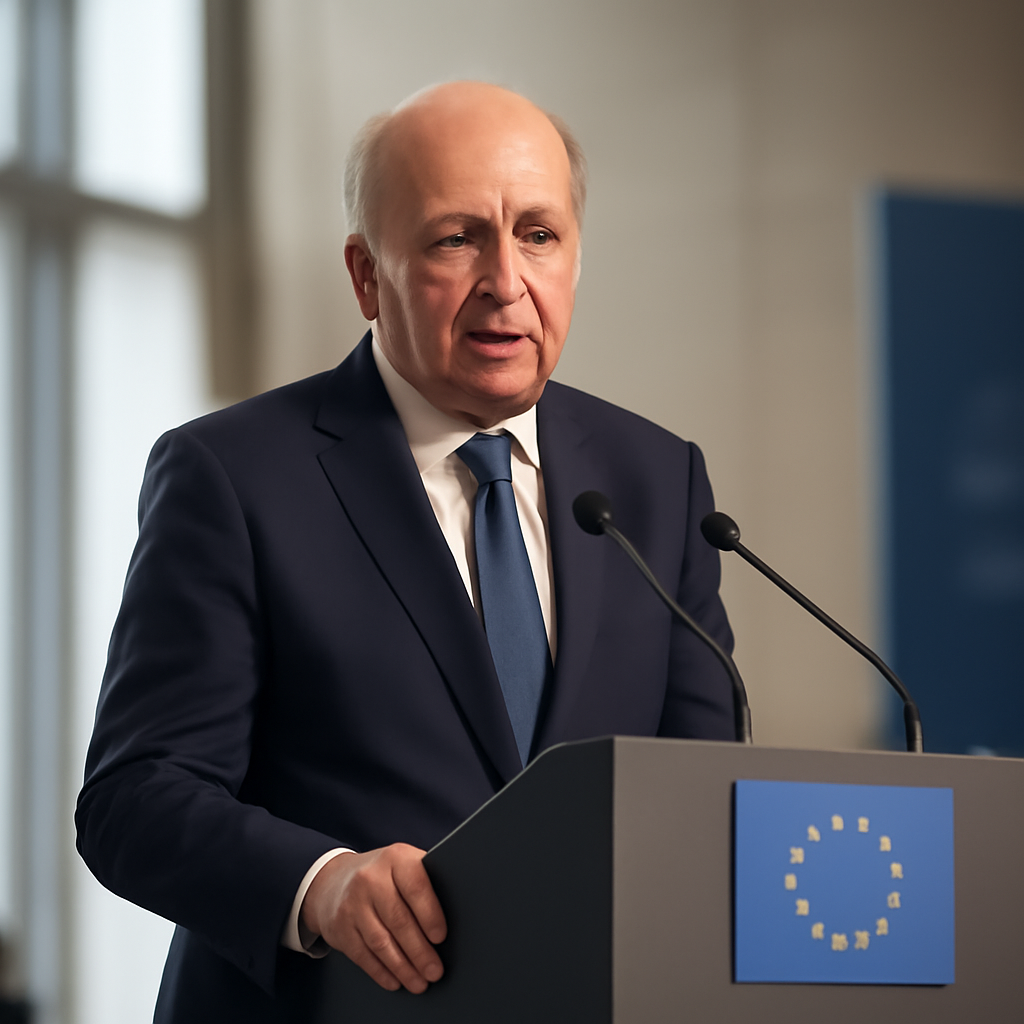
“It’s very crucial to help Ukraine to defend itself and to defend the whole Europe,” Commissioner for Defence and Space Andrius Kubillius told the Warsaw Security Forum on Tuesday.
Andrius Kubillius and the European Commission’s defense push
Kubillius told forum attendees that the European Commission will continue to strengthen its defense capabilities specifically to help defend Ukraine in its ongoing conflict with Russia. He framed the Commission effort as part of a broader shift in global defense posturing, saying his remarks were not tied solely to recent calls from the Trump administration that Europe become more self-reliant.
European Security Council proposal — scope and intent
Kubillius reiterated a proposal first advanced by European Commission President Ursula von der Leyen in her September State of the Union Address: to explore creation of a European Security Council. According to Kubillius, the envisioned format would include member states and could bring in the United Kingdom, Ukraine, Norway, and Canada — a grouping the commissioner described as “close to Europe.” Von der Leyen urged a leaders’ format focused on continental security in September, saying “this is even more urgent now.”

This site is the portfolio.
OSINTSights runs on Cloudflare Workers, D1, R2, and Vectorize, with an AI pipeline on Hetzner ARM. Nubivance designed, built, and operates it. We do the same for clients.
See what we buildNorway’s emphasis: anti-ballistic cooperation and exportable lessons
Norwegian Minister of Defense Tore O. Sandvik used the forum to argue that European countries must “take our responsibility,” saying Norway will “go on for Europe.” Sandvik described a coalition of 11 countries in Europe supporting an anti-ballistic coalition and trying to develop anti-ballistic missile systems for Europe, a project he framed as necessary for collective defense. He also suggested those systems and operational lessons could be applied more widely: “To a global level, we can support both countries in the Middle East, the US themselves, Europe, and our Pacific friends,” and what “we can do in Ukraine, we can pass, we can develop, we can learn, and we can build new systems.”
Hungary’s internal shift toward EU engagement
Hungarian Minister of Defence Romulusz Ruszin-Szendi said under a new government Budapest is aiming to focus more on the EU and to secure the general public’s support for that direction. He appealed for Hungarians to “change the mindset of the Hungarian society,” adding that “more and more people are coming to the EU, more society is supporting them.” Ruszin-Szendi described efforts to “introduce the Hungarian military to the society who can trust,” and urged EU countries to develop better plans to handle potential future conflict, noting divergent interests across Europe and “the danger of aggression in Europe.”
Netherlands, France and the fight over narrative in hybrid war
Netherlands Deputy Prime Minister and Minister of Defence Dilan Yeşilgöz-Zegerius argued that unity and a coherent narrative are essential in a hybrid war that combines propaganda and disinformation with physical attack. “The next conflict… will not be ended with tanks and guns,” she said; it will “start and end with communication and … who controls the narrative.” Yeşilgöz-Zegerius urged European efforts to “get that narrative right.” The emphasis on information and narrative was echoed in France’s 2035 national security plan, released in September, which the forum noted as consistent with the Netherlands’ warning about hybrid threats.
The Warsaw Security Forum brought together positions that converge on a common theme: EU institutions and several member states want to strengthen European defense capabilities, both materially and politically, to support Ukraine and to bolster continental resilience. Concrete initiatives discussed at the forum range from a proposed European Security Council that would expand a leaders’ security format to a working anti-ballistic coalition of 11 countries, plus efforts to build public trust in national militaries and to contest informational battlefields.
The next institutional step named in the discussion is procedural: von der Leyen proposed looking into the possibility of creating a European Security Council that would include EU member states and like-minded partners such as the United Kingdom, Ukraine, Norway, and Canada. Whether that proposal moves from exploration to establishment will be the specific test of the unity speakers at Warsaw urged.
https://breakingdefense.com/2026/10/in-warsaw-eu-continues-push-for-unity-in-defense/