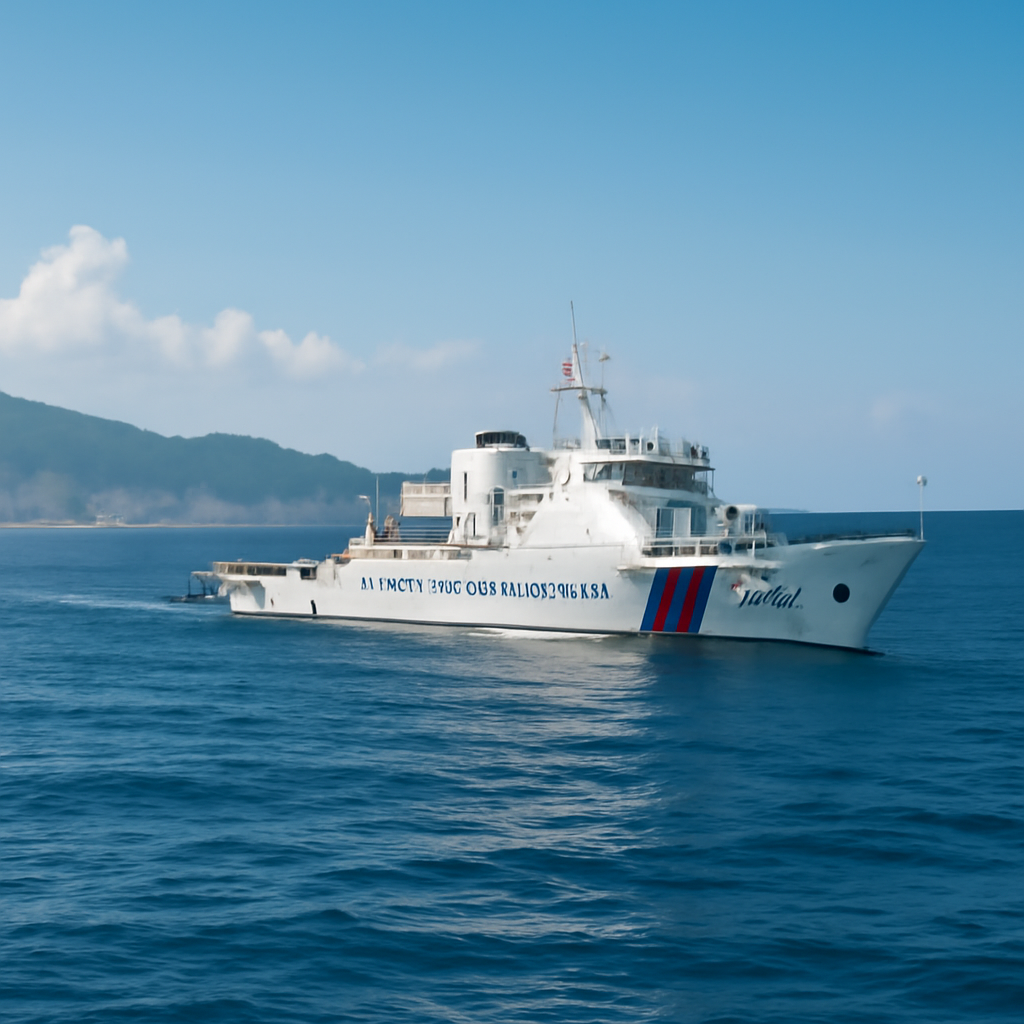
"These actions threaten regional stability and the freedom of navigation and safety of international shipping," the British, German and French diplomatic missions in Taiwan said on 24 June.
What Beijing put at sea: Transport Ministry vessels, the China Coast Guard and survey ships
In June, for the first time, China sent vessels of its Transport Ministry — the agency responsible for securing sea lanes — to waters east of Taiwan as part of a "special maritime traffic law-enforcement operation." The China Coast Guard and marine survey vessels from the Ministry of Natural Resources also joined the mission. On 4 July the coast guard announced a new patrol group would take over from the first and continue with routine "law-enforcement patrols" in the area, implying a continuous non-naval presence to the east of Taiwan.
State-aligned media framed the step as a turning point: the Global Times said China’s control of the waters east of Taiwan had entered a "new phase." A spokeswoman for Beijing’s Taiwan Affairs Office described the patrols on 2 July as a "lawful exercise of jurisdiction, a just act to safeguard national territorial sovereignty and maritime rights and interests."
What the June patrols did: questions, surveys and seabed mapping
During the June patrol, Chinese coast guard vessels demanded that commercial ships disclose their ports of departure and destinations — activity the source describes as harassment of commercial shipping. At the same time, the Ministry of Natural Resources conducted marine environment surveys and Transport Ministry vessels mapped the eastern seabed. The mapped area is where Taiwanese and Japanese undersea cables are believed to be laid and where the Pacific Ocean's continental shelf drops rapidly — features the source notes make the area "crucial for submarine warfare."
China Global Television Network (CGTN) said China had previously conducted individual scientific projects in the area but, in a new twist, the marine environment survey mission "formed ‘part of a regular survey program, indicating a move towards more systematic and long-term monitoring.'" The original CN source flagged the words "regular" and "long-term."

Audit-ready is a season. It shouldn't be.
Evidence in spreadsheets, controls drifting between audits, frameworks multiplying on flat headcount. Nubivance runs continuous compliance on Rapid7 Cyber GRC - SOC 2, HIPAA, ISO 27001, PCI, CMMC.
End the scrambleTaiwan and international reactions: denouncements and vows to respond
The first patrol drew a rare joint response from Western diplomatic missions: on 24 June the British, German and French missions to Taiwan denounced the novel activity in the island’s eastern waters in a joint statement, saying the moves threatened regional stability and freedom of navigation. The American Institute in Taiwan told media that the United States "rejected any claim by China of authority to interfere with navigation and overflight, the freedom to lay undersea cables, and other lawful uses of the sea in the area."
Taiwan’s Mainland Affairs Council responded to news of the second patrol on 4 July, saying the Chinese Communist Party "had no sovereignty or authority in waters east of Taiwan." The council called the actions "illegal acts" and said they "remain illegal no matter how many times they are committed and will not be recognized internationally." It added that the Taiwanese coast guard would "respond with concrete action," without specifying what that would be — a development the source says raises fears of accidents or collisions that could escalate tensions.
Strategic intent and implications: seabed data, quarantine rehearsals and grey-zone tactics
Analysts quoted in the reporting describe the new pattern as "dark grey-zone operations." Su Tzu-yun of Taiwan’s government-funded Institute for National Defense and Security Research said Beijing’s "main objective is likely to collect data on the seabed topography, ocean currents, salinity, temperature and other hydrographic conditions, all of which are essential for future submarine operations and anti-submarine warfare planning."
Su also warned that normalising non-naval law-enforcement activity east of Taiwan "shortens the step" to imposing a quarantine that would control what ships go to or from the island. He said a permanent presence "functions as a rehearsal for a potential maritime blockade of Taiwan by gradually normalising Chinese presence and administrative control in the surrounding waters." The source records Su's view that Beijing may have judged that "seven large-scale military exercises held since 2022 had had limited effect" and is thus adjusting tactics.
How Taiwan, Beijing and third parties are responding
- Taiwan (Mainland Affairs Council, coast guard): The Mainland Affairs Council publicly rejected any Chinese authority in eastern waters and pledged the coast guard will take "concrete action," increasing the risk of at-sea encounters.
- Beijing (Taiwan Affairs Office, Transport Ministry, China Coast Guard, Ministry of Natural Resources): Beijing frames patrols as lawful jurisdictional enforcement and as a response to talks between Japan and the Philippines on EEZ boundaries; it is extending non-naval presence and moving to "regular" survey programs.
- Third-party actors (British, German and French missions; American Institute in Taiwan): Western missions have denounced the patrols for threatening freedom of navigation; the American Institute publicly rejected any Chinese claim to interfere with navigation, overflight or the laying of undersea cables in the area.
The new pattern recorded in June and reiterated on 4 July shifts non-naval instruments of maritime control into a contested zone east of Taiwan. The facts presented here point to two immediate questions left by the patrols themselves: will Beijing keep these law-enforcement patrols continuous and be able to upgrade them into a coercive quarantine, and how will Taiwan’s coast guard balance unspecified "concrete action" with the risk of accidents at sea?



