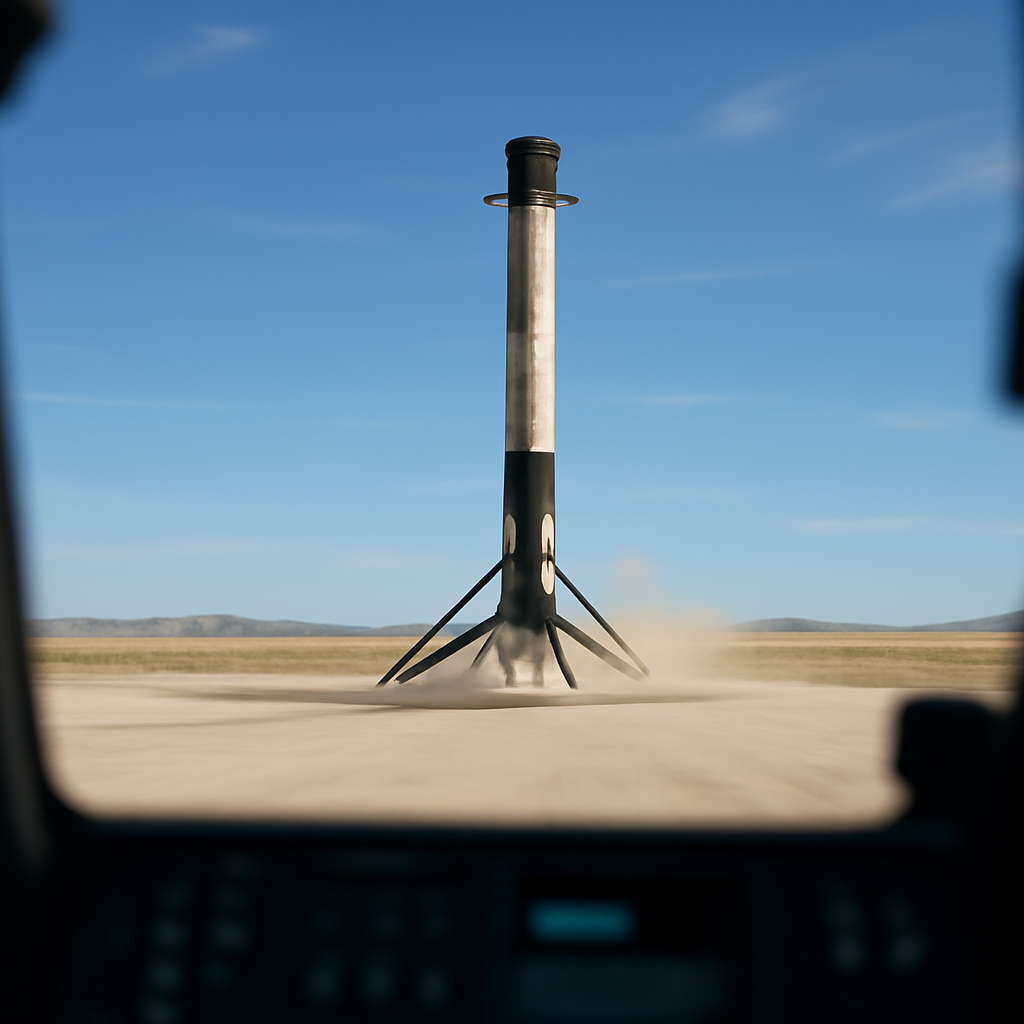
"At approximately 07:41, the first stage performed a successful soft touchdown at the LandSpace Landing Site#1 in Minqin County, Gansu Province, following the planned trajectory – marking the full success of the flight test mission," LandSpace wrote on its official account on X.
The ZQ-3 Y2 flight and an explicit recovery milestone
On August 19, 2026, at 07:35 (UTC+8), LandSpace’s ZhuQue-3 (ZQ-3) Y2 reusable launch vehicle lifted off from the Dongfeng Commercial Space Innovation Pilot Zone. Approximately 137 seconds after liftoff the first and second stages separated; the second stage delivered the Honghu 03 satellite — independently developed by Hongqing Technology — into its designated orbit. About six minutes after launch the first stage executed a controlled descent and, according to LandSpace, performed a soft touchdown at its Minqin County landing site.
LandSpace described the mission as China’s first successful recovery of an orbital-class first stage using landing legs and marked it as a pivotal flight-test transition toward “engineering application” of reusability for the ZQ-3 family.
CASC’s July sea recovery and ZQ-3’s earlier failure
This land recovery follows a July milestone in which state-owned China Aerospace Science and Technology Corporation (CASC) recovered a reusable booster from a Long March 10B at sea using a net-like device installed on a ship. The Long March 10B’s recovered booster did not require landing legs and used stabilizing fins.
The Y2 mission was only the ZQ-3’s second flight. The first ZQ-3 launch, in December, reached low Earth orbit on its upper stage but failed to recover the first stage; that booster exploded on the pad after “abnormal combustion occurred during the process, preventing a soft landing on the recovery site,” according to Xinhua (machine-translated and reported after the initial flight).

The cyber insurance questionnaire just landed. Now what?
SOC 2, HIPAA, insurance renewals - someone has to own security strategy. Nubivance provides fractional CISO leadership without the full-time salary.
Get a security leadDesign choices: ZQ-3, propellant, and the Falcon 9 comparison
The ZQ-3 is roughly 216.5 feet (66 meters) long and about 15 feet (4.5 meters) in diameter, with a stated payload capacity of up to 14.2 metric tons to low Earth orbit. Its reusable booster features fold-out landing legs at the base and stabilizing fins at the top — a configuration the source describes as “very reminiscent” of U.S. firm SpaceX’s Falcon 9. For comparison, the Falcon 9 is cited at 229.6 feet (70 meters) tall, 12 feet (3.7 meters) in diameter, with a higher stated maximum payload of 22.8 metric tons to LEO.
LandSpace has highlighted the ZQ-3’s primarily stainless-steel construction as a cost advantage versus competitors. The rocket uses liquid methane and liquid oxygen as propellants; a SpaceNews report from 2023 is cited noting methane-LOX advantages for performance and reduced soot and coking—attributes relevant to reuse. LandSpace previously claimed the first-ever liquid methane-fueled rocket to reach orbit with its two-stage Zhuque-2 (ZQ-2), which has flown eight times with six successes. The company’s earlier ZQ-1 three-stage vehicle made one unsuccessful attempt in 2018.
What this means for U.S. Space Command, LandSpace, and commercial launch customers
- U.S. Space Command and U.S. military leaders: The pace of China’s space activity is already a stated concern. Gen. Stephen Whiting told attendees at the Space & Missile Defense Symposium that “China is moving breathtakingly fast.” Lt. Gen. Gregory Gagnon cited a dramatic satellite build-up — from fewer than 100 satellites in 2013 to about 1,900 today, including more than 500 remote sensing satellites — and argued those systems are “purposely designed and networked to track mobile forces” and “cue their long-range fire weapons.” The military response, the source reports, has included calls within the U.S. military for new anti-satellite capabilities to challenge China’s growing presence in orbit.
- LandSpace and Chinese aerospace firms: LandSpace’s successful land recovery and CASC’s ship-based catch demonstrate parallel technical approaches inside China — landing legs for vertical return and ship-capture for sea recovery. Both paths aim to reduce per-launch costs and increase launch tempo, and the ZQ-3’s stated design and propellant choices are explicit efforts to prioritize reusability and lower production cost.
- Commercial launch customers and global market competition: The source highlights that reusable boosters lower costs and can dramatically increase launch tempo — factors that would improve China’s ability to compete on price in the commercial market. The U.S. is described as currently enjoying a competitive advantage “largely to SpaceX and its reusable launch options,” so the development of robust Chinese reusable systems could recalibrate market dynamics.
Implications for military, intelligence, and constellation deployments
The reporting links reusable launch capability directly to national-security effects: a mature, reliable reusable launcher would both accelerate China’s access to space and lower the cost of putting up large, distributed constellations. That combination is specifically framed as enabling faster deployment of new remote sensing capabilities and other national-security space systems, while also spreading cost burdens across commercial revenue streams that could feed further development.
Two months of milestones — CASC’s sea recovery and LandSpace’s first land touchdown using landing legs — show multiple Chinese actors pressing reusable concepts in parallel. The immediate technical fact is simple: China now demonstrably has both a ship-based booster catch and a land-based leg touchdown in its recent record. The strategic question the facts leave in plain view is whether either approach can be turned into sustained, routine reuse that meaningfully lowers costs and increases launch cadence at the scale required to reshape global commercial markets and national-security architectures.