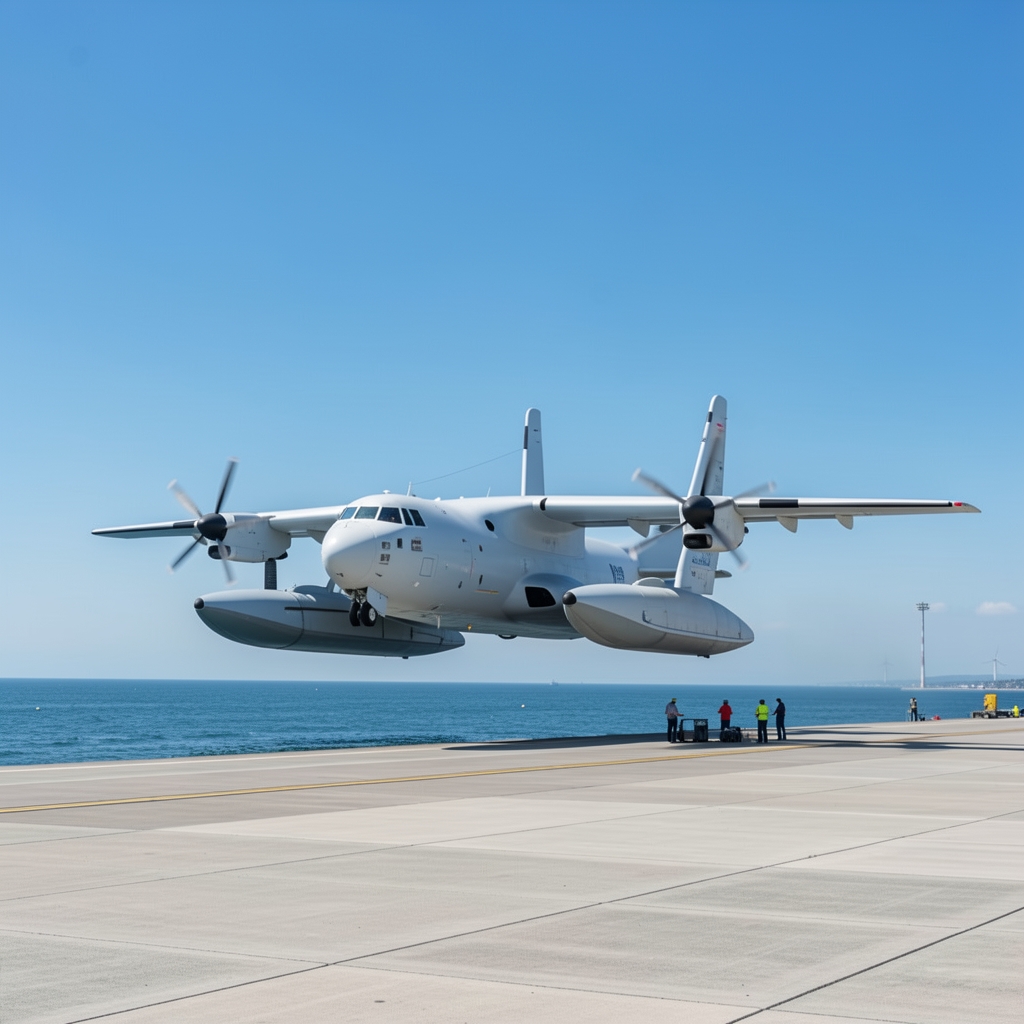
The fourth production AG600 amphibious aircraft completed a test flight at Zhuhai Jinwan Airport on May 9, 2026, marking another step in a program that aims to field what the program’s advocates describe as the world’s largest operational seaplane.
The Zhuhai test: fourth production aircraft takes to the air
Photographs from the May 9 flight show the fourth production AG600 moving through flight testing at Zhuhai Jinwan Airport. That sortie follows a program that formally entered mass production on June 11, 2025, and signals continuation of an aircraft series built to operate from both runways and open water. The flight represents progress from a protracted development cycle into the operational testing phase for production-standard airframes.
Design role and claimed capabilities: SAR, firefighting, island transport
The AG600 is presented as China’s first large amphibious aircraft since the 1970s SH‑5 and stands alongside the Y‑20 strategic transport and the C919 airliner as one of three flagship “big aircraft” programs. Designed for maritime search and rescue (SAR), aerial firefighting, and island transport, the AG600 is described as capable of rescuing up to 50 people or carrying “several dozen” fully armed troops across a reported range of roughly 4,500 km. In size, it is placed in the Boeing 737 class—an unusually large platform for a flying boat.

This site is the portfolio.
OSINTSights runs on Cloudflare Workers, D1, R2, and Vectorize, with an AI pipeline on Hetzner ARM. Nubivance designed, built, and operates it. We do the same for clients.
See what we buildWhy development took more than 15 years: engineering and regulatory hurdles
The AG600’s path from concept to near‑service exceeded 15 years, reflecting the difficulty of building a large, complex amphibious aircraft. Engineers had to rebuild design expertise that had not been used since the SH‑5 era and meet stringent civil airworthiness standards. A list of technical challenges cited in the program narrative includes validating performance across both land and open‑ocean environments, dealing with water impact loads, ensuring hull integrity, resisting corrosion, and proving safe operation in higher sea states. Those demands required extensive testing and redesigns. The program also faced tighter regulatory oversight in recent years, which added further delays to certification and entry into production.
Mass production posture: initial output and the shape of steady production
The program moved into mass production on June 11, 2025, at an initial output rate stated as five aircraft per year. That production rate frames the near‑term pace at which operational capability can scale. Transitioning from a long, technically demanding development cycle into steady production means airframes will increasingly be available for civilian roles while retaining the potential for dual use. The move to regular production is the program’s response to the long lead times and iterative testing that characterized earlier phases.
How technologists, regulators, and military planners are likely to respond
- Technologists and test engineers will continue to focus on the very problems that slowed the program: validating hull strength under water impact loads, corrosion resistance in maritime settings, and operational safety in higher sea states—issues that drove repeated redesigns during development.
- Regulators and certifying authorities — who tightened oversight and lengthened the timeline during development — will remain central to the AG600’s transition from flight test to routine operations, because certification for amphibious operations must reconcile both land and maritime airworthiness standards.
- Military planners and logistics authorities will note the aircraft’s stated utility in rapid personnel movement, logistics, and SAR. The program’s narrative explicitly links those capabilities to operations in the South China Sea, where long distances and dispersed outposts are cited as conditions that favor amphibious lift.
Although the AG600 is officially described as a civilian program, the aircraft’s combination of payload, range, and amphibious capability makes it inherently relevant to both civilian emergency services and military support roles. The fourth production test flight at Zhuhai underscores that the program is moving from bespoke prototypes into a phase where a predictable production cadence—five airframes per year, initially—will govern how quickly the platform can influence maritime operations.
The broader point is straightforward: after more than a decade and a half of engineering, regulatory work, and iterative testing, the AG600 program is no longer solely an experimental project. It is entering steady production, and that transition carries civilian and dual‑use implications that will matter for years to come.