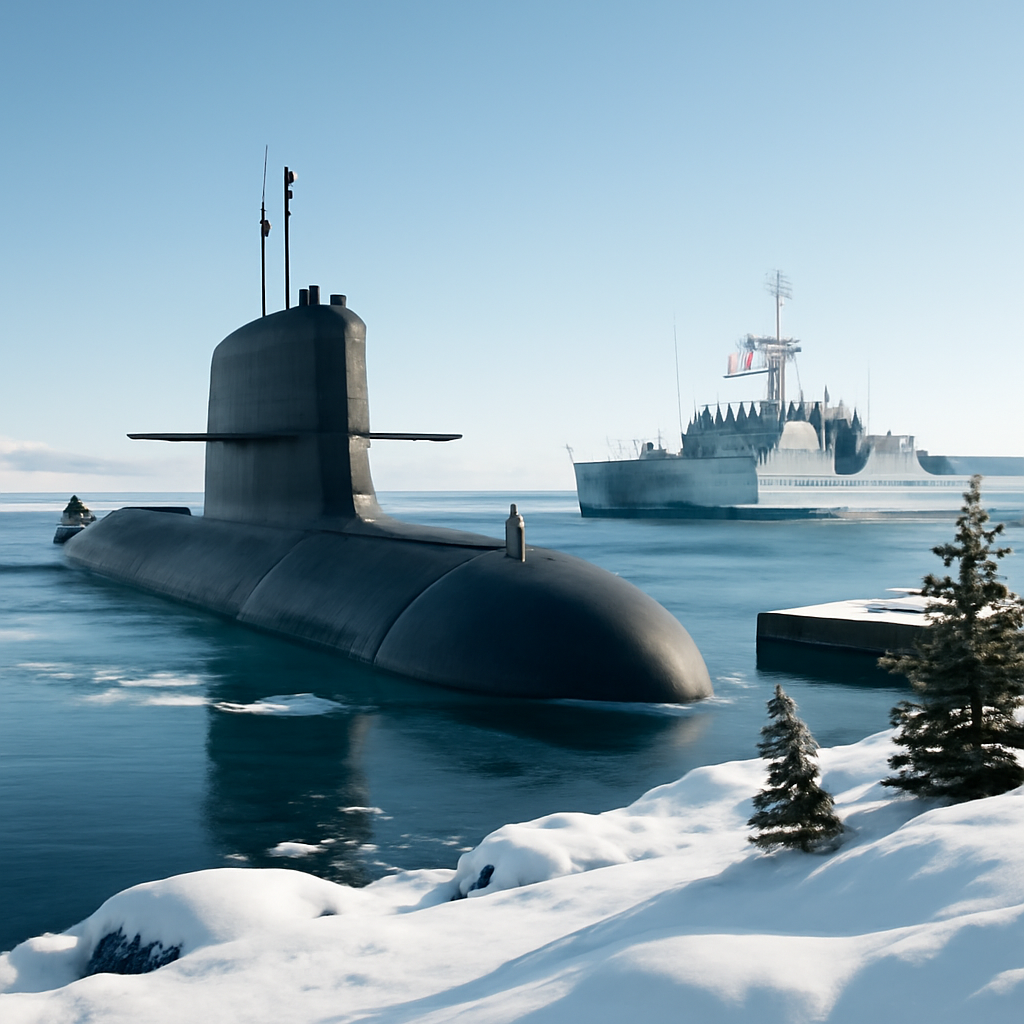
Canada’s new submarine project could cost as much as CAD $70 to $80 billion once roughly 30 years of operations, maintenance, and support are included — even though the boats themselves are priced at an estimated CAD $20 to $30 billion. Prime Minister Mark Carney announced on 6 July 2026 that ThyssenKrupp Marine Systems’ Type 212CD is the preferred supplier for the Canadian Patrol Submarine Project (CPSP), a requirement for up to 12 conventionally powered, under-ice-capable submarines for the Royal Canadian Navy (RCN).
Why Ottawa set the 12-boat requirement
Canada’s decision flows directly from a small, unreliable legacy fleet. The RCN currently operates four Victoria-class boats acquired secondhand in 1998; three entered service between 2000 and 2003, while HMCS Chicoutimi was delayed into commission until 2015 after a fatal onboard fire during its 2004 delivery voyage. Today, three of the four boats are in maintenance, leaving just one submarine available for operations. The CPSP’s 12-hull scope is built on the arithmetic of standard readiness cycles: with rotation through deployment, training, and deep maintenance, a 12-boat force would permit roughly a third of the fleet to be available at any time for concurrent Atlantic, Pacific, and Arctic tasking. Core requirements spelled out by Ottawa include conventional propulsion, extended under-ice endurance, long range, low acoustic and magnetic signatures, full NATO interoperability, and a first boat in service no later than 2035.
What the Type 212CD is and why it won
The Type 212CD is an evolution of the long-serving Type 212A lineage and is co-developed with Norway; Germany and Norway are already launch customers. The 212CD displaces roughly 2,750 tons surfaced, measures about 73 metres, and carries six 533 mm torpedo tubes. Its signature features are an improved fuel-cell air-independent propulsion (AIP) system paired with new-generation batteries — most likely lithium-ion — and upgraded diesel generators, delivering greater submerged endurance targeted at extended under-ice patrols. The design also introduces a diamond-shaped hull and maintains ultra-low acoustic and magnetic signatures. In the procurement contest, Hanwha’s KSS-III Batch II was a serious rival: larger (around 3,600 tonnes submerged) and fitted with a vertical launch system for land-attack missiles. Ottawa, however, chose the 212CD in part because it joins an active, multi-navy production program and aligns with allied operators.

Audit-ready is a season. It shouldn't be.
Evidence in spreadsheets, controls drifting between audits, frameworks multiplying on flat headcount. Nubivance runs continuous compliance on Rapid7 Cyber GRC - SOC 2, HIPAA, ISO 27001, PCI, CMMC.
End the scrambleThe industrial package: $86 billion claimed and what it includes
TKMS forecasted that it could reinvest upwards of $86 billion into the Canadian economy through the Type 212CD program and related joint ventures, and sized the bid’s total footprint at $167 billion in economic activity and more than 650,000 job-years over the project life. Concrete elements include a heavyweight torpedo (HWT) production plant in partnership with Magellan Aerospace — built atop a February 2026 teaming agreement and ongoing co-development of parts of the Anti-Torpedo Torpedo, expected to reach the market in 2029 with a final assembly facility in design at Magellan’s Rockwood plant. TKMS’s package also contemplates a new hypersonic missile testing facility, redevelopment of the Port of Churchill in Manitoba, and a partnership with Germany’s Isar Aerospace to build sovereign launch capacity in Canada aimed at late 2028 or early 2029. Additional industrial and technological agreements were announced with E3 Lithium, Destiny Copper, GH Power, and Heirloom Carbon. TKMS framed part of its reach as extending from “seabed to space.”
Team 212CD: Canadian companies and the division of work
The bid rests on more than 20 Canadian teaming agreements. The combat system is a cornerstone: Kongsberg Geospatial has contributed over 50,000 hours of Canadian software development to the 212CD’s ORCCA combat management system and will establish a CMS centre of excellence in Ottawa. Toronto’s Cohere converted a teaming agreement into a full contract in June 2026 for secure enterprise AI, onboard information management, and decision-support tools. Valbruna ASW in Welland received a 70-ton order of non-magnetic submarine steel in June 2026 to begin material qualification, while Finkl Steel — Sorel, Patriot Forge, and Marmen of Trois-Rivières were named for stainless-steel melting, forgings, and submarine section manufacture. Sustainment work is slated to anchor on the West Coast with Seaspan Shipyards leading an integrated sustainment enterprise and EllisDon building maintenance, sustainment, and training facilities. CAE will supply training and simulation, Gastops a centre for submarine automation monitoring, and Imagine 4D digital twins for through-life sustainment. That said, most of these commitments are teaming agreements or memoranda rather than signed contracts; the conversion rate will determine how much of the $86 billion materializes as enforceable work and IP ownership.
What this means for policymakers, Canadian defence firms, and NATO partners
- Policymakers and procurement leaders: Ottawa expects to conclude contracting no later than the end of 2027; the key tests are a signed contract and whether items such as the Magellan torpedo plant, the Churchill redevelopment, and the hypersonic facility are codified with delivery dates and IP terms rather than left as memoranda.
- Canadian defence firms and technologists: companies that converted memoranda into contracts (Cohere, Valbruna) will watch conversion of other teaming agreements and the depth of IP transfer — particularly in the CMS and AI layers where Canada could secure high-value, sovereign capabilities.
- NATO partners (Germany and Norway): operating the same design creates operational and logistical commonality, enabling integrated training, sustainment, and a more persistent undersea presence in the High North; Canada’s membership in the EU’s SAFE initiative further opens routes into European procurement and exports.
The announcement is a turning point but not the finish line. A preferred-supplier selection locks Canada to a proven, under-ice-optimised submarine design and a wide industrial package — yet the program’s shape will be defined in the months of contract negotiation ahead. The immediate yardsticks are simple and concrete: a signed contract by the end of 2027, clear ITB obligations with delivery dates and IP terms, and the first hulls delivered on the accelerated timeline Ottawa has set. Until those boxes are checked, the $86 billion headline remains a forecast and Canada’s leap from a token submarine capability to a persistent, Arctic-ready fleet remains a work in progress.