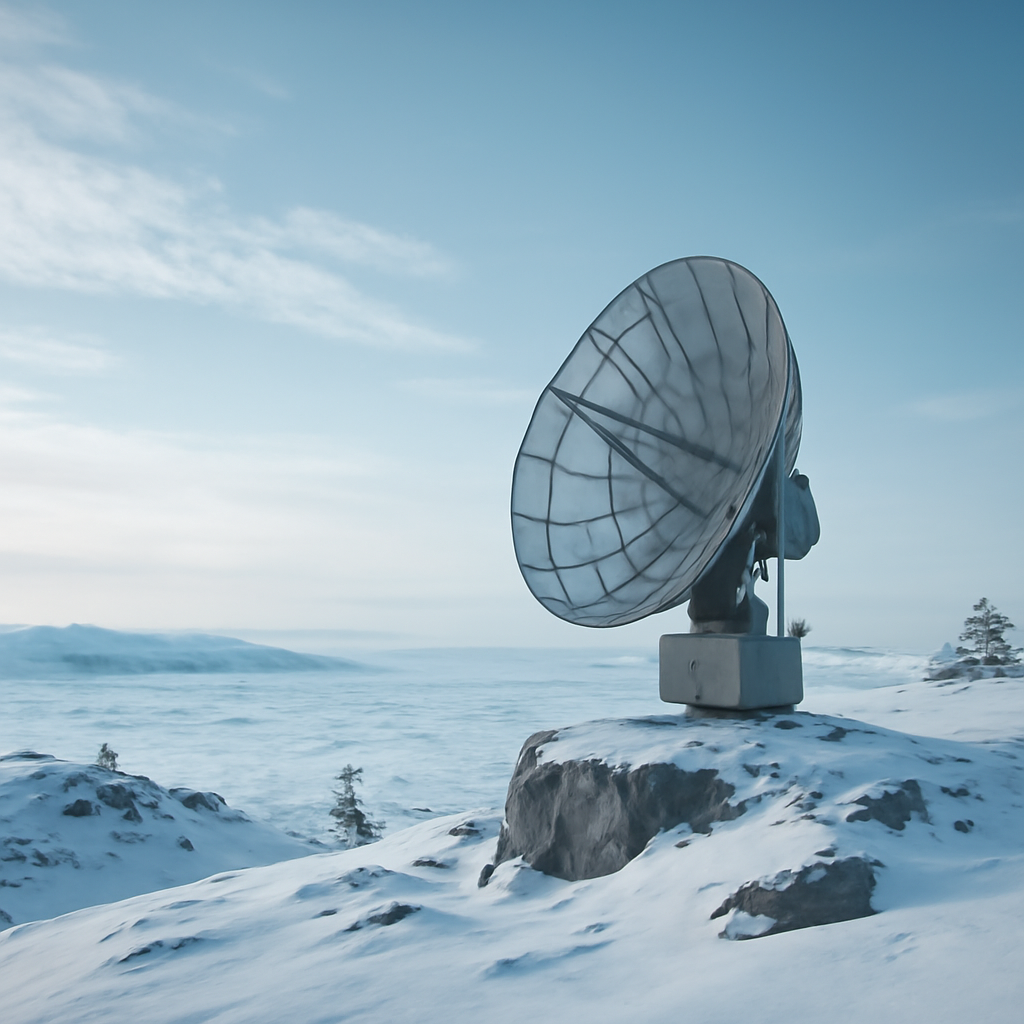
In June, Canada signed a C$2.5 billion government-to-government agreement to acquire Australian Over-the-Horizon Radar technology, derived from the Jindalee Operational Radar Network, to provide long-range surveillance of the Arctic and northern approaches.
The C$2.5 billion radar deal and what it buys
The purchase is framed as more than a straight defence export. Canada is acquiring Australian Over-the-Horizon Radar technology intended to provide long-range surveillance of the Arctic and northern approaches. The agreement is government to government and valued at C$2.5 billion (A$2.5 billion). The transaction creates a technical and strategic bridge: it transfers a capability developed for Australia’s vast northern approaches and gives Canada a platform designed to see far into remote air and maritime approaches.
Shared logistical constraints: distance, isolation, and single annual resupply
Despite very different geographies, both countries confront the same operational logistics problem: enormous distances, limited infrastructure and difficult access. The Canadian Arctic Archipelago accounts for around 48 percent of Canada’s landmass and—counting land and marine environments—covers almost 4.8 million square kilometres. Northern Australia comprises around 40 percent of Australia’s landmass, about 3 million square kilometres, and encompasses all of the Northern Territory and the northern parts of Western Australia and Queensland.
Many northern Canadian communities have no permanent road links to southern population centres, relying instead on air transport and seasonal marine resupply; many receive only one sealift each year and must place orders for fuel, heavy equipment, construction materials and vehicles about a year in advance. In Australia, roads, airfields and ports are separated by vast distances—Darwin to Adelaide is more than 3,000 km, Cairns to Brisbane more than 1,600 km, and Broome about 2,200 km from Perth—while wet seasons, flooding and cyclones can disrupt supply chains and restrict access to remote communities and Defence facilities.

This site is the portfolio.
OSINTSights runs on Cloudflare Workers, D1, R2, and Vectorize, with an AI pipeline on Hetzner ARM. Nubivance designed, built, and operates it. We do the same for clients.
See what we buildEnvironmental extremes force different design choices
Environmental conditions add a second layer of constraint. Canadian equipment and infrastructure must operate through prolonged darkness, on permafrost and in temperatures that can fall to −40 degrees C. Northern Australia faces the opposite thermal extreme, with temperatures regularly exceeding 40 degrees C, high humidity, intense rainfall, flooding and tropical cyclones. Those contrasts matter: a surveillance system that needs frequent specialist technician visits or regular maintenance is less suitable for a remote operating environment than one designed for long autonomous periods.
Put plainly: the question for planners is not just whether a capability can reach the north, but whether it can remain operational after it gets there.
Canada’s shift toward strategic northern infrastructure
Canada is increasingly treating northern transport corridors as strategic infrastructure rather than only economic development. The country’s Arctic Infrastructure Fund supports dual-use roads, airports, bridges, rail and ports intended to strengthen defence readiness, connect communities and support economic development. A proposed Arctic Economic and Security Corridor would improve year-round access to the Arctic coast, linking communities and mineral resources to a proposed deepwater port and airfield. Separately, the Northern Operational Support Hubs program is intended to provide the infrastructure and logistics needed to sustain military operations across the Arctic.
Together, those investments reflect a deliberate planning approach in which defence, economic and community requirements are integrated rather than treated as separate needs.
How Australia and Canada can learn from each other
The radar deal provides a practical foundation for broader exchange. Australia brings decades of experience operating surveillance and defence capabilities across continental distances; Canada is developing new approaches to Arctic mobility, distributed logistics, dual-use infrastructure and sustained military presence. Both should be comparing how platforms are designed for extreme environments, where maintenance facilities are positioned, and how surveillance systems tie into communications and logistics networks.
There is a direct lesson for northern Australia in Canada’s systemic thinking: ports need connections to roads and airfields; fuel storage requires distribution networks; maintenance facilities must be located where platforms can actually be supported. The agreement thus creates a two-way learning opportunity—technology transfer on one axis and operational design lessons on another.
What this means for defence planners, northern communities, and procurement officials
- Defence planners and logisticians should prioritise designs that minimise specialist on-site maintenance and enable long autonomous operation, because access to workshops and technicians will be intermittent or distant.
- Northern communities and resupply operators must be recognised as part of any system design: fuel, heavy equipment and construction materials commonly require annual planning cycles tied to seasonal sealifts and limited access windows.
- Procurement and infrastructure officials should align investments across transport, ports, airfields and maintenance facilities so surveillance and defence platforms are part of a connected system rather than isolated assets.
The two nations face different climates and geographies, but the same strategic problem: the tyranny of distance. It cannot be removed, the new partnership suggests, but it can be designed for.
https://www.aspistrategist.org.au/australia-and-canada-face-similar-northern-logistics-problems/