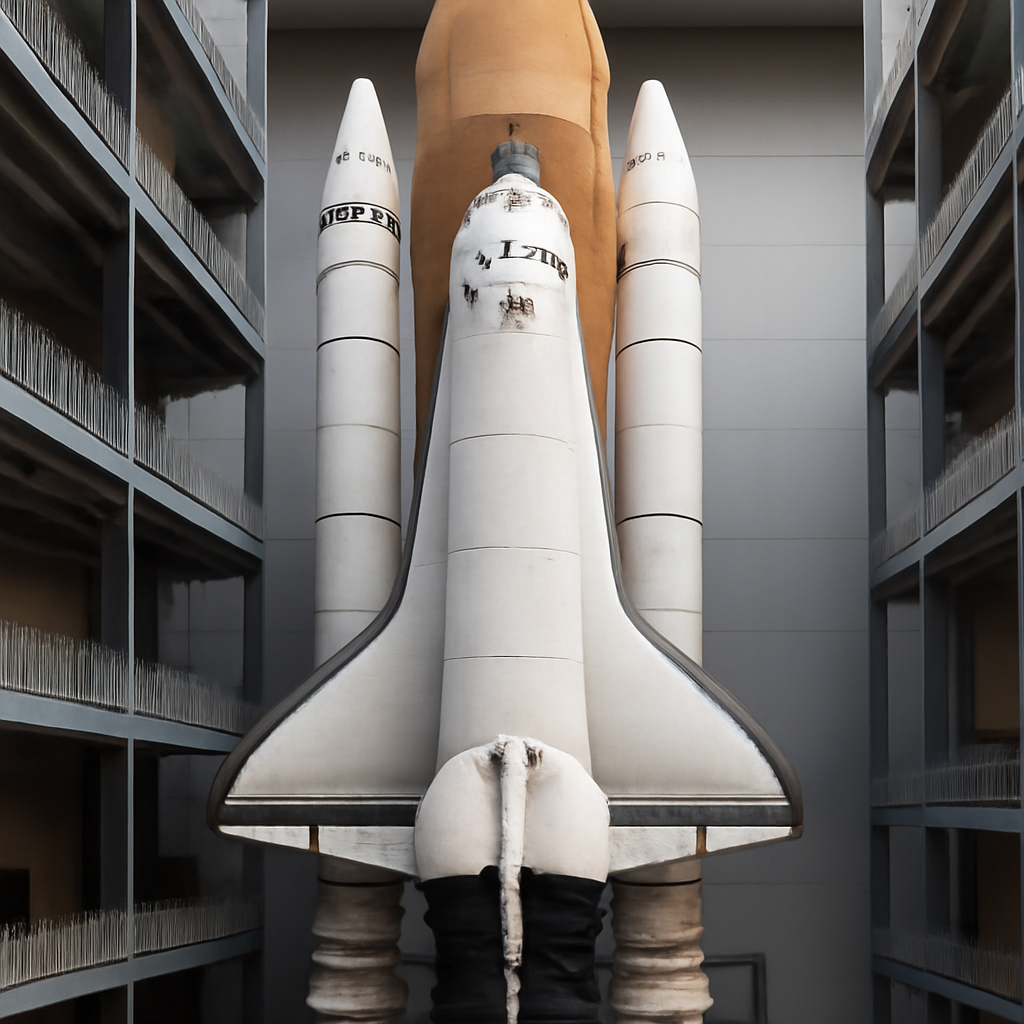
“The only place in the world to see a complete, authentic space shuttle system, displayed in a 20-story launch position,” the California Science Center said in a media release, announcing the long-awaited full-stack display of Space Shuttle Endeavour.
Samuel Oschin Air and Space Center: a purpose-built home
The California Science Center (CSC) in Los Angeles has given a sneak peek at Endeavour mounted in its “full stack” configuration inside the Samuel Oschin Air and Space Center, a 200,000‑square‑foot expansion of the museum. CSC says the exhibit will present the orbiter together with its solid rocket boosters and external tank in a vertical launch orientation that fills a 20‑story volume. The center has set the public opening date for Nov. 13, 2026.
Endeavour’s technical pedigree and service record
Endeavour was authorized for construction in 1987 as a replacement following the Challenger accident on Jan. 28, 1986, and it lifted off on its maiden flight on May 7, 1992. The orbiter flew 25 missions, concluding service in May 2011. Over its career it spent 299 days in space, completed nearly 4,700 orbits and traveled close to 123 million miles, according to NASA.
As the last orbiter built, Endeavour incorporated upgrades and newer systems: it was the first shuttle to carry a Station‑Shuttle Power Transfer System (SSPTS); it carried the first fully activated Advanced Health Management System to monitor the three main engines during launch; and it employed a three‑string global positioning system for precise navigation at landing. The vehicle entered service with more advanced avionics, including glass displays.

This site is the portfolio.
OSINTSights runs on Cloudflare Workers, D1, R2, and Vectorize, with an AI pipeline on Hetzner ARM. Nubivance designed, built, and operates it. We do the same for clients.
See what we buildNotable missions: Hubble service, ISS assembly and global mapping
Endeavour performed a range of tasks in orbit. It helped construct and sustain the International Space Station, and in its cargo bay the first two pieces of the ISS were joined together. It flew the first shuttle mission to service the Hubble Space Telescope. The orbiter also took part in missions distinguished by EVA activity—one mission included the first shuttle flights to feature four spacewalks and another the first to include five—and its airlock uniquely supported three spacewalkers exiting through it for a single EVA.
One mission in 2000 carried radar instruments in Endeavour’s payload bay for the Shuttle Radar Topography Mission (SRTM). Over 11 days the crew collected elevation data on a near‑global scale, producing the most complete, high‑resolution digital elevation model of Earth at the time. NASA described SRTM as a cooperative effort managed by the Jet Propulsion Laboratory in Pasadena with the Department of Defense’s National Imagery and Mapping Agency (now the National Geospatial Intelligence Agency), the German space agency and the Italian space agency.
Transport, temporary shelter and the long road to a permanent exhibit
NASA delivered Endeavour to Los Angeles on Sept. 21, 2012, and over several days in October the orbiter was moved through the city’s narrow streets to public attention. Because the California Science Center had not yet raised the funds to build an earthquake‑resistant gallery large enough for a 184‑foot‑tall Shuttle stack, it placed the orbiter in a temporary metal hangar. AmericaSpace.com reported that an earthquake‑resistant building had a cost estimate of $400 million, a figure that prevented immediate construction of the permanent display at the time. The new Samuel Oschin Air and Space Center completes that long‑planned aspiration.
What this means for museum visitors, the California Science Center, and NASA/JPL
- Museum visitors and the general public: Beginning Nov. 13, 2026, visitors will be able to see Endeavour assembled vertically with boosters and tank—an orientation CSC says is unique worldwide—offering a rare opportunity to view the shuttle system as a launch vehicle rather than a freestanding orbiter.
- California Science Center (CSC): The permanent, 200,000‑square‑foot expansion converts a years‑long, temporary solution into a purpose‑built gallery capable of presenting the full Shuttle Launch System in a seismically safe, vertical configuration—an institutional milestone after an earlier inability to fund a $400 million structure.
- NASA, JPL and the science community: Endeavour’s missions, particularly the SRTM mapping flight managed by JPL, remain tangible reminders of the vehicle’s scientific contributions. The exhibit preserves the platform that supported cooperative projects with the National Imagery and Mapping Agency (now NGA) and international partners.
Endeavour’s full‑stack display ties together engineering achievement, scientific missions and civic spectacle: a spacecraft born from a painful program lesson, upgraded with newer systems, and now reunited with the visual drama of a launch stack for a new generation to study. The Samuel Oschin Air and Space Center opens the door on Nov. 13, 2026, when visitors can judge for themselves whether the vertical presentation matches the memory the shuttle left in flight.



