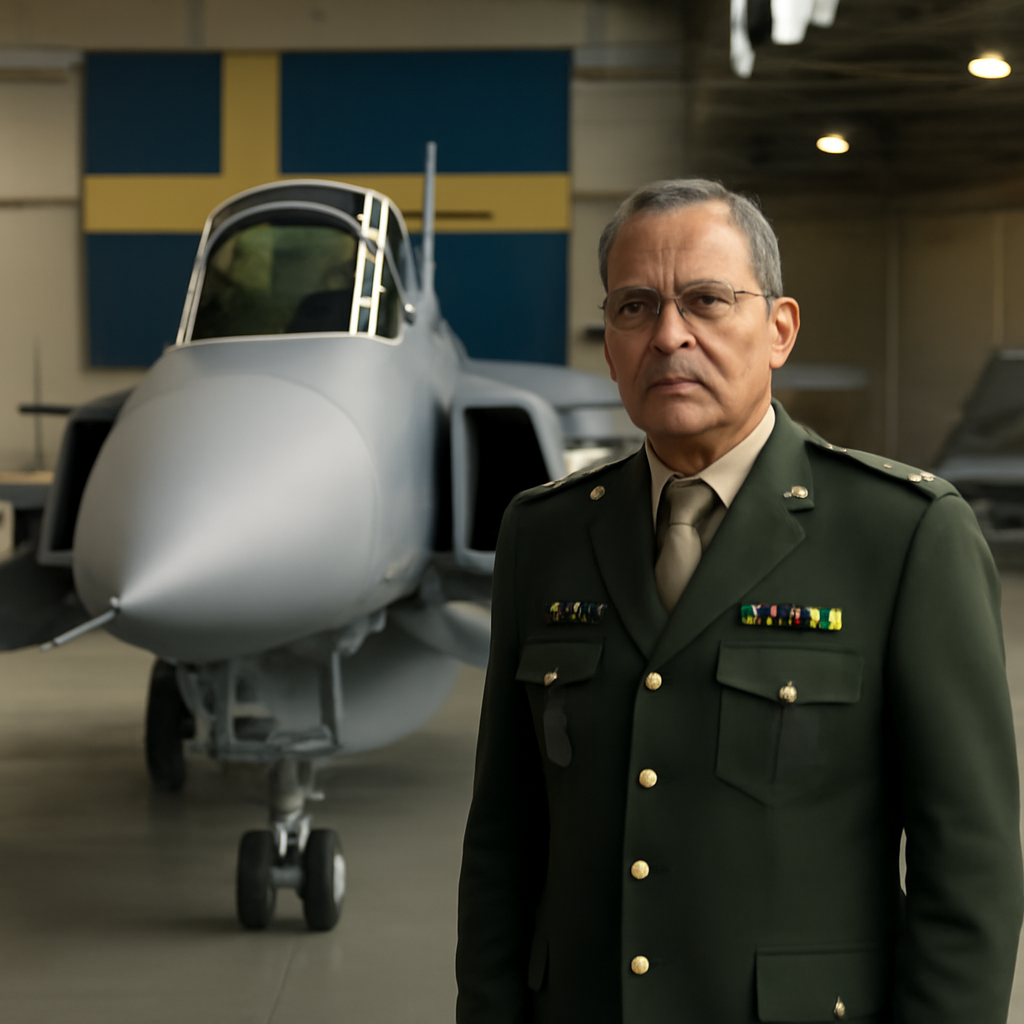
"Our staff studies signalized for us a [requirement] of between 50 and 60 fighter aircrafts," Gen. Marcelo Kanitz Damasceno told reporters — a benchmark that has pushed Brasília to seek 20 more Gripen jets and could lift Brazil's fleet to 56 fighters.
Brazilian Defense Minister José Múcio Monteiro Filho and the 20‑jet proposal
Brazilian Defense Minister José Múcio Monteiro Filho announced during a press conference concluding a four‑day visit to Sweden that he wants to purchase an additional 20 Gripen E jets. If completed, the purchase would increase Brazil’s total Gripen fleet from the 36 aircraft ordered in 2014 to 56 fighters. Swedish Defense Minister Pål Jonson confirmed negotiations are advancing to amend the existing Gripen agreement, but both ministers emphasized that no deal has yet been reached.
Gen. Marcelo Kanitz Damasceno on Brazil’s fighter requirement
Air Chief Gen. Marcelo Kanitz Damasceno framed the request in operational terms. He said staff studies indicated a requirement "between 50 and 60 fighter aircrafts" to maintain sovereignty, and described the planning range as starting from the original 36 Gripens up to 56 or "a little bit more than 60." Damasceno noted the 2014 contract for 36 jets included an option to increase the order by 25 percent, and that Brasília and Stockholm are now "figuring out how to step up to 56 Gripens." He added that discussions with Saab and Sweden started months ago.

The cyber insurance questionnaire just landed. Now what?
SOC 2, HIPAA, insurance renewals - someone has to own security strategy. Nubivance provides fractional CISO leadership without the full-time salary.
Get a security leadEmbraer assembly in São Paulo and Saab rollout in Linköping
Industrial arrangements are central to the talks. Final assembly of the single‑seat Gripen E is carried out at Embraer’s facility in São Paulo, the only Gripen production line outside Sweden. Embraer rolled out the first fully Brazilian‑assembled Gripen E in March 2026. Two days before the Brazilian announcement, Saab rolled out the first Gripen F two‑seat fighter for the Brazilian Air Force during a ceremony at its facilities in Linköping.
Saab and Sweden have signaled that further E‑version jets for Brazil will "probably be built locally." Jonson noted that a production site for the Gripen system has existed in Brazil since last fall and said additional Gripen Fs that Brazil ordered "could also be built in Brazil," a useful relief to Sweden because "we have our hands full right now."
Saab, Sweden, and the wider Gripen market
The Brazilian discussions unfold amid a broad export push for the Gripen system. Last week Stockholm and Kyiv announced Ukraine’s plan to acquire up to 20 new Gripen E/F jets while Sweden will donate 16 older C/D models; the contract for the new jets is not yet signed. Thailand previously ordered four E/Fs, Colombia signed for 17 aircraft last year with deliveries starting in 2026, and Canada is weighing a decision that could add Gripens alongside American F‑35s. Sweden’s own air force received its first JAS 39 Gripen E last year — the lead aircraft of a 60‑jet order — with deliveries expected through 2030.
Jonson underscored reasons for the growing interest: he cited the Gripen’s "world‑leading electronic warfare capabilities," its "low life cycle costs," and the ability to "also use an AI agent" as selling points that have driven demand over the past ten months.
What this means for Saab, the Brazilian Air Force, and Embraer
- Saab and Sweden: Negotiations to amend the 2014 contract are active. Saab faces capacity pressure — Jonson said Sweden has its "hands full" — making local production in Brazil an attractive option to accelerate deliveries.
- Brazilian Air Force: The service is acting on a formalized requirement that ranges from 50 to 60 fighters; moving from 36 toward 56 would align procurement with that assessment and make use of the contract’s 25 percent option.
- Embraer: The São Paulo final‑assembly line is positioned to absorb more work. The first fully Brazilian‑assembled Gripen E rolled out in March 2026, establishing the industrial base that Brazil and Sweden expect to leverage if additional jets are contracted.
Negotiations now hinge on turning political declarations and study conclusions into contractual language that exercises the 25 percent option in the original deal. Ministers and military leaders have articulated both the requirement and the industrial pathway: the remaining variables are timing, financing and the precise split between jets assembled in Sweden and those built at Embraer’s São Paulo line. For now, Brasília has signaled intent; Stockholm has signaled openness; and the question left on the table is whether talks will convert intent into an amendment that raises Brazil’s Gripen fleet to 56 aircraft.
Original reporting: "Brazil plans to buy 20 more Gripen fighters," Breaking Defense, June 5, 2026