Scale and overall layout: a tailless, heavy tactical jet
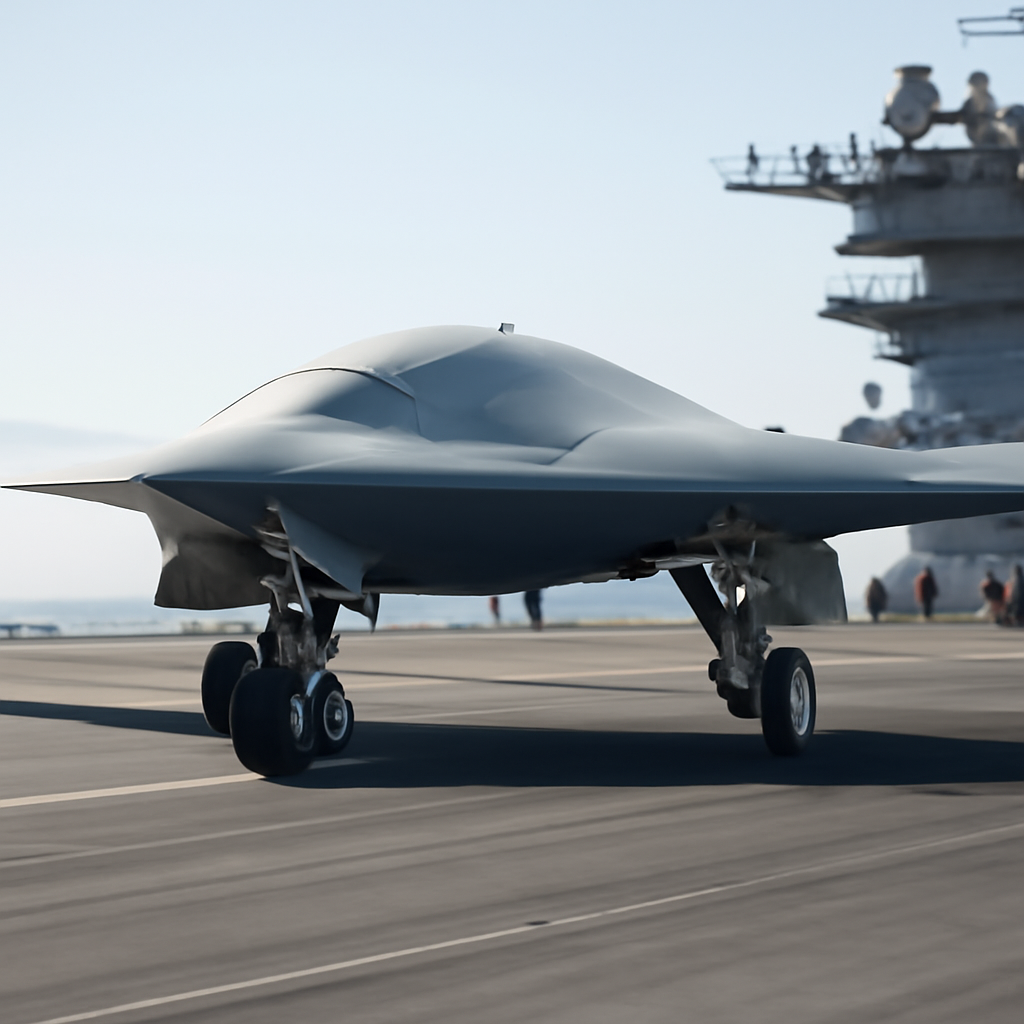
The new front-quarter render depicts a large, tailless aircraft with a broad forward fuselage and a clear emphasis on internal volume. The image shows a heavy carrier-capable jet taxiing to a catapult; the design language is described as "very broad" and "stout," consistent with an aircraft sized for carrier operations. The wings show a positive dihedral — a design trait noted in Boeing’s earlier F-47 renders — and the trailing edge flaps are extended, indicating attention to slow-speed, terminal carrier handling.
Crew, cockpit, and the role of automation
The render shows a large single-piece canopy with what appears to be seating for a single pilot. The source explicitly notes that visibility to the rear looks "limited at best" and that earlier speculation about two-crew arrangements — to support roles like battle management and control of Collaborative Combat Aircraft (CCA) and other drones — is not borne out by this image. The article concludes that a "high degree of automation and artificial intelligence (AI)" will be necessary to help a single pilot handle complex tactical problems.

The cyber insurance questionnaire just landed. Now what?
SOC 2, HIPAA, insurance renewals - someone has to own security strategy. Nubivance provides fractional CISO leadership without the full-time salary.
Get a security leadSensors, stealth shaping, and intake placement
The jet’s broad nose is depicted as likely able to house a "relatively giant" active electronically scanned array (AESA) radar. A pronounced chine-line wraps around the forward fuselage, a trait the source identifies as consistent with low-observable shaping. Engine inlets appear below the rear of that chine-line, mounted on the sides of the lower fuselage in a blended trapezoidal arrangement and set well back from the nose — all visible choices in the rendering that point toward integrated sensor and signature-management trade-offs.
Carrier-specific hardware: landing gear, flaps, and the canard question
The image emphasizes robust carrier hardware: "extremely stout" landing gear with a twin-wheel nose gear and thick main struts, features the source calls customary for carrier-based fighters and especially for a heavy design. Large trailing-edge flaps are shown extended, underscoring slow-speed handling for carrier approaches and catapult launches. One notable ambiguity in the render is the absence — or visual obscuring — of canard foreplanes that appeared in previous Boeing imagery of related designs; the article notes the canard question has been a major point of debate and that canards could make sense for a tailless naval fighter given its low-speed requirements.
Commonality with the F-47, NGAD ties, and designation uncertainty
The author points out clear visual affinities between the Navy’s F/A-XX render and Boeing’s earlier F-47 images, but stresses the degree of commonality is unclear. The possibilities outlined are either a literal navalized F-47 — maximizing design efficiency between Air Force and Navy programs — or a version with substantial naval-specific changes in proportions and systems. The source also raises the question of nomenclature: if the design is a navalized F-47 the formal designation could be F/A-47, though F/A-45 is also presented as a possible alternative. The article cites a naming rationale tied to the F-47’s partial naming "in honor of President Trump," noting he is the "45th and 47th President of the United States." Separately, the piece references a thermal-imager sighting of an unusual aircraft outside Area 51 and a Project Fear tweet, suggesting that aircraft was "likely a Next Generation Air Dominance (NGAD) demonstrator from Boeing, or at least an aircraft related to those efforts."
What this means for the Navy, Boeing, and the Air Force
- Navy: A single-pilot, heavy tailless design would shift carrier air-wing dynamics. The source notes that if F/A-XX replaces the Navy’s current two-seat platforms (the F/A-18F Super Hornet and EA-18G Growler), it would end frontline two-seat tactical jet operations for the seagoing service.
- Boeing: The company has won the Navy tender over Northrop Grumman and now publicly controls the visual narrative around F/A-XX via staged renderings that emphasize certain features while obscuring others.
- Air Force / NGAD programs: The render invites questions about hardware and software commonality with the F-47/NGAD family; the source suggests that internal systems could share the most overlap even if external proportions diverge.
These public images are deliberately controlled and, the article warns, designed to obscure or mislead on critical details. The rendering supplies a clear set of design cues — a big internal-volume, single-pilot, tailless carrier fighter with prominent stealth shaping and carrier-oriented hardware — but it leaves central questions unresolved: the presence or absence of canards, the degree of commonality with Boeing’s F-47, and the program’s formal designation. Each of those answers will matter for how the Navy organizes its air wing, how Boeing manages commonality across services, and how opponents and partners interpret the platform’s operational envelope.
Source: What Boeing’s New Rendering Of Its Winning F/A-XX Fighter Tells Us — TWZ