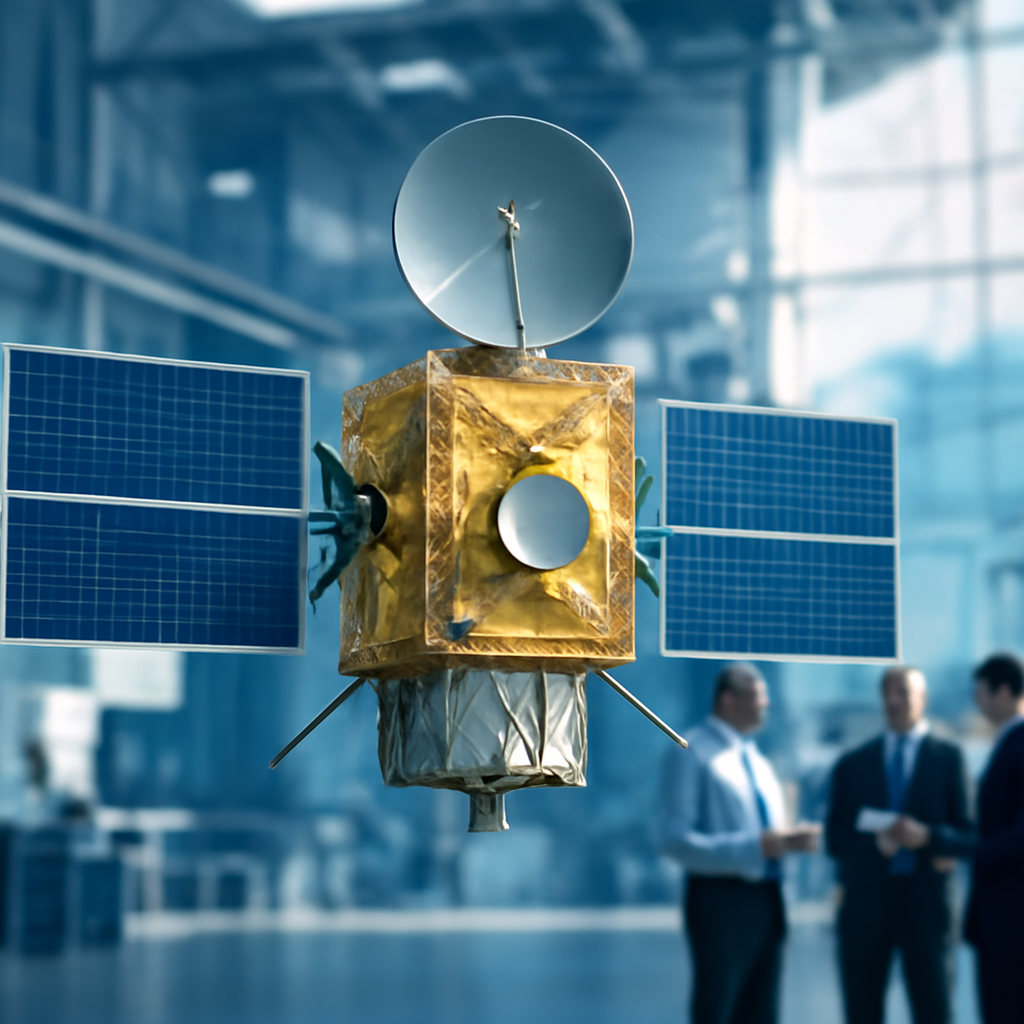
$2 billion: that is the dollar figure the Space Force announced it will pay Boeing to produce two additional Mobile User Objective System satellites, a contract the service says covers “development, delivery, system integration and on-orbit test support,” according to a Space Systems Command release.
A $2 billion award to Boeing
Space Systems Command (SSC) announced today that Boeing, not the original MUOS contractor Lockheed Martin, won a $2 billion contract to build two more MUOS narrow-band communications satellites. The contract is the outcome of SSC’s two-year MUOS Service Life Extension competition and covers the full range of follow-on work SSC specified in its release. Lockheed Martin built the first five MUOS satellites.
MUOS: narrow-band UHF service for the military and allies
SSC describes MUOS as providing secure ultra-high frequency (UHF) satellite communications to U.S. military services and to allied forces, with a particular emphasis on naval users. The program’s management has shifted over time: responsibility moved from the U.S. Navy to the Air Force in 2019 and later to the Space Force, according to the announcement.

This site is the portfolio.
OSINTSights runs on Cloudflare Workers, D1, R2, and Vectorize, with an AI pipeline on Hetzner ARM. Nubivance designed, built, and operates it. We do the same for clients.
See what we buildLaunch timing, constellation size, and life-extension targets
Under the award Boeing’s two new satellites are set to launch “no earlier” than 2031 and 2032, per SSC. When added to the existing five MUOS spacecraft, the two new satellites will bring the MUOS constellation to seven total. SSC said the additions will allow the MUOS constellation to continue operating until 2035. By contrast, SSC had expected in 2024 — when Boeing and Lockheed Martin each won $66 million Phase 1 design contracts under the MUOS Service Life Extension program — to launch the two new satellites in 2030.
Budget lines in the Space Force FY2026–FY2027 requests
SSC’s announcement included program funding figures embedded in the Space Force budget. The service’s fiscal 2026 budget contains $415 million in research and development (R&D) for MUOS and almost $50 million in procurement. The FY2027 R&D request rises to $856 million, with a total of $2.6 billion through 2031. Procurement for FY2027 is requested at $51 million, with a total procurement projection of $265 million through 2031.
What this means for naval forces, the Space Force, and commercial providers
Navy and allied maritime users: MUOS is cited as a service tailored to naval forces’ needs for secure UHF links; additional satellites aim to extend that capability through 2035. Continuity of service is the explicit outcome SSC ties to the Boeing award.
The Space Force and program managers: SSC has moved the program forward with a second-phase contract award after Phase 1 design work in 2024, shifting the expected launch window later than previously anticipated and funding R&D at materially higher levels in FY2027 than FY2026.
Commercial satellite providers: SSC’s release sits alongside a separate, ongoing workstream — since mid-2023 the Space Force has been developing a long-range strategy that could transfer some or all of the MUOS narrowband communications mission to commercial providers. That strategic work raises a question about the balance between government-owned, life-extended assets and potential reliance on commercial services.
The announcement contains a handful of clear, immediate facts: Boeing will build two MUOS satellites under a $2 billion contract; the launches are scheduled no earlier than 2031 and 2032; the two additions will bring MUOS to seven satellites and extend operation through 2035; and the program’s funding profile increases notably in the FY2027 request. What remains to be seen — and what SSC’s mid-2023 strategy work intentionally left open — is how much of the narrowband mission the Space Force will continue to perform with government-owned spacecraft versus shifting to commercial providers as the service plans its longer-term architecture.