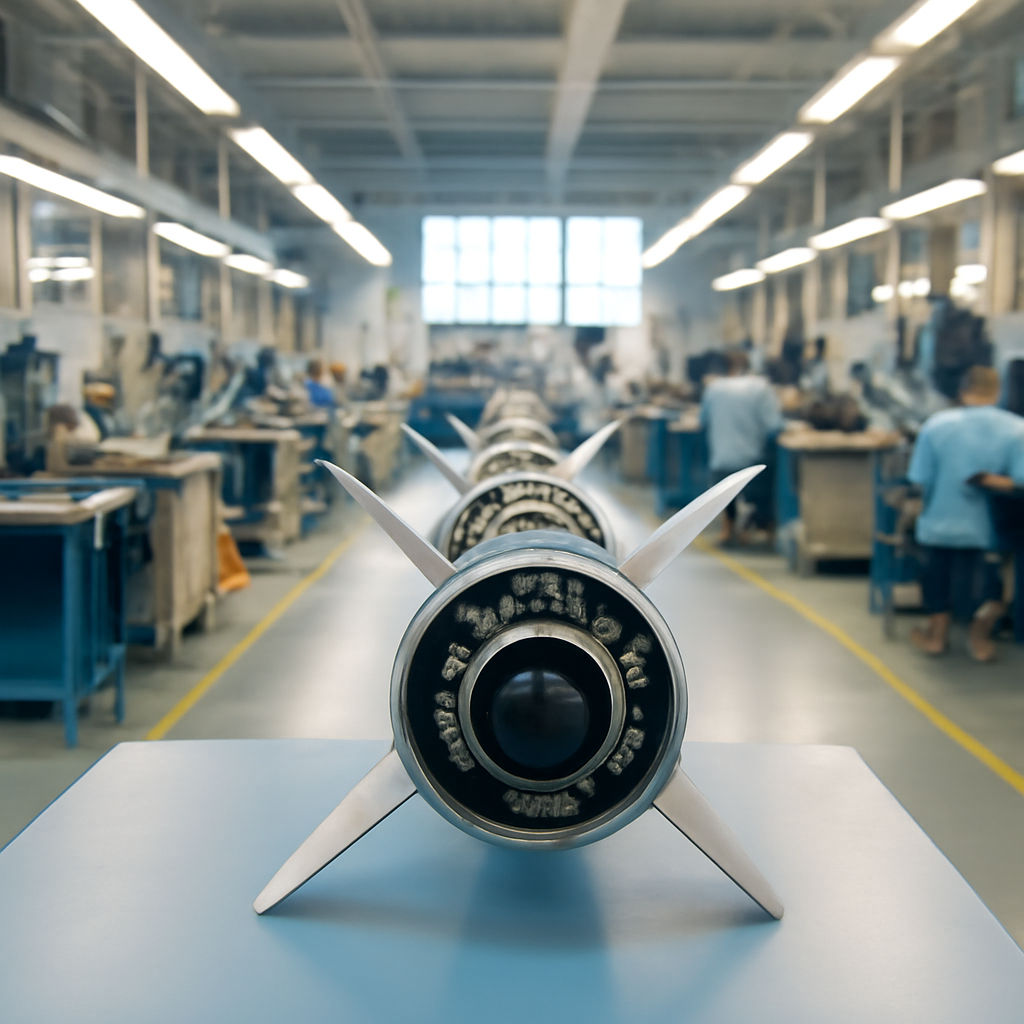
“Early investment and a relentless focus on quality and execution have positioned us to now deliver seekers at unprecedented levels in the near-term, and we’re committed to building on that momentum,” Steve Parker, the president and CEO of Boeing’s defense unit, said in a company press release.
Boeing wins up to $14.7 billion undefinitized seeker contract
Boeing announced it has been awarded an undefinitized contract action (UCA) worth up to $14.7 billion to increase production of seekers for the PAC-3 Missile Segment Enhancement (MSE) interceptor. The company said the contract was issued as a seven-year deal by Lockheed Martin, the manufacturer of the PAC-3 MSE. As described in Boeing’s release, the award effectively underwrites an earlier seven-year framework agreement reached with the Pentagon in April to triple seeker production, although Boeing has not disclosed specific quantities.
How the seeker ties into PAC-3 MSE production led by Lockheed
The PAC-3 MSE is a hit‑to‑kill interceptor launched by the Patriot air defense system. Seekers — the sensors mounted in a missile’s nose that help guide it to its target — are a critical component for the interceptor’s effectiveness. In July, a nearly $59 billion contract vehicle for PAC-3 MSE production was issued to Lockheed, following a framework agreement to raise missile output to 2,000 units annually by 2030. Boeing’s seeker award, also an undefinitized contract action, runs parallel to that production ramp-up and is intended to remove a historically cited choke point in PAC-3 output.

Audit-ready is a season. It shouldn't be.
Evidence in spreadsheets, controls drifting between audits, frameworks multiplying on flat headcount. Nubivance runs continuous compliance on Rapid7 Cyber GRC - SOC 2, HIPAA, ISO 27001, PCI, CMMC.
End the scrambleWhy an undefinitized contract matters now — budget timing and early work
A UCA permits work to begin before final quantities and prices are settled, allowing production to proceed despite unresolved contracting details. Boeing noted the UCA can kickstart work even when there are roadblocks for appropriations — a salient point given that a fiscal 2027 budget had not been approved by lawmakers at the time of the announcement and a separate reconciliation package “looks in doubt,” according to the company’s release. The seeker award therefore functions as a contracting mechanism to keep tempo and production planning moving while officials finalize budgets and long‑form contracts.
Production ramp-up in Huntsville and the search for lower-cost seekers
Boeing said it began ramping up production and “surging hiring” earlier in the year at its facilities in Huntsville, Ala., to support increased production. The company acknowledged that the seeker has been a historical choke point for PAC‑3 output. Seekers are also an expensive line item inside the missile, and Boeing in August disclosed development of an Ultra Low‑Cost Seeker as a lower‑priced alternative. The company said future flight tests for the low‑cost seeker are planned but did not disclose when that seeker could enter service.
What this means for the Pentagon, Lockheed Martin, and Western allies
- Pentagon: The April framework and the Boeing UCA collectively aim to expand seeker production capacity in advance of finalized appropriations, enabling the department to pursue higher PAC‑3 MSE output despite fiscal uncertainty.
- Lockheed Martin: As the prime producer of the PAC‑3 MSE and the issuer of the seven‑year seeker deal to Boeing, Lockheed’s larger $59 billion production vehicle and the seeker award are linked pieces of the same surge to reach 2,000 missiles annually by 2030.
- Western allies: The PAC‑3 MSE is described as a key system used by Western allies for air defense; the seeker award is positioned to help replenish interceptor stockpiles depleted by conflicts in Ukraine and the Middle East.
The contract announcement is an operational step as much as a financial one: it moves seeker production from planning to execution, cushions industry throughput against budgetary delays, and signals investment in both capacity and lower‑cost alternatives. The facts in Boeing’s release leave two concrete, immediate questions open — how quickly the undefinitized terms will be finalized, and when the Ultra Low‑Cost Seeker will reach flight test and service entry. Until those answers arrive, the UCA and the Huntsville ramp‑up are the mechanisms keeping interceptor production on an accelerated track.