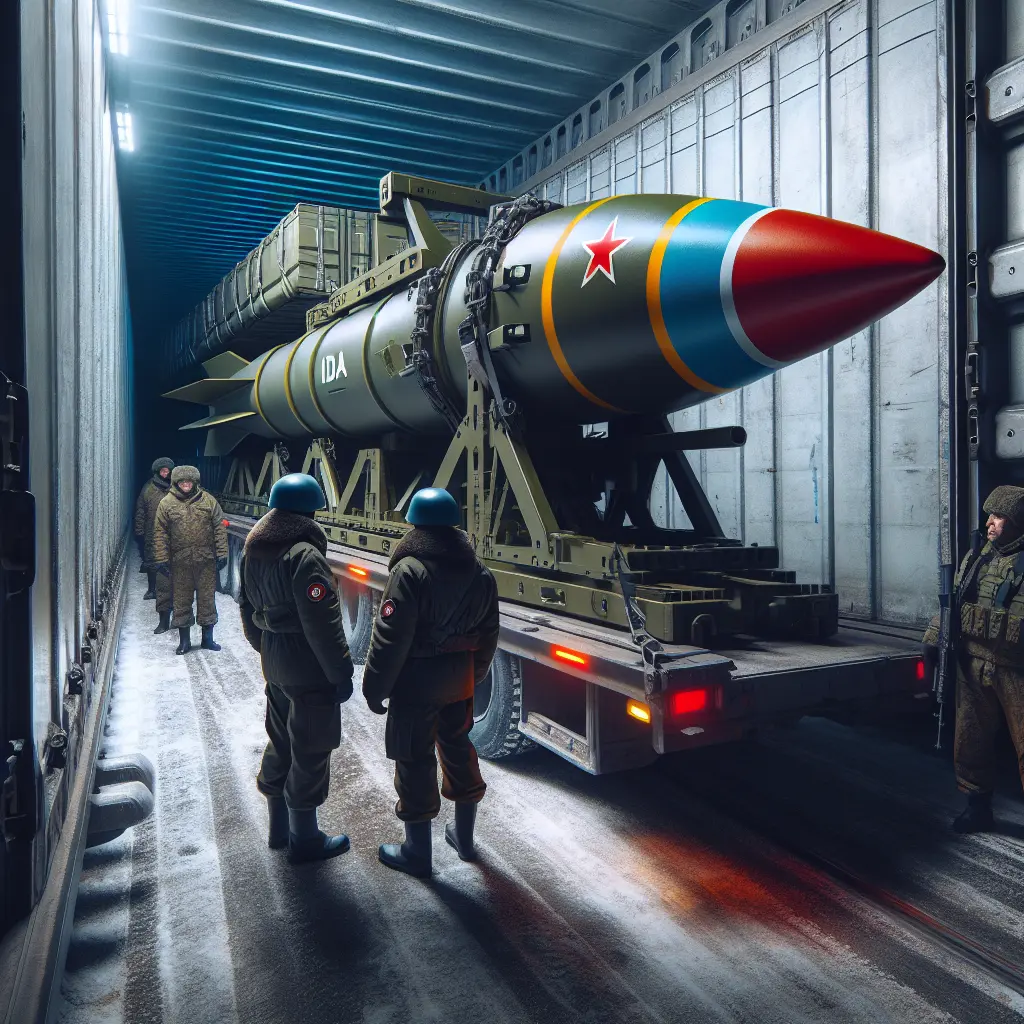
Belarus on the Brink: The Implications of the Oreshnik Missile Deployment
As tension simmers at the crossroads of Europe and Russia, Belarusian President Alexander Lukashenko’s announcement of the impending deployment of Russia’s Oreshnik medium-range missile system raises critical questions about regional security and geopolitical alliances. The missiles are set to be operational on Belarusian soil by the end of 2025, signaling a bold military collaboration that not only enhances Belarus’ defense capabilities but also deepens its alignment with Moscow.
In a ceremonial address marking Belarus’ Independence Day, Lukashenko referred to Russia as his nation’s “older brother,” underscoring the historical and political ties that bind these two nations. This phrase encapsulates more than camaraderie; it reflects a significant shift in Belarus’ military posture amid an era characterized by increasing tensions with Western nations. The Kremlin’s influence over Minsk has grown substantially since the onset of Russia’s military actions in Ukraine and subsequent economic sanctions imposed by Western countries.
The Oreshnik missile system, developed by Russian defense industry leaders, is designed for precision strikes against enemy ground targets at distances up to 300 kilometers. Such capabilities not only extend Belarus’ military reach but also alter the strategic calculus for NATO members in Eastern Europe, particularly Poland and the Baltic States. Given that Belarus has acted as a critical staging ground for Russian forces during various military exercises, this escalation may prompt a reassessment of regional defense strategies among NATO allies.
This recent development does not exist in a vacuum. Historical context reveals that Belarus has been increasingly reliant on Russian support since widespread protests against Lukashenko’s regime following the controversial 2020 presidential election. In response to both internal dissent and external pressures, Lukashenko has sought closer military ties with Russia as a means to fortify his grip on power while simultaneously enhancing national defense capabilities.
Currently, geopolitical dynamics are rapidly evolving. Following the announcement of the Oreshnik deployment, several Western officials voiced concern about its potential implications. U.S. Secretary of State Antony Blinken stated that “the continued militarization of Belarus under Russian influence presents new challenges for European security.” Likewise, Polish President Andrzej Duda expressed apprehension, emphasizing that this military collaboration poses threats not only to Poland but to broader European stability.
The implications of deploying the Oreshnik missile system extend beyond immediate military considerations. The enhanced capability may embolden Lukashenko’s regime domestically, allowing for more aggressive posturing against dissenters while consolidating power through fear and increased military presence. Furthermore, it could provoke an arms race in Eastern Europe, compelling neighboring countries to bolster their defenses or reconsider their military alliances.
Experts highlight several scenarios that could unfold from this development. Dr. Marina Kaldy, an analyst at the European Institute for Security Studies, suggested that “the missile deployment could lead NATO to increase its troop presence along its eastern flank as a deterrent measure.” In contrast, others argue that heightened tensions may give way to unexpected diplomatic negotiations aimed at de-escalation if key stakeholders recognize the risks of direct confrontation.
The international community must closely monitor these developments as they unfold. Observers should pay attention to reactions from NATO member states—particularly those bordering Belarus—as well as any shifts in public opinion within Belarus regarding increased militarization under Russian influence. As Europe grapples with its security architecture amidst external pressures from both Russia and internal fractures among EU member states, understanding the nuances behind such deployments becomes increasingly vital.
In conclusion, as Belarus prepares to integrate advanced military capabilities from its powerful neighbor, one must ponder: what does this mean for regional sovereignty and international peace? Will an increasingly militarized Belarus lead to greater stability or serve as a catalyst for conflict? Amidst uncertainty lies an imperative for vigilance—where national boundaries and alliances are tested daily against the backdrop of history and ambition.



